
Bowling Business Plan Template
-
 ShopifyPut your brand on Shopify. Launch your online store with tools designed for growth and success. Ready to turn your idea into profit? Start building your e-commerce business today.
 -
 SquarespaceShowcase your brand with Squarespace’s sleek designs. Build a professional online presence with ease. Start with a template that already looks finished.
 -
 WixBring your ideas to life with Wix. Customize every aspect of your site with unmatched flexibility. Start creating your unique online space and let your creativity shine.
 -
 ElementorCraft captivating websites effortlessly with Elementor. Enjoy complete creative control without coding. Make your site stand out to your audience. Start turning your vision into reality now.
- Executive Summary
- Business Info
- Business Model Overview
- SWOT Analysis
- Bowling Business Name Ideas
- Website
- Marketing Details
- Industry Trends
- Competitor Information
- Financial Information
- Legal and Compliance
- Operational Plan
- Contingency Planning
- Building a Bowling Business
- Types of Businesses in the Bowling Space
- Growing with Your Business Plan
- Practical Uses for Your Business Plan
- Seize Your Opportunity
A bowling business plan is the foundational document for launching a recreational facility that combines lane revenue with food and beverage, events, and league programs. Bowling has maintained broad appeal across generations, and modern bowling venues that upgrade the experience beyond just lanes - adding full-service dining, arcade games, and private event space - are outperforming traditional alleys consistently. Getting the economics right from the start means understanding the revenue mix, staffing model, and capital requirements specific to this kind of venue business.
This plan is for founders who are serious about building a bowling facility that generates strong returns, not just a fun idea. The financial model, operational plan, and marketing strategy here are built around what actually drives profitability in the entertainment venue business - repeat visits, event bookings, and food and beverage per-guest spend.
Executive Summary
We will establish a modern bowling facility that combines traditional lane play with a contemporary entertainment experience including full-service dining and event hosting. Venues looking to add a themed attraction can also use our escape room business plan template. Our mission is to create a welcoming venue for families, friend groups, corporate teams, and league players - a destination that people visit repeatedly, not just occasionally. Financial targets include breaking even within year one and reaching a 20% profit margin by year three, driven by strong event bookings and food and beverage revenue alongside lane rentals.
Business Info
Our facility will offer lanes for casual play, competitive league matches, and private party and event bookings. A full-service snack bar and lounge area will support the experience beyond bowling itself. We will target families with children, young adult groups looking for social activities, corporate teams seeking team-building venues, and dedicated bowling league players who commit to regular facility use through seasonal contracts.
Business Model Overview
Revenue will come from four streams: lane rental fees for walk-in and reserved play, food and beverage sales, private event and party bookings, and merchandise. Online booking capability will be built into the site from launch - reducing front desk workload and improving advance revenue visibility. League programs provide predictable recurring income that smooths the seasonal variability in casual lane rentals.
SWOT Analysis
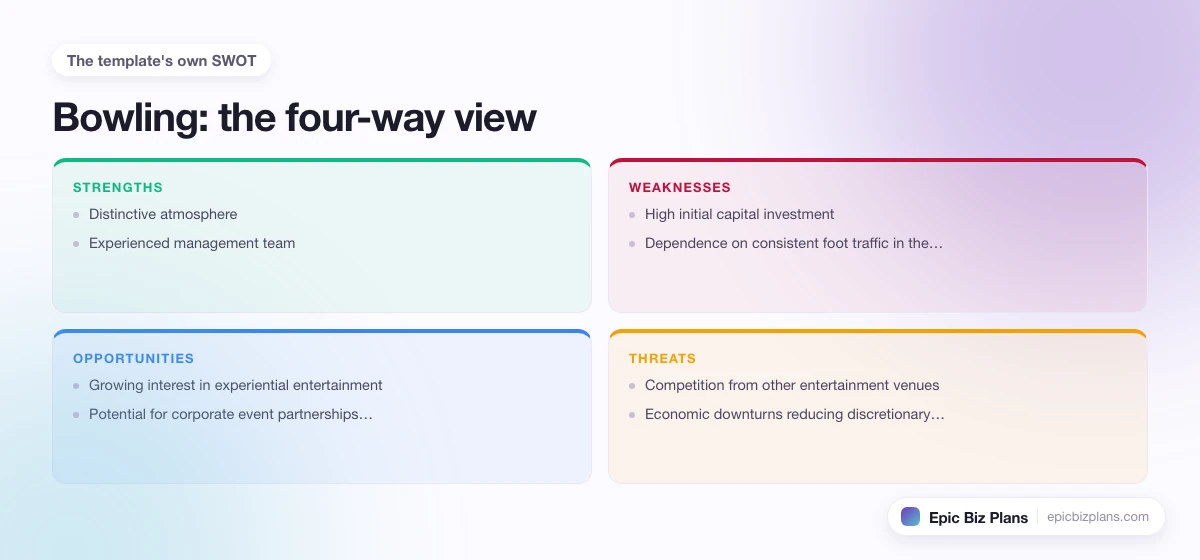
- Strengths: Distinctive atmosphere, comprehensive service mix, experienced management team.
- Weaknesses: High initial capital investment, dependence on consistent foot traffic in the facility's catchment area.
- Opportunities: Growing interest in experiential entertainment, potential for corporate event partnerships with local businesses.
- Threats: Competition from other entertainment venues, economic downturns reducing discretionary leisure spending.
Bowling Business Name Ideas
Website
Wix is a practical choice for a venue business that needs an online presence with lane booking, event inquiry forms, and menu displays. The site must support online reservations from launch - customers increasingly expect to book entertainment venues the same way they book restaurants. A clean, visual site with clear pricing, lane availability, and event package information will convert browsers into bookings more effectively than any other digital investment.
Marketing Details
Our most effective marketing will be local - Google Business profile optimization, local SEO for "bowling alley near me" and "private event venue [your city]" searches, and partnerships with local employers for corporate team event packages. We will use Semrush to track our local search rankings and identify content opportunities around family entertainment and event planning in our area. HubSpot will manage email campaigns targeting past customers with league registration reminders, birthday party packages, and seasonal promotions.
TikTok content showing strikes, party events, and behind-the-scenes venue moments works well for a visually engaging business like bowling. Social proof from events - tagged photos, short video clips - is our most cost-effective organic marketing. For adjacent recreational business models, the billiard business plan and recreation center business plan cover comparable venue economics.
Industry Trends
Modern bowling centers are moving toward the "eatertainment" model - integrating quality dining and lounge areas that drive higher per-guest spend and attract non-bowlers who come for the atmosphere. Mobile lane booking and contactless payment are baseline expectations for any new venue. Corporate and private event bookings have become a major revenue driver as businesses replace traditional team events with more active, venue-based experiences. Venues that invest in the full experience - lighting, music, food quality, service - command premium pricing over traditional alleys.
Competitor Information
Direct competitors are other bowling alleys in the local market, ranging from basic lanes-only operations to modern entertainment complexes. Indirect competition includes other entertainment venues - escape rooms, mini-golf, arcades, and bars with activity options. Our differentiation is the quality of the full-service dining experience alongside bowling, which positions us closer to a restaurant-entertainment hybrid than a traditional bowling alley. Customers choosing between us and a competitor will choose us for the food and atmosphere, not just the lanes.
Financial Information
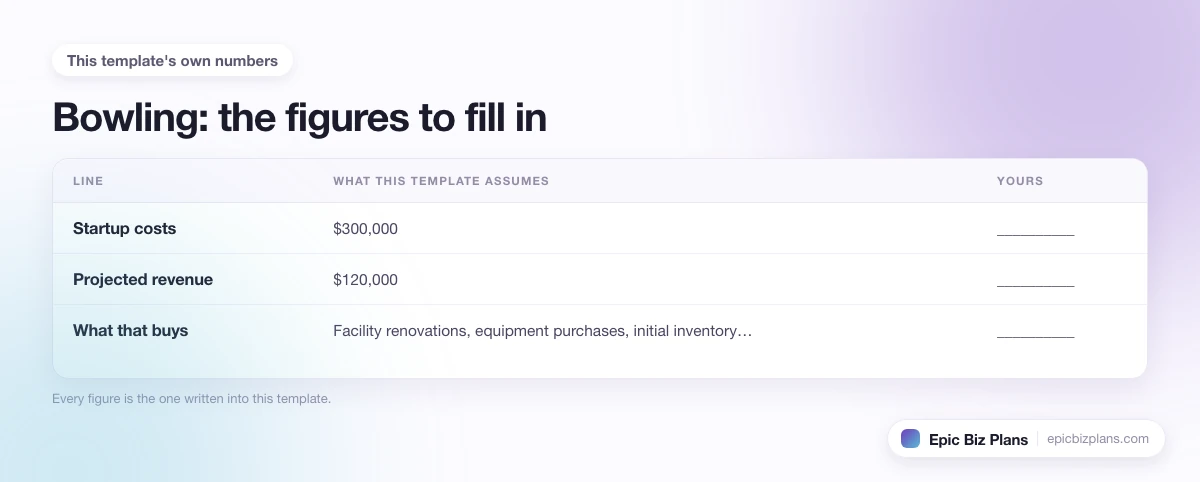
Startup costs are projected at $300,000, covering facility renovations, equipment purchases, initial inventory for the food and beverage operation, and marketing to support the opening. First-year revenue is targeted at $120,000, growing at 15% annually as the facility builds its regular customer base and league programs mature. Annual operating costs - payroll, utilities, food costs, maintenance - are projected at $75,000. Monthly P&L reviews are non-negotiable; venue businesses have tight margins and require close monitoring of labor and food cost percentages.
Legal and Compliance
Business registration, food service permits, alcohol licensing (if applicable), and health and safety compliance are all required before opening. We will trademark our brand name and logo from the start. Liability insurance covering customer injuries on premises is essential for any physical venue operation, and we will obtain appropriate coverage before the first customer walks in.
Operational Plan
Daily operations will be managed by a venue manager responsible for staffing, lane allocation, event scheduling, and customer experience quality. Our supply chain covers bowling equipment maintenance, food and beverage inventory, and cleaning services. Staff training on both bowling operations and hospitality service is critical - the customer experience depends equally on lane quality and front-of-house service. We will establish preventive maintenance schedules for all equipment to minimize service disruptions during peak hours.
Contingency Planning
Economic downturns that reduce discretionary entertainment spending are our primary macro risk. We will mitigate this by building corporate and league revenue streams that are less sensitive to casual consumer spending cycles - corporate event budgets and league memberships tend to hold up better in moderate recessions than casual walk-in traffic. A financial reserve covering three months of operating expenses will protect the business during any demand dip in the early years.
Building a Bowling Business
Bowling venues that invest in the full entertainment experience - not just functional lanes - are performing better than traditional alleys because they generate more revenue per guest visit and attract a broader customer base. A thorough business plan helps you design the right venue model, raise the capital needed, and execute on an operational plan that delivers that experience consistently. Related facility models like the billiard hall face similar economics and offer useful benchmarking for pricing and staffing ratios.
-
 SemrushSemrush is a platform with literally any online tool you will need to promote your business. Spy on your competitors, get search traffic, keyword research, social info, ad copies and much more. Used by most of the top online companies in the world. Besides all its tools, Semrush also has many available integrations possible with many other tools that will make your work even better.
 -
 Surfer SEOSurfer SEO is an incredibly smart AI tool that will give you exact explanations what to do in order to make your website rank better. They use hundreds of parameters, check your competitors and decide on the best course of action. Whether it be inner links, bold text, paragraphs, headers, images and much more. Surfer is a must-have in 2026.
Types of Businesses in the Bowling Space
The bowling business spectrum runs from small community lanes with basic amenities to large-format entertainment centers with full dining, arcades, and private event suites. Each model has different capital requirements, staffing structures, and revenue per square foot. This plan can be adapted to any point on that spectrum by scaling the venue size, food and beverage investment, and event programming accordingly. Operators adding a motorsport attraction to a larger entertainment center can also review the go karting business plan template for that venue model.
Growing with Your Business Plan
Revisit your bowling business plan annually - track actual performance against projections and update forward-looking assumptions based on what you've learned. Revenue mix shifts over time as league programs grow and event bookings mature; your plan should reflect those changes rather than remaining frozen at the pre-opening assumptions.
Practical Uses for Your Business Plan
This plan is your primary tool when approaching a commercial real estate landlord to negotiate a lease, presenting to a bank for construction or renovation financing, or building out an investor pitch deck for equity partners. A detailed, realistic plan signals that you understand the business operationally, not just conceptually.
Seize Your Opportunity
Your bowling business plan is 100% free - with unlimited edits, unlimited downloads, and unlimited chances to get it right. The lanes are waiting - build the venue worth coming back to.
