
Bow Tie Business Plan Template
-
 ShopifyPut your brand on Shopify. Launch your online store with tools designed for growth and success. Ready to turn your idea into profit? Start building your e-commerce business today.
 -
 SquarespaceShowcase your brand with Squarespace’s sleek designs. Build a professional online presence with ease. Start with a template that already looks finished.
 -
 WixBring your ideas to life with Wix. Customize every aspect of your site with unmatched flexibility. Start creating your unique online space and let your creativity shine.
 -
 ElementorCraft captivating websites effortlessly with Elementor. Enjoy complete creative control without coding. Make your site stand out to your audience. Start turning your vision into reality now.
- Executive Summary
- Business Info
- Business Model Overview
- SWOT Analysis
- Bow Tie Business Name Ideas
- Website
- Marketing Details
- Industry Trends
- Startup Cost Breakdown
- Competitor Information
- Financial Information
- Legal and Compliance
- Operational Plan
- Contingency Planning
- Why Start Your Bow Tie Business Plan?
- Exploring Your Options
- Embrace Change as You Grow
- Step Forward with Confidence
A bow tie retail business plan gives you a concrete framework for building a fashion accessories brand in a niche with genuine demand - from everyday style-conscious buyers to event and wedding markets. The bow tie category is small enough to allow a focused brand to build real authority, but broad enough to support multiple revenue streams: direct-to-consumer eCommerce, wholesale to retailers, and bulk orders for events. This template walks through the key decisions for any bow tie retail business, from product sourcing to financial projections.
The accessories market rewards brands that commit to a clear aesthetic and customer profile rather than trying to appeal to everyone. A bow tie business that knows exactly who it's dressing - formal event attendees, style-forward everyday wearers, wedding parties, corporate gifting buyers - can build targeted marketing and product development strategies that convert at much higher rates than a generic approach. Use this plan to define those specifics before you invest in inventory or paid advertising.
Executive Summary
We are building an eCommerce bow tie brand focused on high-quality materials and distinctive designs for men aged 18–40 who treat accessories as a form of personal expression. Our product range covers classic formal styles, contemporary patterns, and seasonal collections, with bulk order capabilities for event planners and wedding coordinators. Our business model is direct-to-consumer through a Shopify store, with selective wholesale agreements as the brand scales. We project first-year revenue of $500,000 at a 25% profit margin, driven by a combination of individual retail orders and bulk event purchases.
Business Info
Our product catalog will include three core lines: a premium line using silk and fine wool for formal occasions, a contemporary everyday line in cotton and linen, and a seasonal/novelty collection for gifting and special events. Bulk ordering - where we handle 10+ units per order for weddings, corporate events, or groomsmen packages - will be a dedicated sales channel with custom pricing tiers. Our target customers are self-purchasing men who follow fashion closely, gift buyers looking for distinctive presents, and event professionals who need consistent quality across large orders. Revenue will come from individual online sales (60%), bulk event orders (25%), and early-stage wholesale agreements with menswear boutiques (15%).
Business Model Overview
Our primary channel is direct-to-consumer eCommerce, which gives us full margin capture and direct customer data. We operate a lean inventory model, holding stock for core SKUs and using a made-to-order approach for custom and bulk event orders. As the brand establishes a following, we will explore wholesale agreements with menswear boutiques and department store buyers who can expand our physical retail presence without the overhead of owning stores.
SWOT Analysis
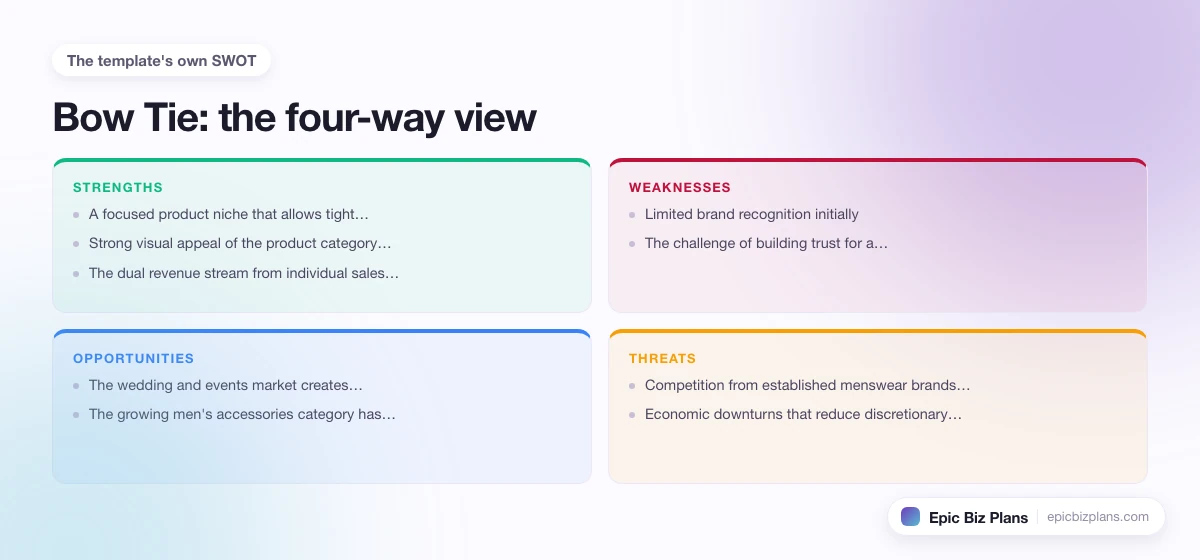
- Strengths: A focused product niche that allows tight quality control, strong visual appeal of the product category for social media and content marketing, and the dual revenue stream from individual sales and event bulk orders.
- Weaknesses: Limited brand recognition initially, and the challenge of building trust for a premium-priced product without an established review base.
- Opportunities: The wedding and events market creates consistent seasonal demand, and the growing men's accessories category has room for independent brands that stand out from mass-market options.
- Threats: Competition from established menswear brands with existing distribution and customer loyalty, and economic downturns that reduce discretionary spending on fashion accessories.
Bow Tie Business Name Ideas
Website
Our Shopify store will be designed around product photography - in fashion accessories, the visual presentation is the pitch. Each product page will include multiple high-resolution images showing the tie in formal and casual contexts, a style guide section suggesting outfit pairings, and a materials and care guide. A dedicated bulk/event ordering page will explain the custom order process, minimum quantities, and lead times for event clients. Customer reviews will be solicited systematically post-purchase and displayed prominently on product pages to build social proof. A lookbook-style blog will serve both SEO and brand positioning purposes.
Marketing Details
Our marketing strategy runs on visual content and community building rather than heavy paid advertising in the early stage. Semrush will guide keyword research for product and category page SEO, targeting buyer-intent searches like "wedding bow ties bulk" and "men's silk bow tie." HubSpot will manage our email list, including a welcome sequence for new subscribers, pre-event purchase prompts for buyers who have previously ordered for occasions, and seasonal sale campaigns. TikTok and Instagram are our primary social channels - short videos showing product styling, behind-the-scenes manufacturing quality, and customer wear shots perform well in the fashion accessories space. For a broader look at how fashion businesses structure their operations, see this fashion stylist business plan template and this formal wear business plan template.
Industry Trends
Men's fashion accessories have seen consistent growth, driven by younger buyers treating personal style as self-expression rather than a dress code obligation. The wedding market is a consistent driver of bow tie demand - the trend toward non-traditional wedding attire has actually expanded options for bow ties as a distinctive alternative to neckties for the wedding party. Sustainable and ethically sourced materials are increasingly important to buyers in the 18–35 demographic, creating an opportunity to build sourcing transparency into our brand story. Direct-to-consumer brands that own their customer relationships outperform those dependent on marketplace platforms, where margin erosion and algorithm risk are ongoing concerns.
Startup Cost Breakdown
Total startup costs are projected at $100,000: $40,000 for initial inventory across all three product lines; $15,000 for Shopify store development, photography, and brand identity design; $25,000 for first-quarter marketing (paid social, content production, influencer seeding); $10,000 for packaging design and materials; and $10,000 as operating reserve. Ongoing monthly costs - platform fees, inventory restocking, marketing, and customer service - are estimated at $8,000–$12,000.
Competitor Information
Direct competitors include specialist bow tie retailers like Bows-N-Ties and The Tie Bar, as well as broader menswear accessory brands. Indirect competition comes from department stores and mass-market retailers carrying bow ties as part of a larger accessories range. Our differentiation is in product quality and brand specificity - we're not a multi-category accessories store with bow ties as an afterthought, we are the bow tie brand. That focus allows more detailed product knowledge, better event service, and a clearer brand identity that resonates with customers who care about what they wear. For related business models, see this wedding planning business plan template and this eCommerce retail business plan template.
Financial Information
First-year revenue is targeted at $500,000, based on a 1,200-unit average monthly sales volume at an average order value of $42 (a mix of single-item purchases and multi-unit event orders). Gross margin on individual retail sales is projected at 55–60%; bulk event orders run at 45% margin given volume pricing. Net profit at 25% margin requires keeping operating costs below $375,000 in year one - achievable with a lean team and disciplined marketing spend. Year-two growth is projected at 30% as the review base builds, repeat customers increase, and the event order channel develops. A formal P&L will be maintained monthly.
Legal and Compliance
The business will be registered as an LLC. Our brand name and logo will be trademarked to protect the brand identity we're building. Product descriptions will accurately represent materials and origin to comply with FTC labeling guidelines. International shipping will be handled through a logistics partner experienced in cross-border customs requirements for textile goods.
Operational Plan
Inventory will be managed through Shopify's built-in system with defined reorder thresholds for each SKU. Core inventory will be held in our fulfillment partner's warehouse; custom and bulk orders will be managed on a made-to-order basis with 10–14 day lead times communicated clearly at checkout. Quality control involves inspecting samples before each supplier production run and periodic spot-checking of shipped inventory. Customer service - handling sizing questions, custom order requests, and returns - will be managed through a Shopify Inbox and Gorgias integration, with a same-business-day response commitment. For additional structure on managing a fashion accessories business operationally, see this fashion bag business plan template.
Contingency Planning
Supplier disruption is the primary inventory risk - we will maintain relationships with backup suppliers for every product line before committing to the primary vendor exclusively. Demand volatility (particularly seasonal dips outside of wedding and holiday seasons) will be managed through targeted promotions and email campaigns aimed at converting repeat buyers. If first-year revenue falls more than 15% below projection, we will conduct a structured review of product mix, pricing, and marketing channel performance before reducing marketing spend - cutting acquisition investment in early-stage retail typically extends the revenue gap rather than closing it.
Why Start Your Bow Tie Business Plan?
A bow tie business is a genuinely viable niche retail opportunity when planned correctly. The key is specificity: a clear brand identity, a defined customer profile, and a product sourcing strategy that delivers consistent quality at a price point that supports healthy margins. Use this template to work through those specifics before you invest in inventory or marketing, and you'll start from a much stronger position than most new retail businesses.
-
 SemrushSemrush is a platform with literally any online tool you will need to promote your business. Spy on your competitors, get search traffic, keyword research, social info, ad copies and much more. Used by most of the top online companies in the world. Besides all its tools, Semrush also has many available integrations possible with many other tools that will make your work even better.
 -
 Surfer SEOSurfer SEO is an incredibly smart AI tool that will give you exact explanations what to do in order to make your website rank better. They use hundreds of parameters, check your competitors and decide on the best course of action. Whether it be inner links, bold text, paragraphs, headers, images and much more. Surfer is a must-have in 2026.
Exploring Your Options
The bow tie category supports multiple business models: premium DTC brand, custom event specialist, subscription box, or wholesale supplier to retailers. Each has different margin profiles, customer relationships, and operational requirements. Define which model fits your skills and market access before finalizing your plan.
Embrace Change as You Grow
Update your plan quarterly in the first year as real sales data replaces your projections. Which products sell fastest, which customer segments convert best, and which marketing channels deliver the most cost-efficient acquisition will all differ from your initial assumptions. Let that data guide your investment decisions.
Step Forward with Confidence
Your Bow Tie business plan is 100% free - with unlimited edits, unlimited downloads, and unlimited chances to get it right. The planning work you do now shapes the quality of every business decision you'll make once orders are flowing.
