
Boundaries Business Plan Template
-
 ShopifyPut your brand on Shopify. Launch your online store with tools designed for growth and success. Ready to turn your idea into profit? Start building your e-commerce business today.
 -
 SquarespaceShowcase your brand with Squarespace’s sleek designs. Build a professional online presence with ease. Start with a template that already looks finished.
 -
 WixBring your ideas to life with Wix. Customize every aspect of your site with unmatched flexibility. Start creating your unique online space and let your creativity shine.
 -
 ElementorCraft captivating websites effortlessly with Elementor. Enjoy complete creative control without coding. Make your site stand out to your audience. Start turning your vision into reality now.
- Executive Summary
- Business Info
- Business Model Overview
- SWOT Analysis
- Boundaries Business Name Ideas
- The Line Between Coaching and Therapy
- Credentials, and What They Actually Cost
- Website
- Marketing Details
- Retreat Economics: Price From Your Break-Even, Not From the Market
- Industry Trends
- Competitor Information
- Financial Information
- Legal and Compliance
- Operational Plan
- Contingency Planning
- Community Retention Strategy
- Building a Business Around Personal Growth
- Keep Your Plan Current
- Put It to Work
A Boundaries business plan is the right starting point for anyone building a business in the personal development, wellness, or community-oriented coaching space. These businesses succeed when they have a clear identity: a specific audience, a defined set of services, and a value proposition that speaks directly to the people they serve. This plan helps you lay that foundation clearly before investing in space, staff, or marketing.
Whether you're launching a coaching practice, a workshop series, a wellness retreat programme, or an online personal development platform, the fundamentals remain the same. Know your audience, build your community intentionally, and manage your finances with discipline. This plan addresses all three.
Executive Summary
Boundaries is a personal growth and community wellness business built around the idea that clear, healthy personal limits lead to better relationships, higher productivity, and stronger mental health. We offer workshops, wellness programmes, personal development courses, and community events for individuals aged 18 to 45 who are actively working on their growth and want to connect with others doing the same. Our goal is to reach profitability within two years by building a committed membership base alongside a schedule of compelling events.
Business Info
Our service offering spans in-person workshops, online courses, wellness retreats, and a community membership that provides access to ongoing programming and peer connection. Our target market is adults who are intentionally investing in their personal growth, typically people going through a significant life transition, career change, or relationship challenge who are seeking practical tools and supportive community.
Business Model Overview
Revenue comes from four sources: membership subscriptions, individual workshop registrations, retreat packages, and sponsorship from aligned local businesses. Membership provides the most stable recurring income and is the core of the model. Retreats carry higher per-participant revenue but require more lead time and logistics. The online component allows us to reach participants beyond our immediate geography and improve overall revenue consistency.
SWOT Analysis
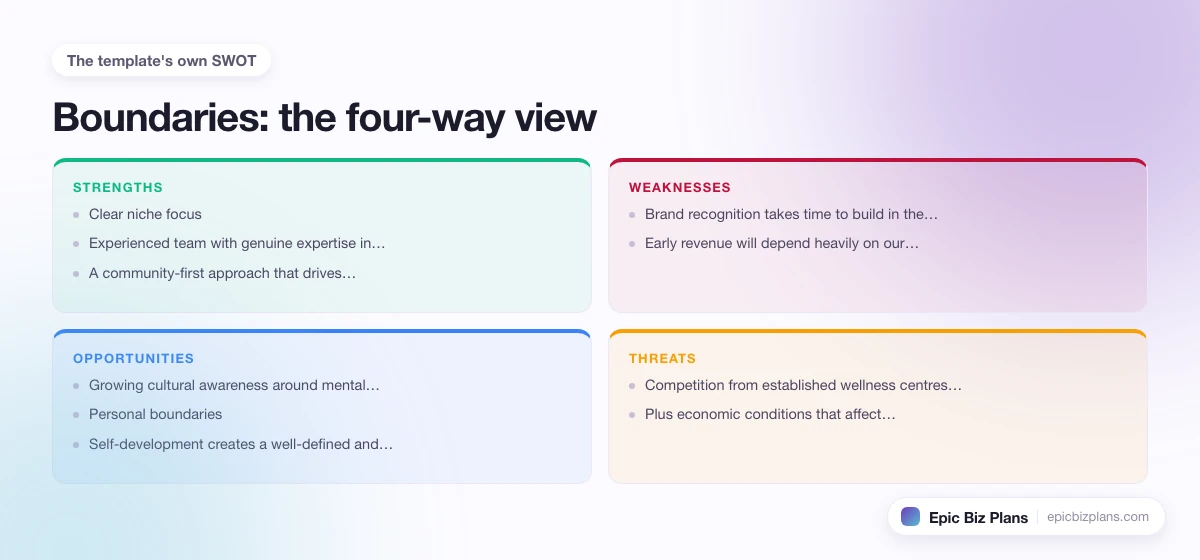
- Strengths: Clear niche focus, experienced team with genuine expertise in the subject matter, and a community-first approach that drives retention over time.
- Weaknesses: Brand recognition takes time to build in the wellness space, and early revenue will depend heavily on our founding community's engagement.
- Opportunities: Growing cultural awareness around mental health, personal boundaries, and self-development creates a well-defined and motivated audience. Adjacent businesses such as a mindfulness business and a life coaching business are succeeding with similar community-driven models.
- Threats: Competition from established wellness centres and online coaching platforms, plus economic conditions that affect discretionary spending on personal development.
Boundaries Business Name Ideas
The Line Between Coaching and Therapy
This is the section most personal development business plans leave out, and it is the one that decides whether the business is still trading in five years. Coaching is unregulated in most jurisdictions. Therapy, counselling and the treatment of mental illness are regulated, licensed activities. A business built around boundaries, life transitions and relationship challenges will attract people whose needs cross that line, often without either party noticing.
Write the following into your operating documents before your first session, not after your first difficult one:
- A written scope statement in the participant agreement saying plainly that your programming is education and coaching, not therapy, diagnosis, or treatment for any mental health condition.
- A referral protocol. Name the situations that trigger a referral, including disclosure of self-harm, active substance dependence, trauma symptoms or an eating disorder, and hold a current list of licensed practitioners to refer to. A referral is not a lost customer, it is the reason a therapist refers back to you later.
- Professional liability insurance written for coaching, alongside general liability for any premises. A general business policy will typically not respond to a claim arising from a coaching relationship.
- Confidentiality terms that say what you cannot keep confidential, and group agreements binding participants as well as facilitators, since group programming means disclosure in front of strangers.
- Facilitator screening. Any guest facilitator working with disclosure-heavy material should carry their own credential and insurance, evidenced in writing before they run a room.
Getting this right is also a marketing asset. Therapists and mental health practitioners are the highest-quality referral source this business has, and they refer only to operators who visibly understand the boundary. Practices on the licensed side of the line are covered in the mental health counseling business plan.
Credentials, and What They Actually Cost
You do not legally need a credential to coach in most places, but you do need one to charge professional rates, to be accepted by corporate buyers, and to be taken seriously by the referral partners above. The recognised path runs through an accredited training programme and a credentialing body, and the numbers are specific enough to plan around.
- Entry-level credential requirements: roughly 60 or more hours of accredited training, 100 logged coaching experience hours, and 10 hours of mentor coaching spread over at least three months, of which at least 3 hours must be one-to-one.
- Accredited entry-level training programmes: commonly $3,400 to $7,300. The full path including mentor coaching, exam and application fees more often lands in the $5,000 to $18,000 range depending on the provider.
- Application and first exam fees: roughly $175 to $625 at entry level, rising to $375 to $900 at the next tier and $675 to $825 at the top tier.
- What it supports in pricing: an entry-level credential is generally sufficient to charge $150 to $300 per one-to-one session with individual clients. Corporate and executive engagements expect a higher tier.
Budget the credential as a founder investment with a repayment period, not as an overhead. Twenty sessions at $250 covers a mid-range programme, which means the credential pays for itself inside the first year if it is what lets you raise your rate at all.
Website
We will build our website on Wix for the initial phase, as it handles event listings, membership signups, and content publishing without requiring technical expertise. As the business grows and we add more online courses and ecommerce functionality, we will evaluate whether migrating to WordPress or Squarespace better serves those needs. Clear calls to action for membership signup, workshop registration, and retreat enquiry will be the priority on every page.
Marketing Details
Our marketing will lead with authentic storytelling. Member testimonials, workshop highlights, and practical personal development content will be the backbone of our social media presence on Instagram and TikTok. Semrush will guide our SEO work to capture organic search traffic from people actively seeking personal development resources. HubSpot will manage our email marketing, with separate nurture sequences for prospective members and event registrants.
Partnerships with complementary local businesses, including therapists, yoga studios, and mental health practitioners, will extend our reach through trusted referral channels without requiring heavy paid advertising investment in the early months. Testimonials need care: a participant quote describing a mental health outcome can read as a clinical claim, so keep testimonials to what people experienced rather than what was cured.
Retreat Economics: Price From Your Break-Even, Not From the Market
Retreats look like the most profitable line in this business and are the most common way operators in it lose money. The failure mode is always the same: price set by looking at what similar retreats charge, then costed afterwards.
Build the price from the bottom instead. Add your fixed costs, meaning venue hire, facilitator fees, your own preparation time and travel, then your variable per-guest costs of accommodation, meals and materials. Divide the fixed costs by your minimum viable headcount, add the variable cost per head, then add a margin of 30% to 50%. A worked example: $8,000 of fixed costs across 20 guests is $400 per head, plus $200 per head variable, giving a $600 break-even; at a 40% margin the ticket is about $1,000. If ten people book instead of twenty, the fixed share doubles to $800 and that same $1,000 ticket earns you almost nothing.
-
 SemrushSemrush is a platform with literally any online tool you will need to promote your business. Spy on your competitors, get search traffic, keyword research, social info, ad copies and much more. Used by most of the top online companies in the world. Besides all its tools, Semrush also has many available integrations possible with many other tools that will make your work even better.
 -
 Surfer SEOSurfer SEO is an incredibly smart AI tool that will give you exact explanations what to do in order to make your website rank better. They use hundreds of parameters, check your competitors and decide on the best course of action. Whether it be inner links, bold text, paragraphs, headers, images and much more. Surfer is a must-have in 2026.
- Set a minimum headcount, put it in the terms, and mean it. Ten participants is a common floor for a residential retreat. Publish that you will refund in full if the minimum is not met.
- Take a non-refundable deposit, commonly $300 to $700 on a mid-priced retreat, because venues require commitment from you long before guests commit to you.
- Use a tiered cancellation schedule. A typical structure is a full refund less deposit beyond 60 days, 50% between 30 and 60 days, and no refund inside 14 days. Guests accept this readily when it is stated at booking.
- Add a 10% to 15% buffer for the costs that always appear late: payment processing, taxes, transport changes and facilitator preparation time.
- Accommodation dominates. It can absorb up to 60% of the budget, so the venue negotiation matters more than every other cost decision combined.
Industry Trends
The wellness and personal development sector is one of the fastest-growing areas of consumer spending globally. Mental health awareness has increased significantly, and consumers are now more willing to invest in tools and communities that support their wellbeing. Hybrid delivery, combining in-person programming with online content, has become the norm, and businesses that offer both are capturing a larger audience than those locked into a single format. Operators in related spaces such as a wellness centre business are seeing similar demand trends.
Competitor Information
Our primary competitors are established wellness centres, online coaching platforms, and therapy practices that have extended into group programming. The differentiator for Boundaries is community: we are not just offering services, but a space where participants build ongoing relationships with each other. That peer connection is something a one-on-one coaching service or an app cannot easily replicate, and it is our most durable competitive advantage.
Financial Information
Startup costs include lease or venue expenses, space setup, initial marketing, and staffing for the first three months, estimated at approximately $50,000 total, with credentialing and professional liability insurance added as separate founder-level line items. First-year revenue is projected at $100,000, driven by workshop registrations and early memberships. Ongoing costs span venue, staff, marketing, and digital platform subscriptions. We are targeting positive cash flow by month 18 and will track performance through monthly profit and loss statements reviewed quarterly with the founding team.
Legal and Compliance
The business will be registered as an LLC with all required local permits secured before our first public event. Intellectual property protections will cover our brand name, course materials, and proprietary workshop formats. Participant agreements will include clear terms around confidentiality, which is particularly important for any programming that touches on mental health or personal disclosure, as well as cancellation, refund, and recording policies. Every agreement will carry the scope statement and referral protocol described above, and facilitator contracts will require evidence of the facilitator's own insurance.
Operational Plan
Core operations cover three areas: programme development, event delivery, and community management. We will establish a quarterly programming calendar published 60 days in advance to allow member planning and advance registration. Partnerships with guest facilitators will add depth to our offering without requiring full-time hires. Community management, meaning monitoring group spaces, facilitating connections between members, and following up after events, will be a dedicated function rather than an afterthought.
Contingency Planning
Key risks include economic slowdowns reducing discretionary spending, lower-than-projected membership retention, and operational disruptions to our physical venue. Mitigation strategies include maintaining a financial reserve covering three months of fixed costs, building a digital programme component that can sustain revenue if in-person activities are reduced, and ensuring no single revenue stream accounts for more than 50% of total income.
The risk specific to this sector is a participant crisis during programming. Have a written incident procedure, know which facilitator holds responsibility in the room, and rehearse it. Businesses that handle one difficult evening well keep both the community and the referral relationships; businesses that improvise lose both at once.
Community Retention Strategy
Retention is the growth engine of this business model. A member who stays for 12 months generates significantly more revenue and referrals than one who attends a single event. We will build retention through consistent, high-quality programming, proactive community management, and a clear member journey that runs from first event, to regular workshop participation, to retreat attendance. Regular check-ins with members and programme feedback loops will identify issues early and keep our offering relevant.
Measure it properly. Track monthly membership churn, the share of workshop attendees who convert to membership within 60 days, and the share of members who attend at least one event per quarter. That last number is the early warning: attendance falls a month or two before a membership is cancelled, which gives you a window to intervene. For reference, the approach used by therapy practice businesses in building long-term client relationships offers useful parallels for membership retention strategy.
Building a Business Around Personal Growth
A boundaries-focused business works because the need it addresses is real and growing. People are actively seeking tools, communities, and spaces that help them build healthier patterns in their relationships, their work, and their lives. A well-run business in this space can serve a genuinely important function while also building a financially sustainable model.
-
ShopifyPut your brand on Shopify. Launch your online store with tools designed for growth and success. Ready to turn your idea into profit? Start building your e-commerce business today.
-
SquarespaceShowcase your brand with Squarespace’s sleek designs. Build a professional online presence with ease. Start with a template that already looks finished.
-
WixBring your ideas to life with Wix. Customize every aspect of your site with unmatched flexibility. Start creating your unique online space and let your creativity shine.
-
ElementorCraft captivating websites effortlessly with Elementor. Enjoy complete creative control without coding. Make your site stand out to your audience. Start turning your vision into reality now.
Keep Your Plan Current
Revisit your Boundaries business plan every quarter as your programming evolves, your membership grows, and your understanding of your audience deepens. The plan should reflect your actual business, not the version you imagined at launch.
Put It to Work
Use your plan when approaching venue partners, applying for grants or loans, briefing collaborators, or setting quarterly targets for the team. A grounded, current plan is an active tool, not a document you produce once and file away.
Your Boundaries business plan is 100% free, with unlimited edits, unlimited downloads, and unlimited chances to get it right.
