
Bottle Business Plan Template
-
 ShopifyPut your brand on Shopify. Launch your online store with tools designed for growth and success. Ready to turn your idea into profit? Start building your e-commerce business today.
 -
 SquarespaceShowcase your brand with Squarespace’s sleek designs. Build a professional online presence with ease. Start with a template that already looks finished.
 -
 WixBring your ideas to life with Wix. Customize every aspect of your site with unmatched flexibility. Start creating your unique online space and let your creativity shine.
 -
 ElementorCraft captivating websites effortlessly with Elementor. Enjoy complete creative control without coding. Make your site stand out to your audience. Start turning your vision into reality now.
- Executive Summary
- Business Info
- SWOT Analysis
- Business Name Ideas
- Website
- Marketing Details
- Industry Trends
- Competitor Information
- Financial Information
- Legal and Compliance
- Operational Plan
- Contingency Planning
- Customization and Brand Community
- Build a Brand, Not Just a Product
- Adapt as You Grow
- Put Your Plan to Work
The reusable bottle market sits at the intersection of a real consumer need - hydration on the go - and a durable sustainability trend. Brands like Hydro Flask and Stanley have demonstrated that consumers will pay $30–$50 for a well-designed, high-quality bottle, and they'll do it repeatedly for new colors, sizes, and collaborations. The market has expanded from outdoor enthusiasts into mainstream consumers, students, and professional commuters, and it shows no sign of contracting.
Building a bottle business in this environment means competing on design, brand identity, and the clarity of your environmental story - not on price. The mass-market segment is already dominated by large players with manufacturing scale advantages. The path for a new entrant is a clearly differentiated position: a specific material innovation, a particular lifestyle aesthetic, or a community-first brand approach that earns loyalty from a defined customer group.
Executive Summary
Our mission is to create a sustainable reusable bottle brand that earns its place in our customers' daily routines through quality, design, and a credible environmental commitment. We envision building a recognized brand in the reusable container category - one associated with a specific lifestyle and aesthetic rather than just a product category. Our value proposition is high-quality, customizable bottles that combine durability with genuine sustainability credentials. We project profitability within year one and consistent market share growth over three years.
Business Info
We specialize in the production and sale of reusable water bottles. Customers who carry reusable bottles often favor low-sugar drinks too, such as those in a sparkling water business. Our target market spans health-conscious individuals, outdoor enthusiasts, and eco-focused consumers aged 18–45. Our primary sales channel is direct-to-consumer e-commerce, which lets us control branding, pricing, and the customer experience end-to-end. A subscription or refill model is being explored as a secondary revenue stream for accessory and replacement parts.
SWOT Analysis
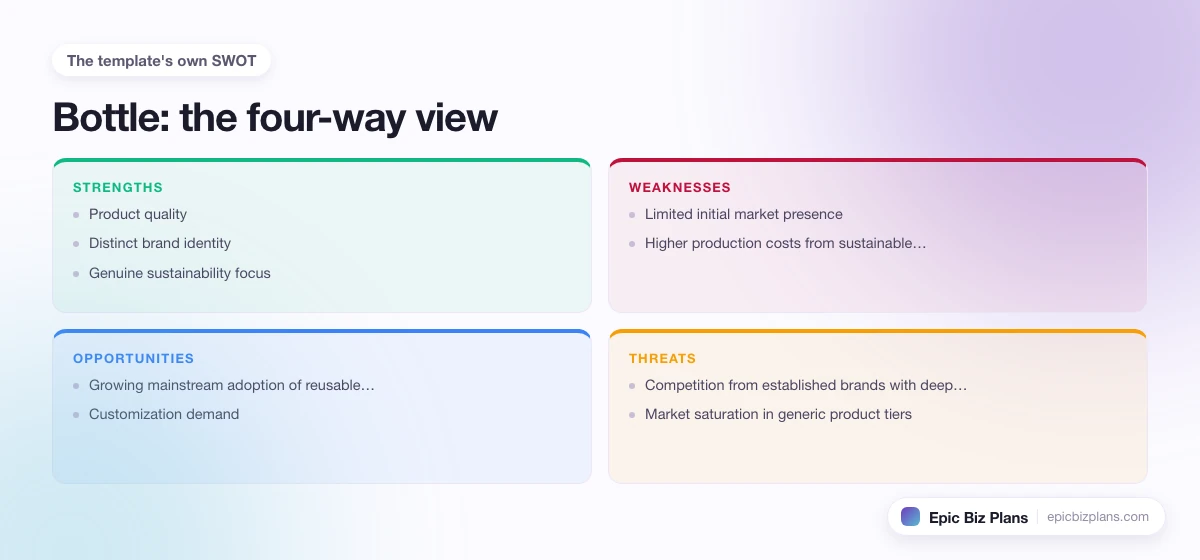
- Strengths: Product quality, distinct brand identity, genuine sustainability focus.
- Weaknesses: Limited initial market presence, higher production costs from sustainable materials.
- Opportunities: Growing mainstream adoption of reusable products, customization demand.
- Threats: Competition from established brands with deep distribution, market saturation in generic product tiers.
Business Name Ideas
Website
We will build on Shopify, which provides the most complete e-commerce infrastructure for a product brand at this scale - inventory management, payment processing, customer accounts, and a wide ecosystem of marketing integrations. Product photography is critical in this category; the site will be built around high-quality visuals that communicate the premium feel of the product. Squarespace is a secondary option if brand aesthetics are the primary design priority over e-commerce functionality.
Marketing Details
The bottle and sustainable lifestyle category performs well on visual platforms. Instagram and TikTok are where product discovery happens for our target demographic - aspirational content showing the bottle in active, outdoor, and everyday contexts drives awareness and social proof. We'll use Semrush to identify search intent around "best reusable water bottle" and related queries, and build product and content pages that capture that organic traffic. HubSpot will manage post-purchase email flows to drive repeat purchases and referrals. For those exploring the broader drinkware market, the tumbler business plan template outlines a complementary product category with overlapping customer demographics.
Industry Trends
The reusable container market has moved decisively into the mainstream over the past five years. The "Stanley cup" phenomenon demonstrated that a product in this category can go viral and achieve cult status - proof that design-led differentiation still has significant upside even in a crowded market. Material innovation is an active trend: double-wall vacuum insulation, lightweight titanium construction, and integrated filtration systems are all commanding premium pricing. Regulatory trends restricting single-use plastics in key markets are also expanding the addressable audience for reusable alternatives. Entrepreneurs building in adjacent drinkware categories can reference the tumbler cups business plan for relevant market positioning insights.
Competitor Information
Hydro Flask, Stanley, S'well, and YETI dominate the premium segment with strong brand recognition and retail distribution. These competitors have scale advantages in manufacturing and marketing that make direct competition on their terms impractical for a new entrant. Our strategy avoids direct overlap: we'll identify a specific niche within the broader market where the established brands have left gaps - whether in design aesthetics, material choice, customization options, or community focus - and own that position clearly. The self-cooling bottle segment is one example of material innovation creating space for differentiation, as outlined in the self-cooling drink bottle business plan.
Financial Information
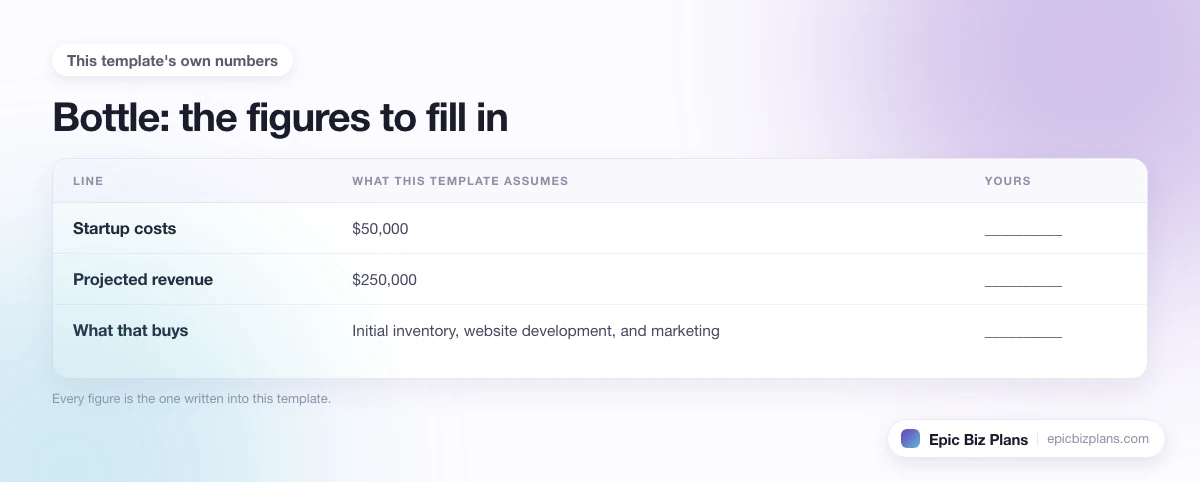
Startup costs are estimated at $50,000, covering initial inventory, website development, and marketing. We project $100,000 in first-year revenue, scaling to $250,000 by year three. Ongoing costs include production, fulfillment, marketing, and operational overhead. Gross margin targets of 50–60% are achievable with premium pricing and controlled direct-to-consumer distribution. Monthly P&L tracking will flag any deviation from margin targets early, before they become structural problems.
Legal and Compliance
We will register the business and protect our bottle designs and brand through trademark and design patent filings. Compliance with material safety standards - particularly FDA and California Prop 65 requirements for food-contact materials - is mandatory before any product goes on sale. We'll also ensure our environmental claims are specific and substantiated to comply with FTC Green Guides guidelines.
Operational Plan
Core operations involve sourcing sustainable materials from vetted suppliers, managing production quality, and fulfilling orders through a third-party logistics provider. Supplier audits will be part of our standard operating process - not just a one-time onboarding check. Initial order quantities will be conservative to minimize inventory risk while the product and brand are validated in-market. We'll track return rates and customer feedback closely as early quality signals.
Contingency Planning
Supply chain disruptions - particularly for specialized sustainable materials - are a primary risk. We'll maintain relationships with backup suppliers for all critical inputs. Market saturation risk is managed by staying in our differentiated niche rather than expanding into the generic mass-market segment. Maintaining a six-month operating reserve will provide stability during slower revenue periods or unexpected inventory challenges.
Customization and Brand Community
Customization is one of the strongest growth levers in the reusable bottle space. Custom engravings, limited-edition colorways, and branded corporate orders all command premium pricing and generate organic word-of-mouth. A brand community - built through social media, user-generated content, and events - amplifies marketing reach without proportional spend increases. The brands that sustain premium pricing over time are the ones that have built a community around the product, not just sold the product itself. Related businesses building in adjacent canteen and portable hydration markets can reference the canteen business plan template for complementary operational frameworks.
Build a Brand, Not Just a Product
The sustainable bottle market has room for new brands that are genuinely differentiated - but it doesn't have room for generic entrants competing on price. The businesses that grow in this category are the ones that know exactly who their customer is and build every product, marketing message, and customer experience decision around that specific person. Your business plan is the document that forces that clarity before you spend a dollar on inventory.
Adapt as You Grow
As you learn from real customers and real market conditions, update this plan. The initial version is your best thinking before you have data; the subsequent versions will incorporate what you've learned. Regular plan reviews - at least twice a year - keep your strategy current and your priorities focused.
-
 SemrushSemrush is a platform with literally any online tool you will need to promote your business. Spy on your competitors, get search traffic, keyword research, social info, ad copies and much more. Used by most of the top online companies in the world. Besides all its tools, Semrush also has many available integrations possible with many other tools that will make your work even better.
 -
 Surfer SEOSurfer SEO is an incredibly smart AI tool that will give you exact explanations what to do in order to make your website rank better. They use hundreds of parameters, check your competitors and decide on the best course of action. Whether it be inner links, bold text, paragraphs, headers, images and much more. Surfer is a must-have in 2026.
Put Your Plan to Work
Use this plan to structure conversations with manufacturers, investors, and retail buyers. A credible, well-structured plan communicates seriousness before you've sold a single unit.
Your Bottle business plan is 100% free - with unlimited edits, unlimited downloads, and unlimited chances to get it right. Build something you're proud of.
