
Botanic Business Plan Template
-
 ShopifyPut your brand on Shopify. Launch your online store with tools designed for growth and success. Ready to turn your idea into profit? Start building your e-commerce business today.
 -
 SquarespaceShowcase your brand with Squarespace’s sleek designs. Build a professional online presence with ease. Start with a template that already looks finished.
 -
 WixBring your ideas to life with Wix. Customize every aspect of your site with unmatched flexibility. Start creating your unique online space and let your creativity shine.
 -
 ElementorCraft captivating websites effortlessly with Elementor. Enjoy complete creative control without coding. Make your site stand out to your audience. Start turning your vision into reality now.
- Executive Summary
- Business Info
- Business Model Overview
- SWOT Analysis
- Botanic Business Name Ideas
- Website
- Marketing Details
- Industry Trends
- Competitor Information
- Financial Information
- Legal and Compliance
- Operational Plan
- Contingency Planning
- Your process Begins with a Botanic Business Plan
- Types of Botanic Businesses
- Keep Your Botanic Business Plan Current
- Practical Uses for Your Plan
Start your plant venture with a Botanic business plan that holds up to real scrutiny. The botanic industry is growing steadily, driven by interest in sustainable living and home gardening, which makes it a practical space to build a business. As you create your Botanic business plan, make sure it reflects your brand and speaks clearly to the gardeners and plant buyers you want as customers.
Your Botanic business plan is more than a document; it is a working tool that keeps your strategy focused. This sector keeps changing, so build a plan you can update as products, suppliers, and customer demand shift. Stay specific, stay true to your mission, and make every section of your Botanic business plan earn its place.
Executive Summary
Our mission at Botanic is to provide eco-friendly and sustainable gardening solutions that align with the growing needs of environmentally conscious consumers. We envision a world where gardening is accessible to everyone, building a deeper connection with nature and promoting well-being. Our value proposition lies in offering unique, organic gardening products alongside educational resources to inspire our customers. Financially, we aim to achieve a break-even point within the first year and reach a revenue of $250,000 by the end of year two.
Business Info
We will specialize in a range of organic gardening products including seeds, fertilizers, and gardening tools, as well as provide workshops and online courses focused on sustainable gardening practices. Our target market consists primarily of urban dwellers aged 25-45 who are looking to engage in gardening as a hobby for both personal enjoyment and as a means of sustainability. Sellers focused on houseplants can also review an indoor plants business plan template for product mix ideas.
Business Model Overview
Our business model is based on both retail sales through our online store and experiential learning through workshops. We plan to implement a subscription service for regular customers, providing them with seasonal products and educational materials.
SWOT Analysis
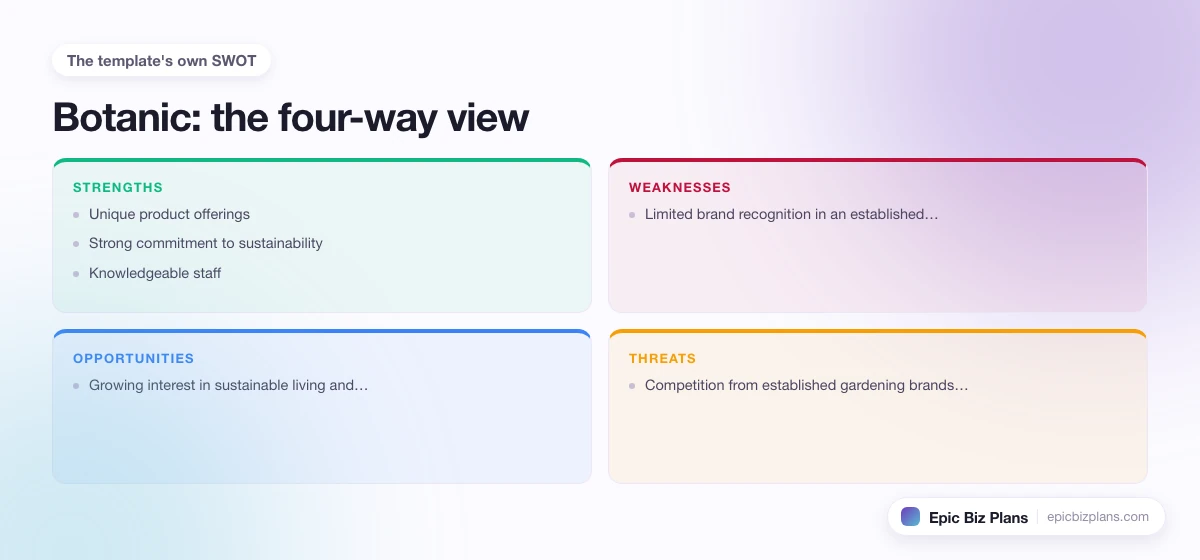
- Strengths: Unique product offerings, strong commitment to sustainability, and knowledgeable staff.
- Weaknesses: Limited brand recognition in an established market.
- Opportunities: Growing interest in sustainable living and DIY gardening.
- Threats: Competition from established gardening brands and fluctuating supply chain costs.
Botanic Business Name Ideas
Website
We will build our website using Shopify to use its eCommerce capabilities for our product sales. Shopify offers an intuitive platform that allows us to easily manage our inventory and customer relationships. This approach is important as we move into the online retail space, targeting customers who prefer the convenience of shopping for gardening products online.
Marketing Details
Our marketing strategy will include digital marketing such as SEO optimization using Semrush, and email campaigns through HubSpot to engage our customer base. We will also run TikTok ads to reach younger demographics, showing our products and workshops in a clear, informative way.
Industry Trends
The gardening industry is shifting steadily toward sustainable practices. Consumers are increasingly interested in organic products, and technology plays a growing role, from app-based gardening tips to smart irrigation systems. Keeping up with these trends will be essential to meeting customer expectations. Businesses adding plant-care services can compare notes with a gardener business plan template and a landscaping business plan template.
Competitor Information
Our primary competitors include established gardening supply companies that offer similar products, as well as niche brands focusing on sustainable gardening. To differentiate ourselves, we will emphasize education, offering a wide set of resources to help our customers succeed in their gardening projects. Operators who also want a physical storefront can study a garden center business plan template.
Financial Information
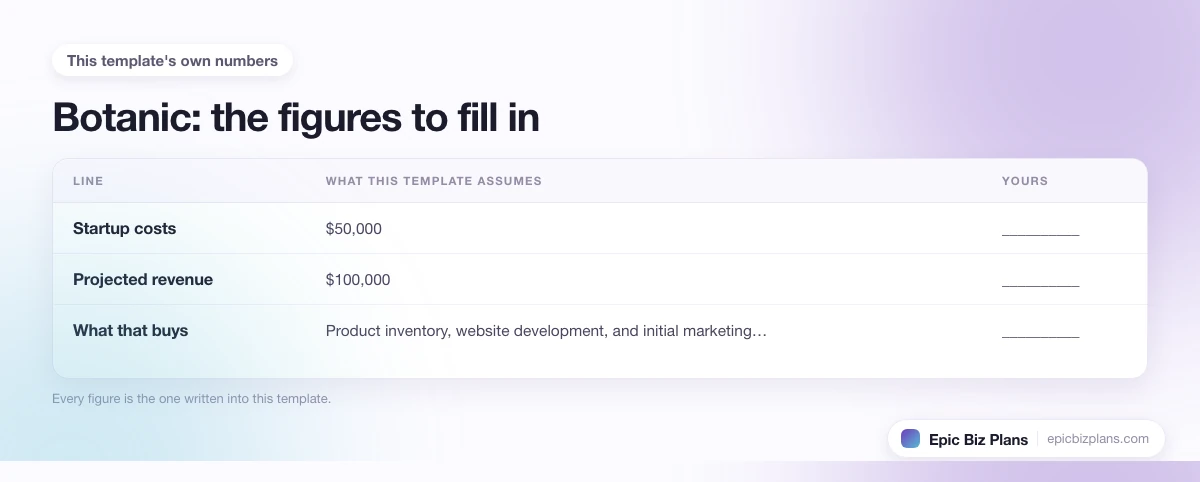
Our startup costs are projected to be approximately $50,000, covering product inventory, website development, and initial marketing efforts. We anticipate generating revenues of $100,000 in our first year as we establish our brand. Ongoing expenses related to operations, marketing, and inventory are forecasted to be around $30,000 annually, ensuring a positive cash flow and the potential for growth.
Legal and Compliance
We will ensure that we comply with all necessary legal requirements for starting a business, including registering the business name, obtaining any necessary licenses, and protecting our intellectual property through trademarks where applicable.
Operational Plan
Key operations will include sourcing our products from reliable suppliers who share our sustainable values, maintaining an efficient inventory system, and logistics for shipping products directly to customers. We will establish relationships with local growers and suppliers to ensure the quality and sustainability of our products. Founders sourcing their own stock may find a seed business plan template useful for procurement planning.
Contingency Planning
We recognize the potential risks involved, including supply chain disruptions and market competition. To mitigate these risks, we will diversify our supplier base, maintain an adaptable inventory approach, and continuously evaluate our market strategies to remain competitive. Regularly reviewing our financial position will also help us adjust our strategies as needed.
Your process Begins with a Botanic Business Plan
Picture building a business around your interest in plants and nature. A botanic business plan gives you a path to turn that interest into a real venture. Whether it is opening a plant shop, launching a sustainable ecommerce brand for garden supplies, or running local workshops on plant care, the options in this niche are as varied as the plants themselves. A specialty grower angle pairs well with a herbal medicine business plan template.
Types of Botanic Businesses
From large-scale nurseries to small artisanal herbal products, the botanic industry offers a wide range of options. Local shops build community, while online platforms reach a wider audience. There are also opportunities for creative workshops or subscription box services that connect plant lovers across regions.
-
 SemrushSemrush is a platform with literally any online tool you will need to promote your business. Spy on your competitors, get search traffic, keyword research, social info, ad copies and much more. Used by most of the top online companies in the world. Besides all its tools, Semrush also has many available integrations possible with many other tools that will make your work even better.
 -
 Surfer SEOSurfer SEO is an incredibly smart AI tool that will give you exact explanations what to do in order to make your website rank better. They use hundreds of parameters, check your competitors and decide on the best course of action. Whether it be inner links, bold text, paragraphs, headers, images and much more. Surfer is a must-have in 2026.
Keep Your Botanic Business Plan Current
Your focus may change, and so should your botanic business plan. Stay flexible and update your strategy for different target audiences, pricing models, and regions. As your business grows, revisiting your plan regularly can sharpen your strategy and help you launch new products or sales channels.
Practical Uses for Your Plan
Use your botanic business plan as a foundational tool to present to potential partners, secure funding from investors, or map out your next steps. It works as a living document that keeps your business moving forward with a clear plan.
Your botanic business plan is 100% free, with unlimited edits, unlimited downloads, and unlimited chances to get it right. Start growing your business today.
