
Booth Business Plan Template
-
 ShopifyPut your brand on Shopify. Launch your online store with tools designed for growth and success. Ready to turn your idea into profit? Start building your e-commerce business today.
 -
 SquarespaceShowcase your brand with Squarespace’s sleek designs. Build a professional online presence with ease. Start with a template that already looks finished.
 -
 WixBring your ideas to life with Wix. Customize every aspect of your site with unmatched flexibility. Start creating your unique online space and let your creativity shine.
 -
 ElementorCraft captivating websites effortlessly with Elementor. Enjoy complete creative control without coding. Make your site stand out to your audience. Start turning your vision into reality now.
- Executive Summary
- Business Info
- Products and Services
- Target Market
- Business Model Overview
- SWOT Analysis
- Booth Business Name Ideas
- Website
- Marketing Details
- Industry Trends
- Competitor Information
- Financial Information
- Legal and Compliance
- Operational Plan
- Contingency Planning
- Choosing the Right Events
- Building a Creative Booth Business
- Business Opportunities in the Booth Niche
- Grow and Adapt Your Booth Business Plan
- Move Forward with Confidence
Start strong with a Booth business plan built for a busy, competitive event market. There is steady demand for fresh products and good experiences at markets, fairs, and festivals. A booth is not just a place to set up shop; it is a chance to present your brand clearly and connect with buyers in person. Your plan should explain what you sell, who you sell to, and why your booth earns a second look. A focused plan now saves you from costly setup mistakes later.
Every part of your booth should reflect your brand, draw people in, and leave them wanting more. This is your chance to design an experience that turns browsers into buyers. Your Booth business plan should be as clear as your vision, covering layout, products, pricing, and the events you will work. Map out the costs and the expected sales for each event before you commit. For a related angle, see our exhibition business plan template.
Executive Summary
Our mission is to run an engaging, customer-focused booth that gives visitors a memorable experience while showing off our products. We picture a booth that stands out for its design and draws a wide range of buyers. Our value proposition is high-quality products and excellent customer service that build satisfaction and repeat business. Financially, we aim to reach profitability within the first year and grow steadily after that.
Business Info
Products and Services
We will offer products chosen for our target market, including useful gadgets, eco-friendly goods, and handmade items. Our booth will work as both a retail space and a place to talk with customers directly. Sellers focused on handmade goods can also review our handmade craft business plan template for sourcing and pricing ideas.
Target Market
Our primary target market is tech-savvy buyers aged 18-35 who look for unique, quality products. We will also serve environmentally conscious shoppers who want sustainable options. Event crowds give us direct access to both groups in a single weekend.
Business Model Overview
Our model is direct sales through our booth at events and markets, backed by an online store. We will use the booth's visibility to send foot traffic to our e-commerce platform. That combination keeps sales going between events.
SWOT Analysis
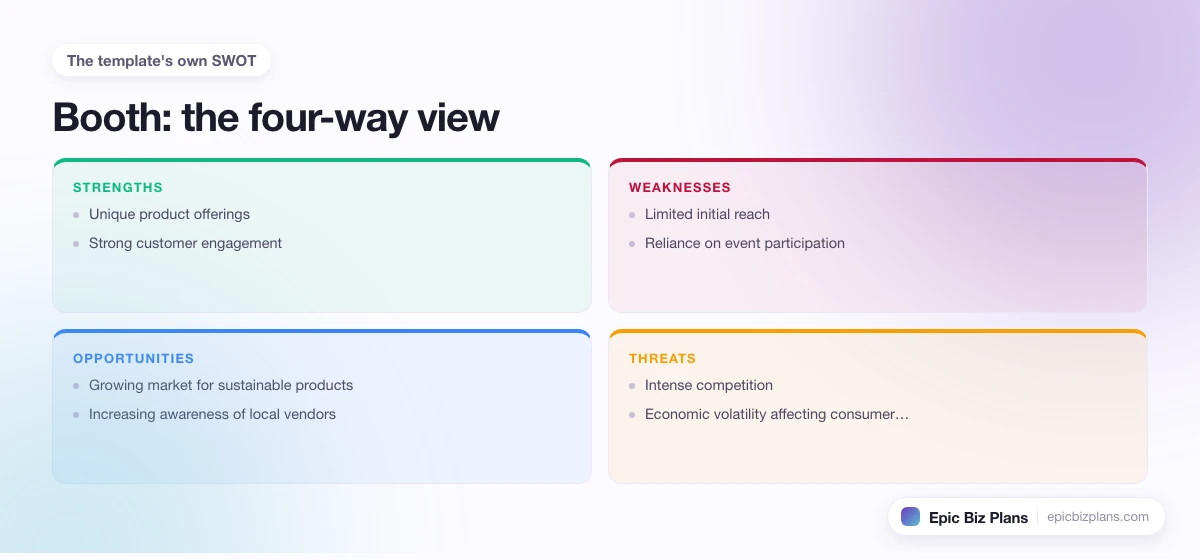
- Strengths: Unique product offerings, strong customer engagement.
- Weaknesses: Limited initial reach, reliance on event participation.
- Opportunities: Growing market for sustainable products, increasing awareness of local vendors.
- Threats: Intense competition, economic volatility affecting consumer spending.
Booth Business Name Ideas
Website
We will build our e-commerce website using Shopify, since it has strong tools for selling products online. The platform helps us manage inventory and keep checkout simple, so we can focus on marketing and customer engagement. It also lets us capture emails from booth visitors for follow-up sales.
Marketing Details
Our marketing strategy uses digital and social media. We will use Semrush for SEO to improve our online visibility and HubSpot for targeted email campaigns about new products and upcoming events. We will also run TikTok ads to reach younger shoppers with short clips of our booth and products. Each campaign will list the next event so online followers can visit in person.
Industry Trends
Current trends show growing demand for sustainable products and rising interest in direct-to-consumer models. Advances in e-commerce and social media marketing also change how we reach customers and promote our booth. Buyers increasingly expect a brand they meet at an event to have a matching online store.
Competitor Information
We will study both direct and indirect competitors. Direct competitors include similar booths at events that sell comparable products, while indirect competitors include established online retailers. To stand out, we will focus on a personalized customer experience and a product mix that reflects current trends.
Financial Information
Our estimated startup costs cover booth setup, inventory, marketing, and website development. We project revenue from event sales and online orders, expecting to break even within six to twelve months. Ongoing expenses include restocking, marketing, and operating costs. We will keep monthly cash flow and P&L statements to track performance closely.
Legal and Compliance
We will comply with all local regulations, including business registration and sales tax collection. We will also seek intellectual property protection for unique product designs and branding to protect our business assets. Event organizers often require permits and insurance, which we will arrange before each show.
Operational Plan
Key operations include sourcing quality products, managing inventory, and coordinating booth logistics. We will build relationships with reliable suppliers and set up a simple process for restocking and order fulfillment. A clear packing and setup checklist keeps each event running smoothly.
Contingency Planning
To handle risks, we will build mitigation strategies. These include a flexible inventory system to adjust to changing demand, emergency funds for unexpected costs, and backup marketing plans if early campaigns underperform. We will monitor risks and market conditions regularly to guide our decisions.
Choosing the Right Events
Not every market or fair is worth the booth fee, so event selection deserves its own plan. We will track foot traffic, audience fit, and sales per event to decide which shows to repeat. Smaller niche events often convert better than large general fairs because the crowd matches our products. We will start with a short list of well-reviewed local markets and expand based on results. Sellers planning around recurring local markets can also see our farmers market business plan template.
-
 SemrushSemrush is a platform with literally any online tool you will need to promote your business. Spy on your competitors, get search traffic, keyword research, social info, ad copies and much more. Used by most of the top online companies in the world. Besides all its tools, Semrush also has many available integrations possible with many other tools that will make your work even better.
 -
 Surfer SEOSurfer SEO is an incredibly smart AI tool that will give you exact explanations what to do in order to make your website rank better. They use hundreds of parameters, check your competitors and decide on the best course of action. Whether it be inner links, bold text, paragraphs, headers, images and much more. Surfer is a must-have in 2026.
Building a Creative Booth Business
Picture work that reflects who you are, where your creativity drives the business and each day moves you toward more freedom. That is the appeal of starting a booth business: a space to show your style while connecting with an active community of buyers. Whether you bring handcrafted goods to local markets, sell vintage finds online, or run a pop-up shop, the options in this niche are wide. The key is matching your products to the right crowd.
Business Opportunities in the Booth Niche
From small farmers' market booths with organic produce to large festival displays with interactive experiences, the booth business covers a lot of ground. Consider e-commerce stores showcasing handmade goods or local artisans setting up for community events. Each booth tells a story and gives customers a chance to connect with your brand in person. Makers selling handmade jewelry can also adapt our handmade jewelry business plan template.
Grow and Adapt Your Booth Business Plan
Your booth business plan should change as your business does. As you grow, revisit and update it to fit new audiences, pricing models, products, regions, or sales channels. Use it to present to potential partners, plan a product launch, secure funding, or clarify your strategy.
Move Forward with Confidence
Your booth business plan is 100% free, with unlimited edits, unlimited downloads, and unlimited chances to get it right. Take the first step and build the business you have been planning.
