
Boot Business Plan Template
-
 ShopifyPut your brand on Shopify. Launch your online store with tools designed for growth and success. Ready to turn your idea into profit? Start building your e-commerce business today.
 -
 SquarespaceShowcase your brand with Squarespace’s sleek designs. Build a professional online presence with ease. Start with a template that already looks finished.
 -
 WixBring your ideas to life with Wix. Customize every aspect of your site with unmatched flexibility. Start creating your unique online space and let your creativity shine.
 -
 ElementorCraft captivating websites effortlessly with Elementor. Enjoy complete creative control without coding. Make your site stand out to your audience. Start turning your vision into reality now.
- Executive Summary
- Business Info
- SWOT Analysis
- Boot Business Name Ideas
- Website
- Marketing Details
- Industry Trends
- Competitor Information
- Financial Information
- Legal and Compliance
- Operational Plan
- Contingency Planning
- Product Line and Pricing Tiers
- Your Path to Freedom: The Boot Business Plan
- Types of Businesses in the Boot Niche
- Stay Flexible with Your Business Plan
- Practical Uses of the Business Plan
Your boot business starts with a plan that shows exactly how style and durability come together in your products. This document sets the direction for sourcing, pricing, and how you reach buyers who care about both looks and long wear. Use it to spell out what makes your boots different and who you expect to buy them, then build every decision from there.
A boot business plan works as a practical blueprint rather than a filing-cabinet formality. Map out the cultural influences, the styles you want to lead with, and the gaps competitors leave open. A clear plan keeps your brand consistent as you grow and gives you something concrete to show partners, suppliers, and lenders. Treat it as a working tool you revisit, not a one-time exercise.
Executive Summary
We will create a boot manufacturing and retail business aimed at providing high-quality, stylish boots for diverse customer needs. Our mission is to combine comfort, durability, and aesthetic appeal in our products to cater to both fashion-conscious individuals and those seeking practical footwear. Our vision is to establish our brand as a leading name in the boot industry, known for sustainability and innovation, and we plan to grow into adjacent categories covered in a wider feet business plan.
Our financial goals include reaching a break-even point within the first year, achieving a revenue of $500,000 in year two, and maintaining a consistent growth rate of 15% annually thereafter. We will use online marketing strategies to attract a broad customer base and maximize our market reach.
Business Info
We will offer a range of products, including casual boots, hiking boots, and dress boots for both men and women. Our target market includes outdoor enthusiasts, professionals in urban settings, and fashion-conscious individuals aged 18-45. Our business model will focus on direct-to-consumer online sales, complemented by select retail partnerships. Founders who want a broader footwear angle can compare notes with our shoe business plan, and those focused on women's styles can review the ladies footwear business plan.
SWOT Analysis
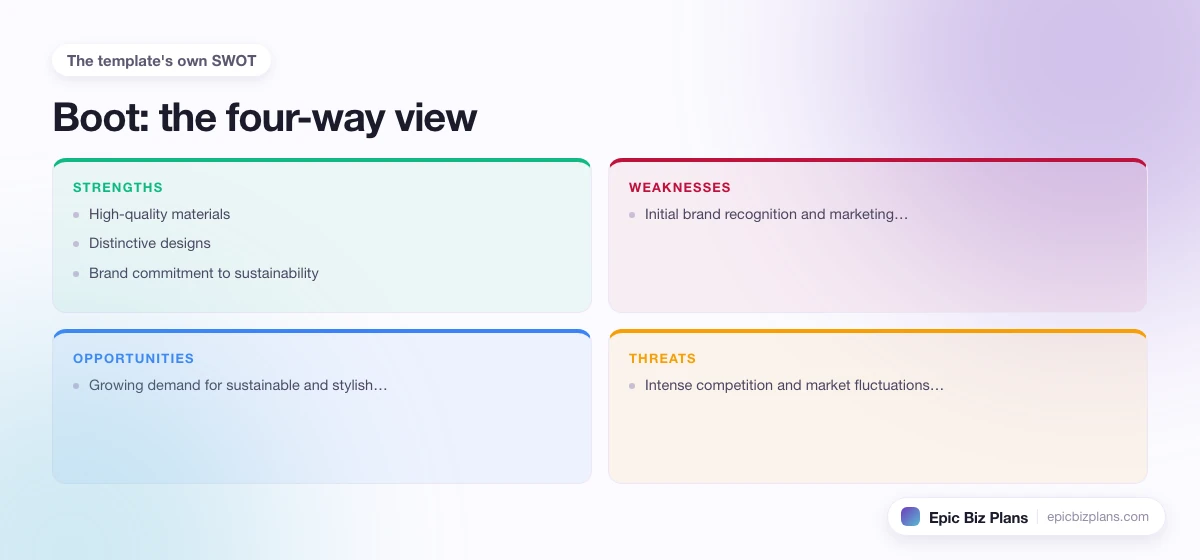
- Strengths: High-quality materials, distinctive designs, and brand commitment to sustainability.
- Weaknesses: Initial brand recognition and marketing budget constraints.
- Opportunities: Growing demand for sustainable and stylish footwear.
- Threats: Intense competition and market fluctuations in raw material costs.
Boot Business Name Ideas
Website
We recommend building our e-commerce website on either Shopify or Squarespace due to their user-friendly interfaces and strong features for online sales. These platforms let us showcase our products and manage transactions without technical headaches. Shopify is particularly useful for a dedicated e-commerce experience, whereas Squarespace offers visually strong templates that are ideal for branding.
Marketing Details
Our marketing strategy will combine digital marketing and social media initiatives. For digital marketing, we will use Semrush to improve our SEO and stay visible in search results. We will also set up HubSpot for our email campaigns to build community engagement and encourage repeat purchases.
We will run TikTok ads to reach younger demographics, using trending content and influencer partnerships to build brand awareness and drive sales.
Industry Trends
We will analyze current industry trends, focusing on the increasing demand for sustainable products and technological advancements in manufacturing processes. The rise of eco-friendly materials and online shopping trends will guide our product development and marketing strategies. Brands leaning into greener production can also study our sustainable fashion business plan for ideas that carry over to footwear.
Competitor Information
We will identify our main competitors, which include both established brands and emerging local businesses. Our indirect competitors include fashion retailers that may not specialize in boots but offer footwear options. To set ourselves apart, we will emphasize quality, sustainability, and unique designs that appeal to our target market.
Financial Information
Our startup costs will be carefully calculated, including expenses for materials, manufacturing, marketing, and initial inventory. We project revenue of $500,000 in year two, with ongoing expenses revolving around production, marketing, and logistics.
We will create cash flow statements and profit and loss statements quarterly to monitor financial performance and ensure we remain on track to meet our goals.
Legal and Compliance
We will register our business with the appropriate governmental authorities, ensuring compliance with local regulations. Additionally, we will pursue intellectual property protection for our brand name and any proprietary designs to safeguard our unique offerings.
Operational Plan
Key operations will include sourcing materials, product manufacturing, and managing logistics for shipping and handling. We will establish partnerships with reliable suppliers and put efficient supply chain processes in place to guarantee product quality and timely delivery. Sourcing quality hides and hardware overlaps with the concerns in our leather goods business plan.
Contingency Planning
We recognize potential risks, including fluctuations in material costs and market demand. To reduce these risks, we will develop contingency plans that include cost management strategies and diversified sourcing options to keep operations stable.
-
 SemrushSemrush is a platform with literally any online tool you will need to promote your business. Spy on your competitors, get search traffic, keyword research, social info, ad copies and much more. Used by most of the top online companies in the world. Besides all its tools, Semrush also has many available integrations possible with many other tools that will make your work even better.
 -
 Surfer SEOSurfer SEO is an incredibly smart AI tool that will give you exact explanations what to do in order to make your website rank better. They use hundreds of parameters, check your competitors and decide on the best course of action. Whether it be inner links, bold text, paragraphs, headers, images and much more. Surfer is a must-have in 2026.
Product Line and Pricing Tiers
We will structure our catalog into three clear tiers so buyers can find the right price and purpose quickly. An entry tier covers everyday casual boots at accessible prices, a mid tier focuses on hiking and work boots built for durability, and a premium tier features hand-finished dress boots with higher margins. This tiering helps us plan production runs, forecast inventory, and market each line to the right audience. Specialty categories such as athletic styles, covered in our football boots business plan, can expand the range as the brand matures.
Your Path to Freedom: The Boot Business Plan
Picture a business where your creativity shapes the brand, your work funds the life you want, and your growth comes from real customer relationships. A boot business lets you build that, making not just footwear but products people connect with. Whether you picture a handcrafted local shop, an online store, or a bold brand that reshapes the category, the paths open to you are wide.
Types of Businesses in the Boot Niche
The boot market holds room for many models. You could open a boutique specializing in sustainable fashion, an online store with exclusive designs, or a local workshop where customers customize their boots. Each approach lets you connect with your audience directly while making a clear statement in footwear.
Stay Flexible with Your Business Plan
Your boot business plan should grow alongside your business. Regular updates help you adapt to different audiences, test new pricing models, and expand into untapped regions or sales channels. As your business grows, your strategies and goals should grow with it. Owners building an eco-focused apparel brand can also study our Viva business plan template.
Practical Uses of the Business Plan
Whether you are presenting to potential partners, planning a launch, seeking funding, or clarifying your strategy, your boot business plan is an essential tool. Use it to explain your vision and handle the challenges ahead with clarity and confidence.
Your boot business plan is 100% free, with unlimited edits, unlimited downloads, and unlimited chances to get it right. Start building it today and put your idea into motion.
