
Boo Business Plan Template
-
 ShopifyPut your brand on Shopify. Launch your online store with tools designed for growth and success. Ready to turn your idea into profit? Start building your e-commerce business today.
 -
 SquarespaceShowcase your brand with Squarespace’s sleek designs. Build a professional online presence with ease. Start with a template that already looks finished.
 -
 WixBring your ideas to life with Wix. Customize every aspect of your site with unmatched flexibility. Start creating your unique online space and let your creativity shine.
 -
 ElementorCraft captivating websites effortlessly with Elementor. Enjoy complete creative control without coding. Make your site stand out to your audience. Start turning your vision into reality now.
- Executive Summary
- Business Info
- Products or Services
- Target Market
- Business Model Overview
- SWOT Analysis
- Business Name Ideas
- Website
- Marketing Details
- Industry Trends
- Competitor Information
- Financial Information
- Legal and Compliance
- Operational Plan
- Contingency Planning
- Sourcing and Product Development
- Why Start Your Boo Business Plan?
- Adapt as You Grow
- Practical Uses for Your Plan
- Step Into Your Process
A Boo business plan gives your creative brand a clear path from idea to first sale. This is more than a document; it maps out how you will build a distinct identity in a crowded market where original design and personality matter more than scale. As you write your Boo business plan, keep it grounded in the specifics of your brand. Show what you sell, who buys it, and why your look sets you apart from everyone else selling to the same shoppers.
Think of your Boo business plan as the working reference you return to as the business grows. It should name your customers, your products, and your numbers instead of relying on broad statements that could describe any shop. A tight plan helps you make faster decisions on pricing, sourcing, and marketing. Stay specific, focus on what makes your brand recognizable, and use the sections below to build a plan that actually guides your next moves.
Executive Summary
Our mission is to provide unique and quality products that cater to our target market's needs. We envision a brand that stands out for its original design and commitment to customer satisfaction. Our value proposition lies in delivering exceptional quality at competitive prices with excellent customer service. We aim to achieve a revenue goal of $500,000 in our first year.
Business Info
Products or Services
We will offer a range of products that cater to the preferences and needs of our target audience. Our offerings will include both physical goods and digital products, ensuring a diverse inventory that attracts various customer segments.
Target Market
Our target market consists of young adults aged 18-35 who are trend-conscious and seek unique products that reflect their individuality. We will focus on urban areas with high disposable income and a penchant for online shopping.
Business Model Overview
We will operate primarily as an e-commerce platform that allows customers to easily browse and purchase products. Our revenue will primarily come from product sales, supplemented by strategic partnerships and collaborations. Owners building a similar storefront often start from a broader e-commerce business plan template and then adjust the product mix to fit their brand.
SWOT Analysis
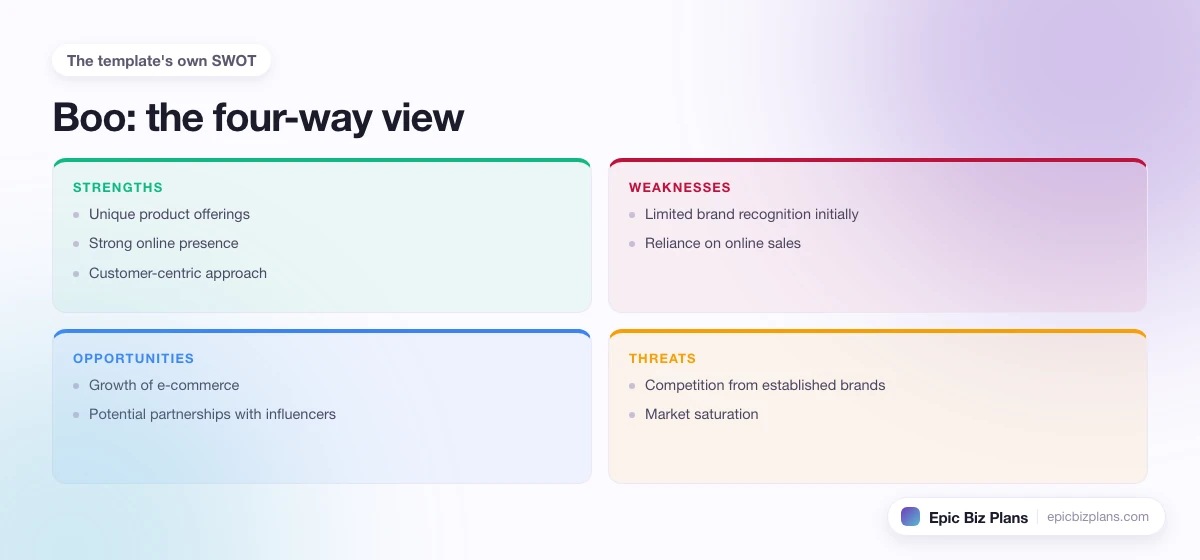
- Strengths: Unique product offerings, strong online presence, customer-centric approach.
- Weaknesses: Limited brand recognition initially, reliance on online sales.
- Opportunities: Growth of e-commerce, potential partnerships with influencers.
- Threats: Competition from established brands, market saturation.
Business Name Ideas
Website
We will consider building our website using Shopify, as it is ideal for e-commerce businesses. Shopify provides an efficient platform for managing inventory, processing transactions, and offering a smooth shopping experience. If we seek broader customization, we will also consider Squarespace as an alternative due to its user-friendly interface. For a deeper look at store setup, our Shopify store business plan template walks through theme, apps, and checkout choices in more detail.
Marketing Details
Our marketing strategy will include a strong digital marketing framework. We will use Semrush for optimizing our SEO efforts, ensuring maximum visibility on search engines. Email marketing campaigns will be managed through HubSpot, targeting our customer base with personalized offers and updates.
Additionally, we will employ TikTok ads to reach younger audiences, highlighting our unique product offerings and engaging content to drive traffic to our website. Social media will play an essential role in building brand awareness and supporting community engagement.
Industry Trends
Technological advancements are reshaping e-commerce, with improvements in logistics and mobile shopping experiences. Customers demand fast shipping and personalized shopping journeys, which pushes us to simplify our operations and improve customer engagement through technology.
Competitor Information
We will analyze our main competitors in the e-commerce space, identifying their strengths and weaknesses. By understanding their strategies, we will differentiate our business through unique product offerings, superior customer service, and targeted marketing approaches aimed at our niche audience.
Financial Information
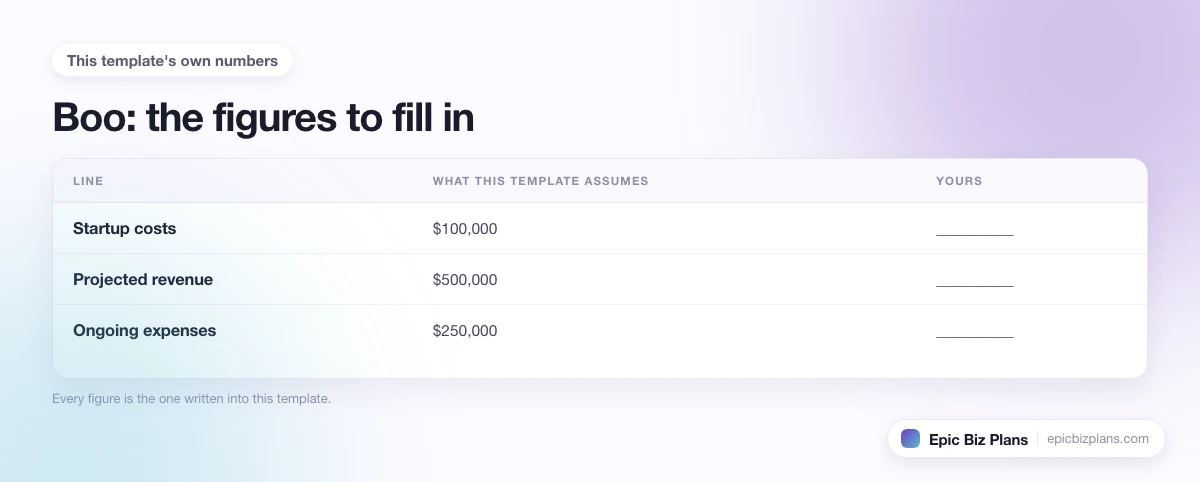
The estimated startup costs for our business are projected to be around $100,000. This includes website development, initial inventory, and marketing expenses. We aim for a projected revenue of $500,000 in our first year, with ongoing expenses around $250,000, which would include operational costs and marketing efforts.
We will maintain a healthy cash flow by tracking our sales and expenses diligently. Regular profit and loss (P&L) statements will be generated to ensure we stay on target for our financial goals.
Legal and Compliance
We will ensure all legal requirements are met, including business registration, acquiring necessary permits, and ensuring compliance with tax obligations. Intellectual property protection will be sought for our unique product designs and branding to safeguard our business against infringement.
Operational Plan
Key operations will include managing our supply chain effectively, sourcing products from reliable manufacturers, and ensuring timely logistics to deliver products to customers. We will establish partnerships with fulfillment centers to simplify our shipping processes.
-
 SemrushSemrush is a platform with literally any online tool you will need to promote your business. Spy on your competitors, get search traffic, keyword research, social info, ad copies and much more. Used by most of the top online companies in the world. Besides all its tools, Semrush also has many available integrations possible with many other tools that will make your work even better.
 -
 Surfer SEOSurfer SEO is an incredibly smart AI tool that will give you exact explanations what to do in order to make your website rank better. They use hundreds of parameters, check your competitors and decide on the best course of action. Whether it be inner links, bold text, paragraphs, headers, images and much more. Surfer is a must-have in 2026.
Contingency Planning
We will address potential risks such as supply chain disruptions, changes in consumer behavior, and economic downturns. Strategies will be developed to reduce these risks, including maintaining a diverse supplier base and adapting our marketing strategies to evolving market conditions.
Sourcing and Product Development
A Boo brand lives or dies on the quality of what it sells, so sourcing deserves its own attention. Decide early whether you will make products yourself, work with small manufacturers, or resell curated goods. Each route changes your margins, your minimum order quantities, and how quickly you can restock a bestseller. Founders leaning toward original goods often model their approach on a handmade products business plan template to plan realistic production timelines, while those testing demand first may prefer a lighter dropshipping business plan template before committing to inventory.
Why Start Your Boo Business Plan?
Imagine building a business that blends creativity, identity, and independence. A brand centered on your passion, whether that is art, fashion, or unique local products, can reflect exactly who you are. A Boo business plan is the blueprint that turns that vision into a working shop. From online stores to artisanal craft fairs, the openings are wide. Picture the boutiques that bring local character to a neighborhood or an online platform that spotlights independent makers, since each of those starts with a solid plan.
Adapt as You Grow
Your Boo business plan is not static; it's an evolving document. As you grow and learn, update your plan to reach different audiences, introduce new pricing models, or expand your sales channels. Keep it current so it reflects your growth and real market changes. This adaptability is key to staying relevant and competitive. Many owners find that a general creative business plan template gives them useful prompts when they revisit their strategy each season.
Practical Uses for Your Plan
Your Boo business plan serves several practical purposes: presenting to potential partners, planning your launch, securing funding, or clarifying your strategy. Each page can move you toward your goals and define your path as an owner. Make it work for you.
Step Into Your Process
Your Boo business plan is 100% free, with unlimited edits, unlimited downloads, and unlimited chances to get it right. Take this opportunity to shape your future and move into ownership with real confidence.
