
Bonding Business Plan Template
-
 ShopifyPut your brand on Shopify. Launch your online store with tools designed for growth and success. Ready to turn your idea into profit? Start building your e-commerce business today.
 -
 SquarespaceShowcase your brand with Squarespace’s sleek designs. Build a professional online presence with ease. Start with a template that already looks finished.
 -
 WixBring your ideas to life with Wix. Customize every aspect of your site with unmatched flexibility. Start creating your unique online space and let your creativity shine.
 -
 ElementorCraft captivating websites effortlessly with Elementor. Enjoy complete creative control without coding. Make your site stand out to your audience. Start turning your vision into reality now.
- Executive Summary
- Business Info
- Business Model Overview
- SWOT Analysis
- Business Name Ideas
- Website
- Marketing Details
- Industry Trends
- Competitor Information
- Pricing Strategy
- Financial Information
- Legal and Compliance
- Operational Plan
- Contingency Planning
- Put Your Plan Into Action
- Explore Your Niche
- Keep Your Plan Current
- Tools for Success
- Your Path Starts Now
A bonding business centers on strengthening personal and professional relationships through structured activities, facilitated workshops, and curated experiences. Whether you serve families looking for quality time, corporate teams working through communication gaps, or community groups seeking deeper engagement, the demand for meaningful connection continues to grow. This plan lays out how to build a profitable operation in this space.
Before you invest time and money, you need a clear plan that covers your market, your services, your finances, and your competitive positioning. This bonding business plan template walks you through each section so you can launch with a realistic strategy and measurable goals. Adjust the details to match your specific niche, whether that is outdoor team retreats, couples workshops, or youth mentorship programs.
Executive Summary
This business will enhance personal connections through a variety of bonding activities and structured programs. The mission is to foster relationships and build community through engaging, facilitated experiences. The vision is to become a recognized provider in the bonding and experiential services industry while promoting social interaction and emotional health.
The core value proposition is offering unique, customizable bonding experiences that serve people of all ages and encourage deeper connections. Financial goals include achieving profitability within the first year of operation and expanding service offerings by year three. Early revenue will come primarily from workshop fees and corporate event contracts.
Business Info
Services and products include bonding workshops, team-building exercises, and connection-focused events. The target market encompasses families, friend groups, and organizations looking to improve interpersonal relationships. The business model emphasizes experiential learning and community engagement, with both one-time bookings and recurring program packages.
Business Model Overview
The business will primarily operate through direct service offerings and event management. Partnerships with local venues, schools, and corporate HR departments will provide a steady pipeline of clients. Revenue streams include per-session fees, multi-week program packages, and corporate retainer contracts for ongoing team development.
SWOT Analysis
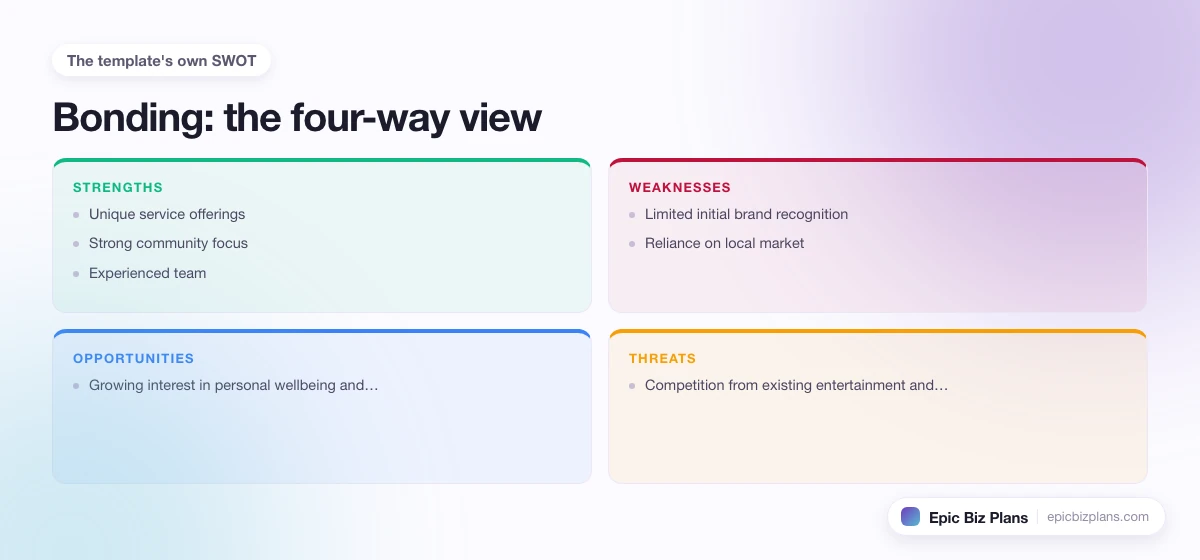
- Strengths: Unique service offerings, strong community focus, experienced team.
- Weaknesses: Limited initial brand recognition, reliance on local market.
- Opportunities: Growing interest in personal wellbeing and community engagement.
- Threats: Competition from existing entertainment and team-building services.
Business Name Ideas
Website
The website can be built using either Wix or Shopify. Wix works well for service-based businesses because of its drag-and-drop editor and built-in booking features. If the business later adds an e-commerce component, such as selling workshop kits or bonding activity supplies, Shopify provides a streamlined storefront with integrated payment processing.
Marketing Details
The marketing strategy will span digital advertising, search engine optimization, and social media content. Semrush will be used for keyword research and SEO tracking, while HubSpot will manage email campaigns and lead nurturing. TikTok and Instagram Reels can showcase workshop highlights and participant testimonials to reach younger demographics.
Local partnerships with schools, community centers, and corporate HR departments will generate referrals. A referral discount program, where past participants earn credit for bringing friends, will help build word-of-mouth traction in the first year.
Industry Trends
The bonding and experiential services industry is shifting toward technology-enhanced experiences. Virtual workshops and online forums have gained traction since 2020, offering flexibility and broader geographic reach. At the same time, in-person demand has rebounded strongly as people seek face-to-face interaction after years of screen fatigue.
An increased focus on mental health and emotional wellbeing is driving more individuals, families, and employers to invest in bonding opportunities. Corporate wellness budgets now frequently include team-building and relationship coaching line items, creating a reliable B2B revenue channel.
Competitor Information
Main competitors include local entertainment services that offer team-building packages, as well as retailers selling bonding-related products like board games and activity kits. Indirect competitors range from online platforms providing virtual workshops to casual meetups organized through Meetup.com and Facebook Groups.
The key differentiator is offering tailored, immersive experiences with professional facilitation. Unlike generic entertainment options, each session is designed around the specific group dynamics and goals of the participants. A strong community-focused approach that encourages ongoing engagement, rather than one-off events, builds long-term client relationships.
Pricing Strategy
Workshop pricing should reflect the level of customization and group size. Public workshops for individuals or small groups can be priced at $35 to $75 per person. Private group sessions for families or friend groups typically range from $200 to $500 per event. Corporate packages, which include pre-session planning, facilitation, and post-event reports, command $1,000 to $5,000 depending on group size and program length.
Offering tiered pricing with early-bird discounts and multi-session bundles encourages repeat bookings. A membership or subscription model for regular participants provides predictable monthly revenue and higher lifetime customer value.
-
 SemrushSemrush is a platform with literally any online tool you will need to promote your business. Spy on your competitors, get search traffic, keyword research, social info, ad copies and much more. Used by most of the top online companies in the world. Besides all its tools, Semrush also has many available integrations possible with many other tools that will make your work even better.
 -
 Surfer SEOSurfer SEO is an incredibly smart AI tool that will give you exact explanations what to do in order to make your website rank better. They use hundreds of parameters, check your competitors and decide on the best course of action. Whether it be inner links, bold text, paragraphs, headers, images and much more. Surfer is a must-have in 2026.
Financial Information
Startup costs will include venue deposits, marketing spend, insurance, and initial staffing. Expect to invest between $15,000 and $40,000 depending on whether you lease dedicated space or partner with existing venues. First-year revenue projections target $150,000, with growth accelerating as corporate contracts and repeat clients build momentum.
Ongoing expenses include employee wages, venue rentals, marketing, supplies, and liability insurance. Cash flow management is critical in a seasonal business; corporate event bookings tend to peak in Q1 and Q3. Quarterly Profit & Loss statements will track performance and guide budget adjustments.
Legal and Compliance
Compliance requirements include registering the business name, obtaining a general business license, and securing liability insurance. If activities involve minors, additional background checks and child safety certifications may be required. Protection of intellectual property, particularly for proprietary workshop curricula and branded materials, should be addressed through copyright registration.
Operational Plan
Key operations involve scheduling events, marketing services, managing staff and freelance facilitators, and maintaining venue relationships. The supply chain includes partners for venue management, equipment rental, and catering for longer events. Logistics planning focuses on efficient event setup, participant communication, and post-event follow-up surveys to gather feedback and testimonials.
Contingency Planning
Primary risks include economic downturns that reduce discretionary spending and new competitors entering the market with similar offerings. Mitigation strategies include diversifying services across B2B and B2C segments, maintaining a flexible cost structure by using contract facilitators rather than full-time staff, and building a strong brand that commands loyalty even during lean periods. Regular monitoring of market trends and customer feedback will inform ongoing strategic adjustments.
Put Your Plan Into Action
Starting a bonding business means building something that directly improves how people relate to each other. Whether you focus on corporate team development, family enrichment, or community group programs, the operational model is straightforward: facilitate meaningful experiences, deliver measurable outcomes, and build a referral engine from satisfied participants.
Explore Your Niche
The bonding services market spans everything from small artisan workshops and adventure retreats to large-scale corporate programs and online courses. Consider starting with a focused offering, such as weekend family workshops or monthly corporate sessions, and expand as demand and cash flow allow. Specializing early helps you build expertise and a reputation in a specific segment.
Keep Your Plan Current
This business plan is a working document, not a one-time exercise. Revisit it quarterly to update your pricing, refine your target audience, add new service lines, and adjust financial projections based on actual performance. A plan that evolves with your business keeps you focused and helps you spot opportunities before competitors do.
Tools for Success
Use this plan to pitch potential venue partners, apply for small business loans, onboard new team members, or simply clarify your next steps. A structured plan turns ambition into a sequence of concrete actions with deadlines and accountability.
Your Path Starts Now
Your Bonding business plan is 100% free - with unlimited edits, unlimited downloads, and unlimited chances to get it right. Step forward with confidence and make your entrepreneurial dreams a reality.
-
ShopifyPut your brand on Shopify. Launch your online store with tools designed for growth and success. Ready to turn your idea into profit? Start building your e-commerce business today.
-
SquarespaceShowcase your brand with Squarespace’s sleek designs. Build a professional online presence with ease. Start with a template that already looks finished.
-
WixBring your ideas to life with Wix. Customize every aspect of your site with unmatched flexibility. Start creating your unique online space and let your creativity shine.
-
ElementorCraft captivating websites effortlessly with Elementor. Enjoy complete creative control without coding. Make your site stand out to your audience. Start turning your vision into reality now.
