
Bomb Business Plan Template
-
 ShopifyPut your brand on Shopify. Launch your online store with tools designed for growth and success. Ready to turn your idea into profit? Start building your e-commerce business today.
 -
 SquarespaceShowcase your brand with Squarespace’s sleek designs. Build a professional online presence with ease. Start with a template that already looks finished.
 -
 WixBring your ideas to life with Wix. Customize every aspect of your site with unmatched flexibility. Start creating your unique online space and let your creativity shine.
 -
 ElementorCraft captivating websites effortlessly with Elementor. Enjoy complete creative control without coding. Make your site stand out to your audience. Start turning your vision into reality now.
- Executive Summary
- Business Info
- SWOT Analysis
- Bomb Business Name Ideas
- Website
- Marketing Details
- Industry Trends
- Competitor Information
- Product Development and Sourcing Plan
- Financial Information
- Legal and Compliance
- Operational Plan
- Contingency Planning
- Build a Brand Worth Buying
- Types of Businesses in Your Niche
- Adapt as You Grow
- Using Your Plan Effectively
- Activate Your Vision
A focused Bomb business plan gives you the commercial framework to launch a compelling product brand in the sustainable consumer goods market. Whether your concept centers on bath bombs, eco-friendly cleaning products, or innovative personal care items with a bold brand identity, a clear plan helps you define your product positioning, manage startup costs, and build a distribution strategy that reaches the right buyers. This document is the starting point for turning a product idea into a viable business.
Consumer brands with strong aesthetics and genuine sustainability credentials have carved out real market share against established players in recent years. Your business plan should reflect what makes your product genuinely different, who your ideal customer is, and how you will build the kind of brand loyalty that generates repeat purchases. Specificity about your product, your customer, and your numbers will make this plan credible to investors, lenders, and retail buyers alike.
Executive Summary
Our mission is to deliver innovative, high-quality products that meet the needs of environmentally conscious consumers while maintaining genuine sustainability standards throughout our supply chain. We aim to become a recognized brand in our product category, known for quality, transparency, and a customer experience that builds lasting loyalty. Our value proposition lies in creating products that deliver tangible performance benefits alongside meaningful environmental credentials. We target a revenue increase of 20% annually over the next five years.
Business Info
We offer a range of products designed for personal and household use, with a focus on quality, affordability, and sustainability. Our target customers are eco-conscious buyers aged 22–45 who actively seek out brands that align with their values and are willing to pay a fair premium for products that deliver on their promises. Our business model is direct-to-consumer via our own website, supplemented by targeted wholesale partnerships with independent retailers and specialty gift shops.
SWOT Analysis
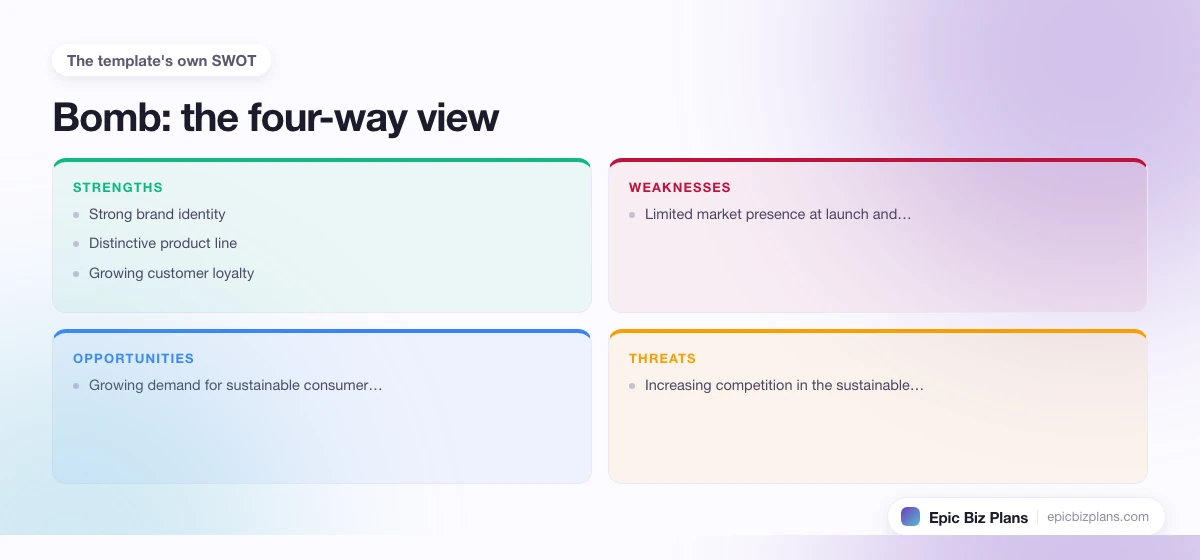
- Strengths: Strong brand identity, distinctive product line, and growing customer loyalty.
- Weaknesses: Limited market presence at launch and dependence on key suppliers.
- Opportunities: Growing demand for sustainable consumer products and expanding direct-to-consumer retail channels.
- Threats: Increasing competition in the sustainable goods category and potential economic pressure on discretionary spending.
Bomb Business Name Ideas
Website
We will build our website on Shopify, which provides a robust ecommerce platform well-suited to consumer product brands. Shopify's payment processing, inventory management, and analytics tools will allow us to manage our online store efficiently from day one. Squarespace is a viable alternative if design flexibility and brand aesthetics take priority in the early stage. Either platform will support our goal of a professional, high-converting online storefront.
Marketing Details
Our marketing strategy will focus on building brand awareness through content that communicates our product benefits and sustainability story. We will use Semrush for SEO to improve organic search visibility in our product category. HubSpot will manage our email marketing, keeping subscribers engaged with product launches, behind-the-scenes sourcing stories, and customer-exclusive promotions.
TikTok will be our primary paid social channel for reaching younger demographics with content that showcases product use, unboxing experiences, and customer testimonials. User-generated content campaigns will amplify authentic brand advocacy at low cost. We will also pursue placements in sustainable lifestyle publications and product roundups to build credibility with buyers who are not yet familiar with our brand.
Industry Trends
The sustainable consumer goods market is growing as buyers apply greater scrutiny to the environmental and ethical claims of brands they support. Ingredient transparency, plastic-free packaging, and verifiable sustainability certifications are increasingly important purchasing factors for our target demographic. Technological advances in eco-friendly manufacturing and materials are also lowering the cost of sustainable production, making it more viable for independent brands to compete on product quality without significant price disadvantage against conventional alternatives.
Competitor Information
Our competitors include both established sustainable product brands with significant marketing budgets and a growing field of independent brands targeting the same eco-conscious buyer. We will differentiate through the specificity and authenticity of our sustainability story, consistent product quality, and the depth of our customer community. Buyers in this category are discerning - brands that overstate their environmental credentials lose trust quickly, so our marketing will focus on honest, substantiated claims.
Product Development and Sourcing Plan
Our product development process will follow a structured approach: concept, formulation, testing, and launch. We will work with suppliers who hold recognized sustainability certifications for raw materials and packaging. All products will go through a minimum of three rounds of internal testing and user feedback before release. We will start with a focused range of three to five SKUs to manage inventory risk and manufacturing complexity, expanding the catalog only after initial products have demonstrated market traction. Packaging will be fully recyclable or compostable, with clear on-pack messaging that reinforces our sustainability positioning.
Financial Information
Initial costs covering product development, website setup, packaging, and first-run inventory are estimated at $100,000. We project first-year revenues of $150,000, with 20% annual growth as our customer base and retail distribution expand. Ongoing costs include production, fulfillment, marketing, and platform fees. We will review P&L monthly and maintain a cash reserve sufficient to cover at least two months of operating expenses. Related sustainable business plans worth reviewing include the sustainable fashion business plan and the essential oil business plan for complementary product category frameworks. The makeup skincare business plan is relevant if your product range overlaps with personal care, and the chapstick business plan covers a specific personal care product niche that shares our target customer profile.
Legal and Compliance
We will register our business, obtain all necessary permits, and protect our brand through trademark registration before our public launch. Product formulations will be reviewed for compliance with relevant consumer safety and labeling regulations in our target markets. We will document all sustainability claims with verifiable supplier certifications to ensure we can substantiate any environmental marketing we publish.
Operational Plan
Key operations include sourcing sustainable raw materials, managing production runs with our contract manufacturer, handling order fulfillment, and providing responsive customer service. We will build relationships with at least two qualified suppliers for each key input to avoid single-source dependency. Fulfillment will initially be handled in-house, with a transition to a third-party logistics provider planned once order volumes exceed our capacity to manage internally.
Contingency Planning
We recognize risks including supply chain disruptions, shifts in consumer purchasing behavior, and increased competition. We will develop relationships with multiple suppliers and maintain a minimum inventory buffer of four weeks of stock. An emergency fund will cover three months of fixed operating costs. If product demand in our initial category slows, our product development process is designed to allow us to pivot to adjacent categories without rebuilding our brand from scratch.
Build a Brand Worth Buying
The sustainable consumer goods market rewards brands that are genuine, consistent, and willing to build customer trust over time rather than chasing short-term sales. A clear business plan gives you the structure to make decisions deliberately - about product development, pricing, marketing spend, and distribution - rather than reactively. The businesses that succeed in this space start with a clear purpose and execute on it consistently.
-
 SemrushSemrush is a platform with literally any online tool you will need to promote your business. Spy on your competitors, get search traffic, keyword research, social info, ad copies and much more. Used by most of the top online companies in the world. Besides all its tools, Semrush also has many available integrations possible with many other tools that will make your work even better.
 -
 Surfer SEOSurfer SEO is an incredibly smart AI tool that will give you exact explanations what to do in order to make your website rank better. They use hundreds of parameters, check your competitors and decide on the best course of action. Whether it be inner links, bold text, paragraphs, headers, images and much more. Surfer is a must-have in 2026.
Types of Businesses in Your Niche
The sustainable consumer product category supports a wide range of business formats - from small artisan operations selling at markets and through Etsy, to direct-to-consumer brands scaling through paid social, to wholesale suppliers building retail distribution. Your plan should match the model you are genuinely prepared to operate, with financial projections that reflect real startup costs and realistic growth timelines.
Adapt as You Grow
Revisit your business plan regularly as you learn from your customers, your suppliers, and your own operational experience. What you know in year two will be significantly richer than what you knew at launch, and your plan should reflect that accumulated knowledge. Keep it current and use it as a decision-making tool, not just a funding document.
Using Your Plan Effectively
Your business plan is most valuable when you use it actively - to evaluate new product ideas against your strategy, to present your brand to wholesale buyers, to apply for business financing, and to align your team around shared priorities. Return to it often.
Activate Your Vision
Your Bomb business plan is 100% free - with unlimited edits, unlimited downloads, and unlimited chances to get it right. Build the product brand you believe in.
