
Boiled Peanuts Business Plan Template
-
 ShopifyPut your brand on Shopify. Launch your online store with tools designed for growth and success. Ready to turn your idea into profit? Start building your e-commerce business today.
 -
 SquarespaceShowcase your brand with Squarespace’s sleek designs. Build a professional online presence with ease. Start with a template that already looks finished.
 -
 WixBring your ideas to life with Wix. Customize every aspect of your site with unmatched flexibility. Start creating your unique online space and let your creativity shine.
 -
 ElementorCraft captivating websites effortlessly with Elementor. Enjoy complete creative control without coding. Make your site stand out to your audience. Start turning your vision into reality now.
- Executive Summary
- Business Info
- Products and Services
- Target Market
- Business Model Overview
- SWOT Analysis
- Boiled Peanuts Business Name Ideas
- Website
- Marketing Details
- Industry Trends
- Competitor Information
- Financial Information
- Legal and Compliance
- Operational Plan
- Contingency Planning
- Conclusion: Build Your Boiled Peanuts Business
A boiled peanuts business plan turns a popular Southern snack into a real operation with goals, numbers, and a clear direction. Boiled peanuts carry a strong regional following, sold at roadside stands, ballgames, and festivals across the South. A well-built plan defines who you serve, what flavors set you apart, and how you make a profit. It also gives you something concrete to show partners, lenders, or a landlord when you need a storefront.
Start by deciding what kind of boiled peanut business you actually want to run. You might cater to adventurous snackers with Cajun and garlic blends, or stick with the classic salted batch that regulars expect. Your plan should match the way you intend to sell, whether that is a single stand, a food truck route, or shipped online orders. The sections below walk through each part of the plan so you can fill in details that fit your own setup.
Executive Summary
Our mission is to provide a flavorful, fresh snack built around boiled peanuts. We want to be a trusted local source for this Southern delicacy, with consistent taste and quality across every batch. Our value proposition is fresh, locally sourced boiled peanuts in both traditional and new flavor profiles. Financially, we aim for a sustainable 20% profit margin within the first three years while gradually widening our market reach.
Business Info
Products and Services
We will offer several boiled peanut varieties, including classic salted, Cajun spice, garlic, and a sweet version. We will also sell them in retail cups and bulk bags for events and repeat customers. Packaging choices will let us serve both walk-up buyers and larger wholesale orders.
Target Market
Our primary market is snack lovers who appreciate Southern food, including local residents, tourists, and event crowds. Fairs, sporting events, and weekend markets bring steady foot traffic of exactly these buyers. Selling at a farmers market stall is one low-cost way to reach them early and test which flavors move fastest.
Business Model Overview
Our model focuses on direct-to-consumer sales through a physical stand and online orders. We will also pursue partnerships with local retailers and cafes to widen distribution. This mix keeps cash coming in from walk-up sales while building a wholesale base over time.
SWOT Analysis
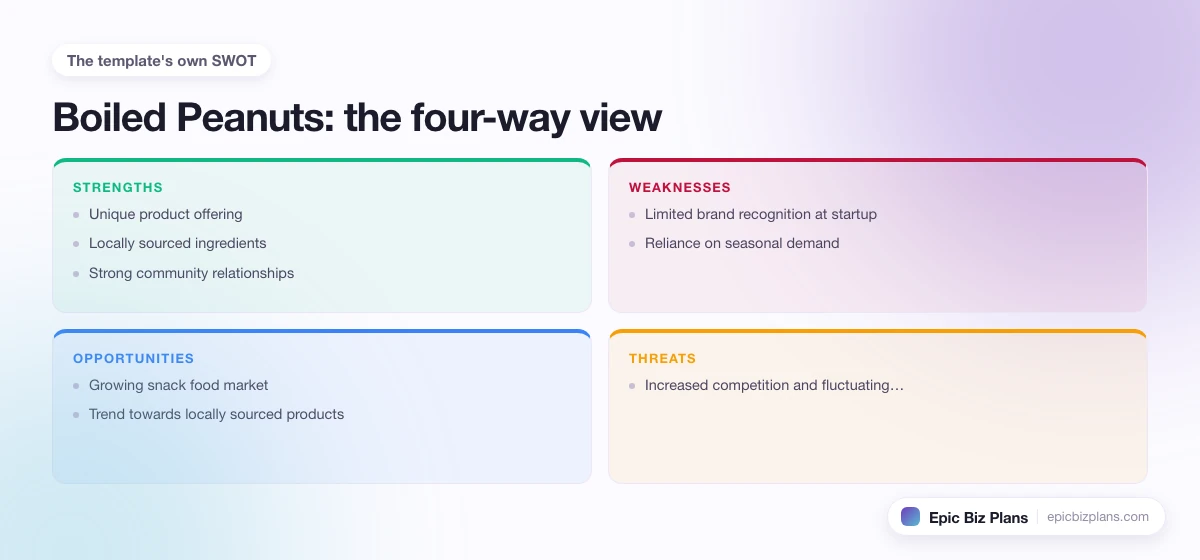
- Strengths: Unique product offering, locally sourced ingredients, and strong community relationships.
- Weaknesses: Limited brand recognition at startup, reliance on seasonal demand.
- Opportunities: Growing snack food market, trend towards locally sourced products.
- Threats: Increased competition and fluctuating ingredient prices.
Boiled Peanuts Business Name Ideas
Website
We will build our website on Shopify for its strong ecommerce features, which support online sales and easy payment processing. The platform will help us promote products and manage inventory without much overhead. Online ordering also lets us ship to customers who first tried our peanuts at an event.
Marketing Details
Our marketing strategy leans on a strong digital approach. We will use Semrush for SEO to improve our online visibility and pull in organic traffic, and HubSpot for email campaigns that keep customers coming back. If you also plan to sell other treats, the ideas in a kettle corn business plan translate well to peanut promotions at the same events.
For social media, we will run TikTok ads aimed at younger snackers, using short video that shows the boil, the seasoning, and the steam coming off a fresh cup. Behind-the-scenes clips of sourcing and cooking tend to perform well for food brands.
Industry Trends
The snack food industry keeps shifting toward healthier options, so we will highlight the protein and fiber in boiled peanuts. Improvements in food processing also let us cook in larger, more consistent batches and keep product fresher for longer. The same demand pattern shows up across the segment, as a roasted nuts business plan often points out when describing better-for-you snacking.
Competitor Information
Our main competitors are local snack food brands and specialty food vendors. Indirect competitors include larger companies selling packaged peanuts on grocery shelves. We will set ourselves apart through local sourcing, distinct flavor blends, and a visible connection to the community. Vendors running a concession stand at the same venues are worth studying, since their pricing and lines reveal what crowds will pay for hot snacks.
Financial Information
Startup costs will cover boiling equipment, packaging, initial inventory, and marketing. We project first-year revenue of $100,000 with cost of goods sold near 50%. Ongoing expenses include labor, ingredients, utilities, and marketing. We will run a regular cash flow analysis alongside P&L statements to track our financial health.
Legal and Compliance
We will follow all local health regulations for food handling and processing. Business registration will be completed, and we will look into protecting our unique flavor combinations where it makes sense. A food handler's permit and a commercial kitchen inspection are usually the first hurdles for a hot-food vendor.
Operational Plan
Our core operations are sourcing raw green peanuts, boiling, seasoning, and packaging. We will build relationships with local farmers for steady ingredient supply. Our process will stay focused on freshness so customers get peanuts at their best. Many operators running a broader snack house business plan use the same sourcing playbook to keep costs down.
Contingency Planning
Potential risks include supply chain disruptions and bad weather affecting the peanut harvest. We will reduce these risks by lining up multiple suppliers and keeping inventory buffers so we never run out mid-season. Tracking the harvest calendar also helps us stock up before prices climb.
-
 SemrushSemrush is a platform with literally any online tool you will need to promote your business. Spy on your competitors, get search traffic, keyword research, social info, ad copies and much more. Used by most of the top online companies in the world. Besides all its tools, Semrush also has many available integrations possible with many other tools that will make your work even better.
 -
 Surfer SEOSurfer SEO is an incredibly smart AI tool that will give you exact explanations what to do in order to make your website rank better. They use hundreds of parameters, check your competitors and decide on the best course of action. Whether it be inner links, bold text, paragraphs, headers, images and much more. Surfer is a must-have in 2026.
Conclusion: Build Your Boiled Peanuts Business
A boiled peanuts business is more than a snack stand; it ties into a long Southern food tradition and the events where people gather. You might run a gourmet food truck, an online shop with unusual flavors, or a single stand at the weekend market. Operations in this space range from large wholesale kitchens to small mom-and-pop carts, each adding its own twist to the recipe. The plan you build should reflect the version you actually want to run.
As you grow, treat your boiled peanuts business plan as a living document. Adjust it for new audiences, test different pricing, expand the flavor lineup, and try new regions or sales channels. Growth rewards flexibility, and revisiting the plan keeps you ready for each new opportunity. Update it whenever your costs, suppliers, or menu change.
Use your boiled peanuts business plan for the moments that matter, whether you are presenting to partners, planning a launch, or applying for funding. It works as your roadmap, so keep it specific and personal to your business. The more detail you put in now, the easier those conversations become later.
This is your moment to act. Your boiled peanuts business plan is 100% free, with unlimited edits, unlimited downloads, and unlimited chances to get it right. Get started and build something worth coming back for.
