
Bodybuilding Business Plan Template
-
 ShopifyPut your brand on Shopify. Launch your online store with tools designed for growth and success. Ready to turn your idea into profit? Start building your e-commerce business today.
 -
 SquarespaceShowcase your brand with Squarespace’s sleek designs. Build a professional online presence with ease. Start with a template that already looks finished.
 -
 WixBring your ideas to life with Wix. Customize every aspect of your site with unmatched flexibility. Start creating your unique online space and let your creativity shine.
 -
 ElementorCraft captivating websites effortlessly with Elementor. Enjoy complete creative control without coding. Make your site stand out to your audience. Start turning your vision into reality now.
- Executive Summary
- Business Info
- Business Model Overview
- SWOT Analysis
- Bodybuilding Business Name Ideas
- Website
- Marketing Details
- Industry Trends
- Competitor Information
- Financial Information
- Legal and Compliance
- Operational Plan
- Contingency Planning
- Summing It All Up
- Multiple Business Models to Consider
- Update Your Plan With Real Data
- Use Your Plan as a Business Tool
A bodybuilding business plan lays out how you will build a profitable company in the fitness and sports nutrition space - whether that means selling supplements, opening a gym, launching an online coaching platform, or some combination of those models. The market is large and competitive, with established supplement brands spending heavily on marketing and endorsements. A solid plan identifies where you fit in that market and how you plan to acquire and keep customers without an unlimited budget.
The fitness and bodybuilding industry rewards brands that build genuine credibility with their target audience. Competitors who have built trust through authentic content, transparent ingredient labeling, and consistent customer results have gained market share against larger incumbents. This plan helps you define your approach across all the areas that determine whether a fitness brand survives past year one.
Executive Summary
We will build a direct-to-consumer bodybuilding supplement brand focused on serious gym-goers and competitive athletes who prioritize performance and ingredient transparency. Our initial product line includes protein powder, pre-workout formula, and a recovery supplement - three products that cover the most consistent purchase categories in sports nutrition and give us a manageable starting inventory without over-extending capital.
Year one revenue target is $150,000, with projected 20% annual growth over the following five years. We will aim to break even by end of year one with startup costs of $100,000 and first-year operating expenses of $80,000. Our competitive position is built on ingredient quality, label transparency, and a brand voice that speaks to experienced lifters rather than casual gym members - a narrower audience but one with higher purchase frequency and stronger brand loyalty. For broader fitness business context, see our fitness trainer business plan and natural supplements business plan.
Business Info
Our initial product range covers three SKUs: a whey protein powder (available in multiple flavors), a stimulant-based pre-workout formula, and a post-workout recovery blend with creatine and BCAAs. Each product will be manufactured by a contract manufacturer that holds current GMP certification, and we will publish a full certificate of analysis for each batch on our website - a transparency standard that most budget supplement brands do not meet.
Target market is serious gym-goers and competitive bodybuilders aged 18 to 45, predominantly male, in urban markets with high gym density. This customer reads ingredient labels, understands what dosages they are looking for, and does not respond to marketing that makes vague or exaggerated claims. They do respond to specific formulation details, third-party testing, and endorsements from coaches or athletes they already follow and respect.
Business Model Overview
Primary channel is direct-to-consumer e-commerce through our own website, with Amazon as a secondary channel for product discovery. DTC gives us better margins and direct customer data; Amazon gives us access to buyers who are actively searching the supplement category and would not find us otherwise.
We will explore a subscription option for protein powder - it is a high-repeat-purchase product that makes economic sense as a subscription. A 10-15% discount for subscribers reduces churn, increases lifetime value, and smooths out revenue variability month-to-month.
SWOT Analysis
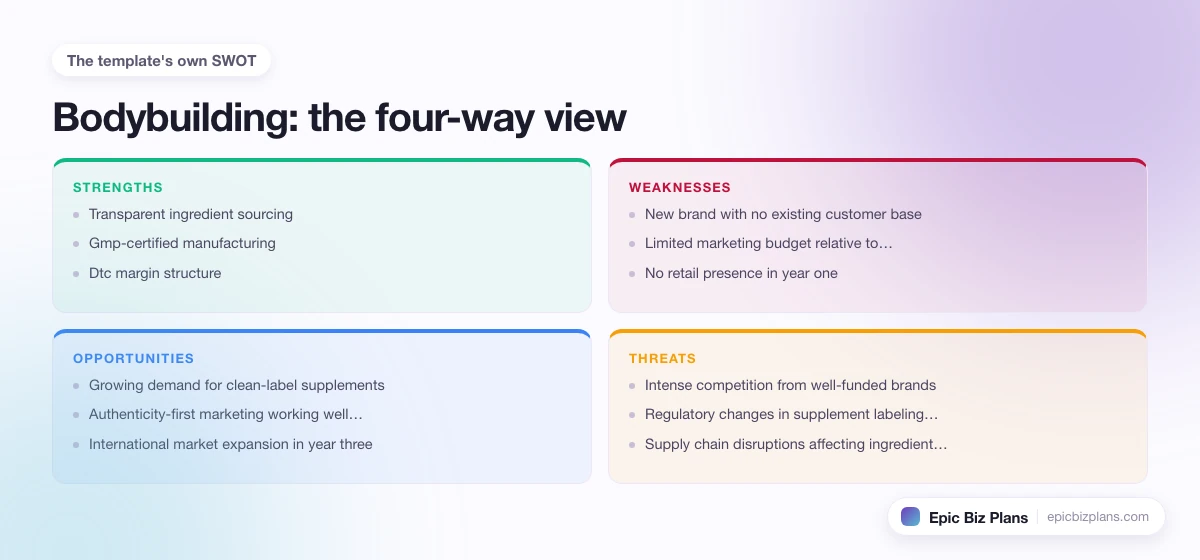
- Strengths: Transparent ingredient sourcing, GMP-certified manufacturing, DTC margin structure, focused initial SKU count that simplifies operations.
- Weaknesses: New brand with no existing customer base, limited marketing budget relative to established competitors, no retail presence in year one.
- Opportunities: Growing demand for clean-label supplements, authenticity-first marketing working well with fitness audiences, international market expansion in year three.
- Threats: Intense competition from well-funded brands, regulatory changes in supplement labeling requirements, supply chain disruptions affecting ingredient sourcing.
Bodybuilding Business Name Ideas
Website
We will build on Shopify, which handles inventory, payment processing, and the e-commerce infrastructure a product brand needs without requiring custom development. Our product pages will be built around the specific details that matter to our target customer: full ingredient panel with dosages, manufacturing certifications, third-party test results, and real reviews from actual users. The site's content strategy will also include training articles and nutrition guides to support SEO and build trust with visitors before they buy.
Marketing Details
Our marketing approach centers on content and influencer partnerships, not heavy paid advertising. In the bodybuilding niche, credibility is earned through relationships with coaches, athletes, and content creators who have established trust with their specific audiences. Micro-influencers with highly engaged followings in strength sports often outperform macro-influencers with millions of followers because their audience actually uses supplements and listens to their recommendations.
We will use Semrush to identify high-intent supplement-related search queries and build content targeting people who are researching specific products before they buy - protein powder comparisons, pre-workout ingredient breakdowns, supplement stacking guides. HubSpot will manage email flows: post-purchase sequences, re-engagement campaigns for lapsed customers, and product launch announcements. TikTok and Instagram content showing real training and real product use will supplement influencer reach with organic brand awareness.
Industry Trends
Consumer demand for clean-label, transparent supplements has grown significantly as buyers become more educated about ingredients and skeptical of proprietary blends that obscure individual dosages. Brands that disclose every ingredient and its exact dose are converting customers who have left brands that use underdosed formulas hidden behind proprietary blend labels.
Personalized nutrition is an emerging trend - supplement brands that can offer customized formulations or tailored stacks based on training type and goals are gaining traction with advanced consumers. This is a more complex business model, but one worth tracking as a future product direction as the brand matures.
Competitor Information
The sports nutrition market is dominated by a few large players - Optimum Nutrition, MuscleTech, and BSN - who compete on price, distribution reach, and marketing spend. These brands have wide retail distribution and large advertising budgets, but they are frequently criticized for underdosed formulas and aggressive use of proprietary blends.
Mid-market competitors like Ghost Supplements and Transparent Labs have built strong followings specifically by competing on transparency and community - positioning that directly counters the legacy brand approach. This demonstrates that the market will support a well-executed transparency-first brand. Our differentiation must be based on actual product quality and honest communication, not just claims - because the customers we are targeting can tell the difference. The health and nutrition business plan covers competitive positioning across the broader nutrition products market.
-
 SemrushSemrush is a platform with literally any online tool you will need to promote your business. Spy on your competitors, get search traffic, keyword research, social info, ad copies and much more. Used by most of the top online companies in the world. Besides all its tools, Semrush also has many available integrations possible with many other tools that will make your work even better.
 -
 Surfer SEOSurfer SEO is an incredibly smart AI tool that will give you exact explanations what to do in order to make your website rank better. They use hundreds of parameters, check your competitors and decide on the best course of action. Whether it be inner links, bold text, paragraphs, headers, images and much more. Surfer is a must-have in 2026.
Financial Information
Startup costs of $100,000 cover initial manufacturing run (approximately 1,000 units per SKU), packaging design, website development, and first-quarter marketing. Year one revenue target of $150,000 at an estimated 60% gross margin generates $90,000 gross profit to cover $80,000 in annual operating expenses, leaving a small net profit by year end.
We will review P&L statements quarterly and update projections based on actual customer acquisition cost and gross margin performance. If marketing spend proves less efficient than projected, we will reduce it and rely more heavily on organic channels until we understand what actually drives conversions for our specific audience.
Legal and Compliance
Dietary supplements sold in the US are regulated under DSHEA (Dietary Supplement Health and Education Act). We must ensure our labels comply with FDA requirements, our manufacturing partner holds GMP certification, and any health claims we make are substantiated and do not cross into drug claim territory. We will work with a regulatory consultant to review all label copy before production.
Business registration, product liability insurance, and trademark filing on the brand name are required before launch. We will also establish terms and conditions for our e-commerce site that clearly define return and refund policies for supplement products, which require specific language around the consumable nature of the goods.
Operational Plan
We will work with a GMP-certified contract manufacturer who can produce our initial three SKUs in minimum order quantities that match our year one demand projections without requiring us to over-invest in inventory. Quality control inspection - including review of certificates of analysis from third-party testing - will happen before each production run is accepted and paid for.
Order fulfillment will be handled by a third-party logistics provider in the first year. This keeps us out of warehouse operations and allows us to scale order volume without hiring additional staff for picking and packing. We will evaluate bringing fulfillment in-house if volume justifies it in year two or three.
Contingency Planning
Supplement ingredients are sourced globally and subject to supply chain disruption. We will qualify at least two sources for each key ingredient before our first production run. If a supplier experiences a shortage or quality issue, we have a backup that can be activated without disrupting our production schedule.
If regulatory changes affect our product formulations - which is possible given the evolving FDA regulatory environment for supplements - we will have the flexibility to reformulate using our contract manufacturer without the complexity of in-house production. We will monitor regulatory developments in the supplement industry and stay in communication with our manufacturer about upcoming changes that could affect our products.
Summing It All Up
The bodybuilding business plan gives you a complete framework for entering the sports nutrition and fitness products market with a clear strategy across products, marketing, operations, and finance. The market is competitive but rewards brands that deliver real quality and communicate honestly with their audience.
Multiple Business Models to Consider
Bodybuilding businesses take many forms. A supplement brand is the most capital-intensive but offers the strongest margins and scaling potential. An online coaching or training platform requires less upfront capital but scales through content and community rather than product inventory. A local gym or training facility is a service business with high fixed costs but strong community retention. Each model requires its own plan; the supplement and e-commerce model outlined here is just one path.
-
ShopifyPut your brand on Shopify. Launch your online store with tools designed for growth and success. Ready to turn your idea into profit? Start building your e-commerce business today.
-
SquarespaceShowcase your brand with Squarespace’s sleek designs. Build a professional online presence with ease. Start with a template that already looks finished.
-
WixBring your ideas to life with Wix. Customize every aspect of your site with unmatched flexibility. Start creating your unique online space and let your creativity shine.
-
ElementorCraft captivating websites effortlessly with Elementor. Enjoy complete creative control without coding. Make your site stand out to your audience. Start turning your vision into reality now.
Update Your Plan With Real Data
Once your business is operating, update this plan every quarter based on what you learn. Supplement brands that fail typically do so because they underestimated customer acquisition costs or overestimated early product demand - real data from your first few months will tell you both. Revise projections as soon as the real numbers diverge significantly from the plan.
Use Your Plan as a Business Tool
Your bodybuilding business plan is more than an internal document. Use it to negotiate better terms with manufacturing partners, present your business to potential investors or co-founders, or apply for business financing. A specific, well-documented plan demonstrates that you understand the market and have thought seriously about the business - which matters to anyone you ask to partner with or invest in your venture.
Your bodybuilding business plan is 100% free - with unlimited edits, unlimited downloads, and unlimited chances to refine it.
