
Boat Business Plan Template
-
 ShopifyPut your brand on Shopify. Launch your online store with tools designed for growth and success. Ready to turn your idea into profit? Start building your e-commerce business today.
 -
 SquarespaceShowcase your brand with Squarespace’s sleek designs. Build a professional online presence with ease. Start with a template that already looks finished.
 -
 WixBring your ideas to life with Wix. Customize every aspect of your site with unmatched flexibility. Start creating your unique online space and let your creativity shine.
 -
 ElementorCraft captivating websites effortlessly with Elementor. Enjoy complete creative control without coding. Make your site stand out to your audience. Start turning your vision into reality now.
- Executive Summary
- Business Info
- Business Model Overview
- SWOT Analysis
- Boat Business Name Ideas
- Website
- Marketing Details
- Industry Trends
- Competitor Information
- Financial Information
- Legal and Compliance
- Operational Plan
- Contingency Planning
- Chart Your Course for Success
- Keep Your Plan Current
- Practical Uses for Your Plan
A boat business plan is the foundation for any serious entrepreneur entering the recreational and commercial marine industry. The boating sector generates billions in annual revenue across rentals, repairs, accessories, and charters - and operators with a clear, well-documented plan are far better positioned to secure funding, attract partners, and scale sustainably. Before launching, you need to understand your market, define your service mix, and project realistic financials.
This plan is not a formality - it's a working document that shapes every decision from staffing to pricing to marketing. The marine industry has real seasonal fluctuations, regulatory requirements, and capital demands that must be addressed upfront. A thorough business plan forces you to confront those realities and build contingencies before they become crises.
Executive Summary
We will establish a boat business specializing in high-quality boating services and products for recreational and fishing customers. Our mission is to deliver a reliable, knowledgeable service experience across boat rentals, repairs, and accessories. Our vision is to become the go-to marine service provider in our region, recognized for technical expertise and customer satisfaction.
Our value proposition rests on three pillars: deep product knowledge, a broad service offering under one roof, and transparent pricing. We will grow revenue steadily by building repeat customer relationships and expanding into adjacent services as the business matures.
Business Info
Our business will serve recreational boaters and fishing enthusiasts through a combination of boat rentals, mechanical repairs, routine maintenance, and retail sales of boating accessories and safety equipment. Brands selling boating gear often add maritime merchandise, so review our nautical business plan.
Business Model Overview
We will operate a hybrid model generating revenue from service labor, rental fees, and product sales. Labor rates for repairs typically yield 60–70% gross margins, while product sales run closer to 35–45% depending on the category. Rentals offer strong seasonal returns with the right asset management. Diversifying across these three streams provides meaningful protection against slow periods in any single area.
SWOT Analysis
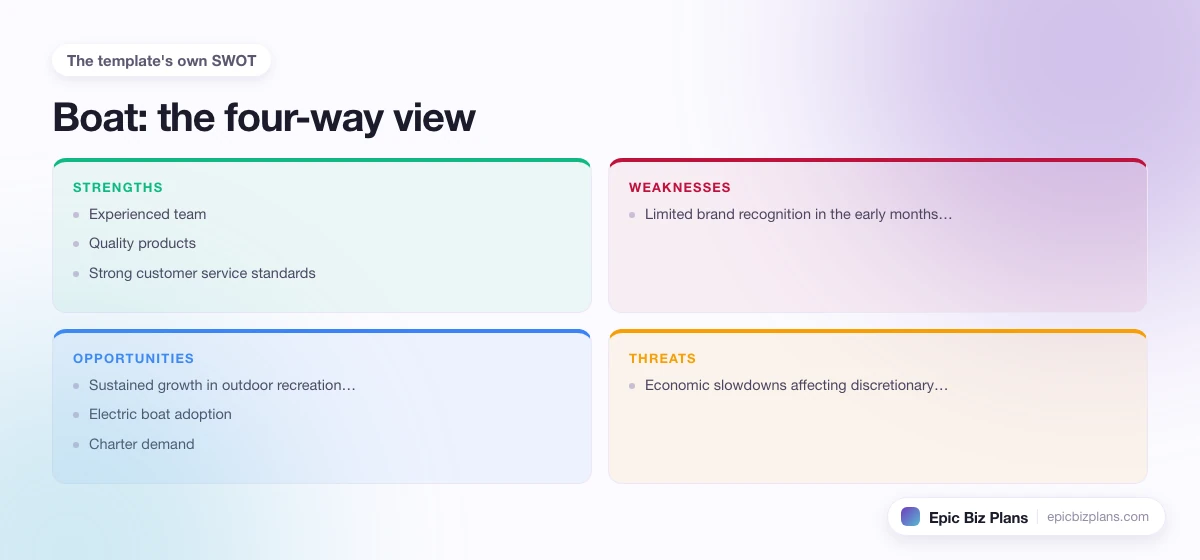
- Strengths: Experienced team, quality products, strong customer service standards.
- Weaknesses: Limited brand recognition in the early months of operation.
- Opportunities: Sustained growth in outdoor recreation spending, electric boat adoption, and charter demand.
- Threats: Economic slowdowns affecting discretionary spending; weather-related seasonal variation.
Boat Business Name Ideas
Website
We will build our website on Wix as a starting point, given its low barrier to entry for non-developers. As revenue grows and we expand our rental and retail inventory, we will evaluate migrating to Shopify or a custom-built platform that better supports booking and e-commerce functionality.
Marketing Details
Our marketing will combine search engine optimization, email marketing, and targeted social advertising. We will use Semrush to identify high-intent keywords around boat rentals and repairs in our local market, and HubSpot to manage email campaigns for repeat customers and seasonal promotions. TikTok and Instagram ads will be used to build awareness among younger demographics interested in outdoor water activities.
Industry Trends
Electric and hybrid-engine boats are gaining significant market share as environmental regulations tighten and consumer preferences shift. Demand for boating experiences - rather than boat ownership - is also rising, particularly among millennials who prefer rental and charter models over the ongoing cost of ownership. Staying current on these trends allows us to adjust our service and product mix proactively. Operators who offer boat tour and charter services alongside standard rentals are capturing a broader share of this experiential spending.
Competitor Information
Our primary competitors are local boat rental companies, independent repair shops, and marine dealerships. We will differentiate through a more complete service offering, stronger technical credentials, and active community engagement including local boating events and skills workshops. Businesses that also invest in professional boat detailing services tend to generate meaningful add-on revenue and improve customer retention.
Financial Information
Startup costs will include facility lease deposits, repair equipment, rental fleet acquisition, insurance, and initial marketing. We anticipate $80,000–$130,000 in initial capital requirements depending on fleet size and location. Revenue will build quarter over quarter as we grow our customer base and referral network. Monthly reviews of cash flow, P&L, and rental utilization rates will guide operational decisions throughout Year 1.
Legal and Compliance
We will register the business, obtain all required local and state boating-related business licenses, and carry appropriate liability and hull insurance. Staff who operate vessels for charter or instructional purposes will hold the relevant USCG certifications. Branding, logos, and proprietary service processes will be protected through trademark registration where applicable.
Operational Plan
Core operations include managing the rental booking calendar, scheduling and executing repair jobs, and maintaining inventory for retail sales. We will build supplier relationships with marine parts distributors to ensure parts availability and competitive pricing. For operators interested in expanding into specialty fishing services, reviewing a fly fishing business plan or a hunting and fishing business plan provides useful context on licensing and guide service structures.
Contingency Planning
Key risks include off-season revenue gaps, unexpected repair costs on rental fleet assets, and fuel price volatility. We will maintain a three-month operating expense reserve, pursue multi-season revenue streams such as winterization services and storage rentals, and build supplier relationships that allow us to source parts quickly when needed. Owners expanding into maintenance-focused services should also consult a marine service business plan to understand the operational structure of a repair-focused model.
Chart Your Course for Success
Building a boat business is a serious commitment - but for operators who plan carefully, the returns can be substantial. The boating industry supports multiple business models, from lean mobile repair operations to full-service marinas, and a detailed plan is what separates ventures that scale from those that stall. Whether you are launching a rental fleet, a repair shop, or a charter service, the plan gives you the roadmap and the credibility to execute it.
-
 SemrushSemrush is a platform with literally any online tool you will need to promote your business. Spy on your competitors, get search traffic, keyword research, social info, ad copies and much more. Used by most of the top online companies in the world. Besides all its tools, Semrush also has many available integrations possible with many other tools that will make your work even better.
 -
 Surfer SEOSurfer SEO is an incredibly smart AI tool that will give you exact explanations what to do in order to make your website rank better. They use hundreds of parameters, check your competitors and decide on the best course of action. Whether it be inner links, bold text, paragraphs, headers, images and much more. Surfer is a must-have in 2026.
Keep Your Plan Current
Your business plan is not a document you write once and file away. Market conditions, customer preferences, and competitive dynamics all shift over time. Review and update your plan at least annually - or whenever you consider a significant expansion, new service line, or capital investment. A living plan is a useful plan.
Practical Uses for Your Plan
Use this plan to approach lenders or investors, structure conversations with potential partners, or guide your own decision-making as the business grows. A well-built plan communicates competence and seriousness to every stakeholder who reads it.
Your boat business plan is 100% free - with unlimited edits, unlimited downloads, and unlimited chances to get it right. Build your plan, refine it, and put it to work.
