
Boarding House Business Plan Template
-
 ShopifyPut your brand on Shopify. Launch your online store with tools designed for growth and success. Ready to turn your idea into profit? Start building your e-commerce business today.
 -
 SquarespaceShowcase your brand with Squarespace’s sleek designs. Build a professional online presence with ease. Start with a template that already looks finished.
 -
 WixBring your ideas to life with Wix. Customize every aspect of your site with unmatched flexibility. Start creating your unique online space and let your creativity shine.
 -
 ElementorCraft captivating websites effortlessly with Elementor. Enjoy complete creative control without coding. Make your site stand out to your audience. Start turning your vision into reality now.
- Executive Summary
- Business Info
- Business Model Overview
- SWOT Analysis
- Boarding House Business Name Ideas
- Licensing and Occupancy Caps: The Section Most Plans Skip
- Website
- Marketing Details
- Industry Trends
- Competitor Information
- Financial Information
- Working the Revenue Backwards From Room Nights
- Startup Costs Breakdown
- Legal and Compliance
- Boarders, Tenants, and Why the Distinction Matters
- How the Income Is Taxed
- Operational Plan
- Screening Standards Worth Writing Down
- Contingency Planning
- Building a Sustainable Boarding House Business
- The Variety of Boarding House Ventures
- Your Plan Evolving with You
- Putting Your Plan to Work
- Take the Next Step
A well-prepared boarding house business plan is the foundation for building a profitable, community-driven accommodation business. As you enter the hospitality sector, your plan needs to capture what makes your property distinctive: the atmosphere, the pricing structure, and the type of residents you intend to attract. This goes beyond financial projections. It is about articulating the living experience you are committed to delivering.
The boarding house market moves quickly, driven by shifting demographics, remote work trends, and housing affordability pressures. Your business plan should demonstrate that you understand these forces and have a clear strategy for turning them to your advantage. Most of all, it should prove you know the two rules that decide whether the business is legal at all: how many people your jurisdiction lets you house, and whether the services you bundle turn you from a landlord into an operator.
Executive Summary
We will establish a boarding house that provides a welcoming and comfortable living space for long-term and short-term residents. Our mission is to offer a home-like environment that caters to students, traveling professionals, and anyone in need of affordable accommodation. Our vision encompasses becoming a preferred choice in the local community for those seeking a quality living experience. We will aim for a revenue goal of $250,000 in our first year with a modest growth of at least 15% annually.
Business Info
Our services will include furnished accommodations, communal living spaces, shared kitchen and dining facilities, cleaning services, and Wi-Fi access. The target market includes college students, interns, and young professionals who search for terms like rooms for weekly rent, house share, and rooming houses near me rather than browsing apartment listings.
Business Model Overview
We will adopt a direct rental model, where residents pay monthly rent with additional charges for certain amenities. Our pricing strategy will be competitive, focusing on value for money while ensuring sustainability. We anticipate a mix of long-term and short-term tenants, with long-term leases providing income stability and short-term occupancy filling gaps during peak demand periods.
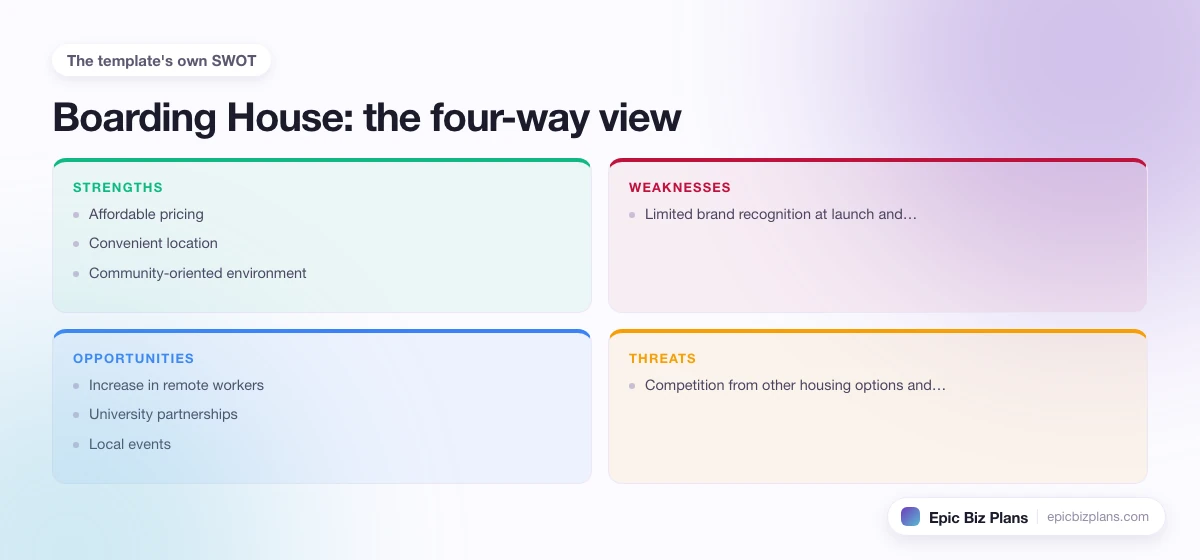
SWOT Analysis
- Strengths: Affordable pricing, convenient location, and community-oriented environment.
- Weaknesses: Limited brand recognition at launch and dependability on local demand.
- Opportunities: Increase in remote workers, university partnerships, and local events.
- Threats: Competition from other housing options and economic downturns affecting occupancy rates.
Boarding House Business Name Ideas
Licensing and Occupancy Caps: The Section Most Plans Skip
Almost every competing boarding house template treats licensing as a single line item. In practice the occupancy cap written into your local code is the number that sets your maximum revenue, and you cannot model the business without it. Operating without a licence is not a paperwork problem, it is grounds for an order to vacate.
The caps vary more than most first-time operators expect. New Jersey's state standard limits occupancy to ten individuals, exclusive of the operators, and municipalities are free to set stricter limits on top of that. Louisville classifies a residential lodging house as containing no more than five guestrooms, with anything larger pushed into a different and more demanding use category. Pocatello, Idaho allows no more than two households per dwelling unit. Austin requires an annual application, an annual fee, a property inspection, and a certificate of occupancy issued before the operating licence.
Work through this checklist before you sign anything:
- Maximum occupants or guestrooms permitted at your address, as written in the zoning code rather than as described by the seller or agent.
- Zoning district, since boarding house use is often a conditional use requiring a hearing, not a permitted use by right.
- Annual licence fee, commonly $150 to $600 depending on jurisdiction and unit count.
- Inspection standards: egress windows in every sleeping room, interconnected smoke and carbon monoxide alarms, fire extinguishers, minimum square footage per occupant, and handrail and stair compliance.
- Certificate of occupancy timing, because in several cities it must be in hand before the licence is issued and before the first resident moves in.
- Parking minimums expressed per bedroom or per occupant, which quietly caps room count on small lots.
Budget four to six months from purchase to first licensed resident if a conditional use hearing is required. That gap is the single most common reason early cash flow projections miss.
Website
We will build our website on Wix, which offers an accessible interface for building and maintaining a small property site without a developer on retainer. The priority is a room availability page that loads quickly on a phone, a clear rent and deposit table, and a short enquiry form, since most enquiries arrive from a phone search rather than a desktop browser.
Marketing Details
Our marketing strategy will combine local search visibility with direct outreach. We will use Semrush for keyword research and rank tracking on the city and neighbourhood terms that actually drive enquiries, and HubSpot to manage email follow-up with applicants who do not convert on the first viewing.
Social video, particularly short walkthrough clips on TikTok, reaches the student and early-career audience that fills rooms fastest. A single honest room tour that shows the shared kitchen and the actual room size outperforms polished exterior footage, because the objection we are answering is always about space and cleanliness.
Two offline channels consistently outperform paid advertising for this business: university off-campus housing offices, which will list a licensed property free of charge, and relocation or travel nurse agencies placing staff on 13-week contracts. Both send pre-screened residents at zero acquisition cost.
Industry Trends
We will analyze technology advancements that can affect the boarding house sector. These include the rise of digital platforms for booking accommodations and an increase in remote work leading to a higher demand for flexible living options. We will stay ahead by integrating technology into our operations and marketing, thereby enhancing the overall customer experience. The growing interest in co-living concepts also presents an opportunity to differentiate through community-building programming.
Competitor Information
Our main competitors will be similarly priced boarding houses and local hotels. We will analyze their pricing models, marketing strategies, and customer reviews to identify areas for differentiation. Our community-focused approach, combined with personalized services and affordable rates, will help us stand out in a competitive local market. We will also monitor vacation rental businesses and serviced accommodation providers as indirect competitors for the short-term occupancy segment.
-
 SemrushSemrush is a platform with literally any online tool you will need to promote your business. Spy on your competitors, get search traffic, keyword research, social info, ad copies and much more. Used by most of the top online companies in the world. Besides all its tools, Semrush also has many available integrations possible with many other tools that will make your work even better.
 -
 Surfer SEOSurfer SEO is an incredibly smart AI tool that will give you exact explanations what to do in order to make your website rank better. They use hundreds of parameters, check your competitors and decide on the best course of action. Whether it be inner links, bold text, paragraphs, headers, images and much more. Surfer is a must-have in 2026.
Financial Information
We estimate our startup costs to be approximately $100,000, which includes renovations, furnishings, and marketing. Projected revenue for the first year is targeted at $250,000, with ongoing expenses including utilities, maintenance, and staff costs estimated at $150,000 annually.
We will ensure a positive cash flow by maintaining high occupancy rates and offering flexible leasing options. A P&L statement will be prepared annually to assess performance and inform strategic decisions.
Working the Revenue Backwards From Room Nights
A $250,000 revenue target is only credible if the room count supports it. Build the figure from the bottom: rooms multiplied by monthly rent multiplied by twelve, then discounted by your realistic occupancy rate. Ten rooms at $900 per month is $108,000 at full occupancy, which means a ten-room house cannot reach $250,000 on rent alone and needs either higher-rent private bathrooms, a second property, or short-stay pricing on part of the inventory.
Plan on 85% to 92% occupancy rather than 100%. Turnover costs roughly two to three weeks of vacancy per room per year once you account for cleaning, minor repairs, and screening the next applicant. Weekly-rate rooms turn over faster and command a premium of 20% to 35% over the monthly equivalent, which is the usual way a small house closes the gap on an ambitious revenue target.
Startup Costs Breakdown
Understanding your upfront investment is critical before signing a lease or purchasing a property. The largest cost items typically include property renovation, furniture and bedding, kitchen appliances, and initial marketing. Budgeting for these items in advance prevents cash shortfalls in the early months of operation. Published ranges for a licensed rooming or boarding house cluster between $75,000 and $200,000 before the property itself, and the spread is driven almost entirely by how much fire safety and egress work the building needs.
- Renovations and repairs: $40,000 to $60,000 depending on property condition
- Furnishings and appliances: $20,000 to $30,000
- Licensing, permits, and legal fees: $5,000 to $10,000
- Fire safety compliance: $6,000 to $20,000 for interconnected alarms, egress windows, and rated doors
- Marketing and website: $5,000 to $8,000
- Working capital reserve: $10,000 to $15,000
Operators expanding into multi-property strategies should also review a rental housing business plan for structuring income across multiple units. Similarly, reviewing what goes into a transitional housing business plan can provide useful frameworks for tenant screening and support services, and an apartment building business plan is the right reference if the property you are considering is large enough to convert into self-contained units instead.
Legal and Compliance
We will comply with all local regulations regarding business registration, health standards, and housing laws. Additionally, we will explore options for intellectual property protection for our brand and marketing materials to prevent infringement.
Boarders, Tenants, and Why the Distinction Matters
Many jurisdictions treat a lodger who shares living space with the owner differently from a tenant with exclusive possession of a unit. The practical consequence is the removal process. A tenant usually requires a formal eviction filing with a court date and a statutory notice period. A lodger, in some states, can be removed on much shorter notice, while in others the protections are identical and an owner who changes the locks commits an illegal eviction.
Confirm which category your residents fall into before you write your house rules, and have a local attorney review the agreement once. A written occupancy agreement should state the rent, the payment date, the licence-mandated occupancy limit, guest policy, quiet hours, notice period, and the grounds for termination. Verbal arrangements are the root cause of most disputes in this business.
How the Income Is Taxed
Room income is reported differently depending on what you provide. Renting rooms while supplying only customary services such as heat, light, and trash collection is typically reported on Schedule E, and that income is generally not subject to self-employment tax. Once you provide substantial services primarily for the occupant's convenience, such as daily cleaning of private rooms, meals, or linen service, the activity is treated as a business and moves to Schedule C, where self-employment tax applies.
-
ShopifyPut your brand on Shopify. Launch your online store with tools designed for growth and success. Ready to turn your idea into profit? Start building your e-commerce business today.
-
SquarespaceShowcase your brand with Squarespace’s sleek designs. Build a professional online presence with ease. Start with a template that already looks finished.
-
WixBring your ideas to life with Wix. Customize every aspect of your site with unmatched flexibility. Start creating your unique online space and let your creativity shine.
-
ElementorCraft captivating websites effortlessly with Elementor. Enjoy complete creative control without coding. Make your site stand out to your audience. Start turning your vision into reality now.
That single classification can swing net income by roughly 15% of profit, so decide deliberately which side of the line your service package sits on rather than discovering it at filing time. Confirm the treatment with a tax professional familiar with lodging income in your state.
Operational Plan
Key operations will include managing tenant relations, overseeing housekeeping, and maintaining property facilities. We will establish a supply chain for necessary provisions and ensure efficient logistics for maintenance and repair services. Shared-facility properties fail on maintenance response time more than on any other operational measure, so a same-day acknowledgement standard and a vetted list of on-call trades are worth setting up before the first resident arrives. Operators who outsource this should review a property maintenance business plan to understand what a reasonable service agreement looks like from the contractor's side.
Screening Standards Worth Writing Down
- Income test: verified monthly income of two and a half to three times the room rent.
- Identity and right to rent: government photo identification, recorded consistently for every applicant.
- Prior residence reference: one contactable previous landlord or hall of residence.
- Written criteria applied identically to every applicant, which is both the fair housing requirement and the best defence if a rejected applicant complains.
- Deposit and first month cleared before keys are issued, never on a promise.
Contingency Planning
Potential risks include fluctuations in occupancy rates and changes in local housing regulations. To mitigate these risks, we will maintain a reserve fund for unforeseen expenses and continuously monitor market trends and regulatory changes. The specific regulatory risk to watch is a municipal cap on unrelated occupants in a single dwelling, which several cities have tightened in recent years and which can reduce a licensed room count overnight.
Through careful planning and execution, we will work towards establishing a successful boarding house that meets the needs of our clients while achieving our financial objectives. Operators looking to expand beyond a single property should also review a room rental business plan for structuring multi-property income streams, and those targeting university towns specifically may find a student rental business plan a closer fit for the academic-year occupancy cycle.
Building a Sustainable Boarding House Business
Running a boarding house is fundamentally about people management as much as property management. Success depends on attracting reliable tenants, maintaining a functional communal environment, and keeping the property in good condition. Operators who establish clear house rules, transparent communication standards, and fair lease agreements from the start tend to avoid most common problems.
The Variety of Boarding House Ventures
From locally managed guesthouses to purpose-built co-living spaces designed for remote workers, the boarding house sector includes a wide range of business models. Consider offering differentiated experiences: workspaces dedicated to professionals, partnerships with nearby universities for student housing, or themed accommodations that reflect the local culture. The niche you target will shape everything from your marketing approach to your lease terms.
Your Plan Evolving with You
Your boarding house business plan is a working document. As you grow, revisit and refine it based on occupancy data, tenant feedback, and local market conditions. Consider whether to expand into additional properties, introduce new amenity packages, or partner with relocation services to keep rooms filled year-round.
Putting Your Plan to Work
This plan is a practical tool. Use it when presenting to property investors, applying for business loans, or mapping out your launch timeline. A well-structured boarding house business plan demonstrates to lenders and partners that you have thought through the risks and have a clear path to profitability.
Take the Next Step
Your boarding house business plan is 100% free, with unlimited edits, unlimited downloads, and unlimited chances to get it right. Step forward with confidence and turn your property into a thriving community residence.
