
Bluetooth Business Plan Template
-
 ShopifyPut your brand on Shopify. Launch your online store with tools designed for growth and success. Ready to turn your idea into profit? Start building your e-commerce business today.
 -
 SquarespaceShowcase your brand with Squarespace’s sleek designs. Build a professional online presence with ease. Start with a template that already looks finished.
 -
 WixBring your ideas to life with Wix. Customize every aspect of your site with unmatched flexibility. Start creating your unique online space and let your creativity shine.
 -
 ElementorCraft captivating websites effortlessly with Elementor. Enjoy complete creative control without coding. Make your site stand out to your audience. Start turning your vision into reality now.
- Executive Summary
- Business Info
- SWOT Analysis
- Bluetooth Business Name Ideas
- Website
- Marketing Details
- Industry Trends
- Competitor Information
- Financial Information
- Legal and Compliance
- Operational Plan
- Contingency Planning
- Startup Cost Breakdown
- Key Success Metrics
- Building a Viable Bluetooth Business
- Types of Opportunities
- Adapt and Evolve
- Practical Use
Your Bluetooth business plan needs to reflect the actual complexity of the wireless technology market, not just a generic strategy document. This industry moves quickly, product cycles are short, and consumers expect both quality and innovation. A well-built Bluetooth business plan will give you a clear advantage by defining your product niche, your go-to-market strategy, and your financial targets from day one.
This isn't just about the tech. It is about building real connections with your customers. Your Bluetooth business plan should highlight what makes your product line different, how you'll reach buyers, and why they'll choose you over established brands. The wireless accessories market has room for focused, well-positioned businesses. Your job is to find that position and execute on it. Entrepreneurs in related sectors should also review the speaker business plan template for complementary business planning frameworks.
Businesses focused on wireless audio can review our wireless headphones business plan template for a product-specific breakdown of positioning and channel strategy.
Executive Summary
Our mission is to provide reliable Bluetooth technology solutions that improve connectivity across devices for everyday consumers and businesses. We aim to become a trusted brand in the Bluetooth accessories space by delivering high-quality products that are easy to use and competitively priced. Our value proposition centers on dependable performance and a customer-first purchase experience.
Financially, we aim to achieve break-even within the first year while maintaining a steady growth rate of 20% annually. We will reach this through a combination of direct-to-consumer e-commerce and targeted B2B partnerships with retailers.
Business Info
We will design and sell Bluetooth-enabled devices including headphones, portable speakers, and smart home accessories. Our primary target market is tech-aware consumers aged 18 to 45, with a secondary focus on small and medium-sized businesses looking for reliable wireless connectivity tools. We will operate on a direct-to-consumer model alongside B2B retail partnerships to maximize distribution reach.
SWOT Analysis
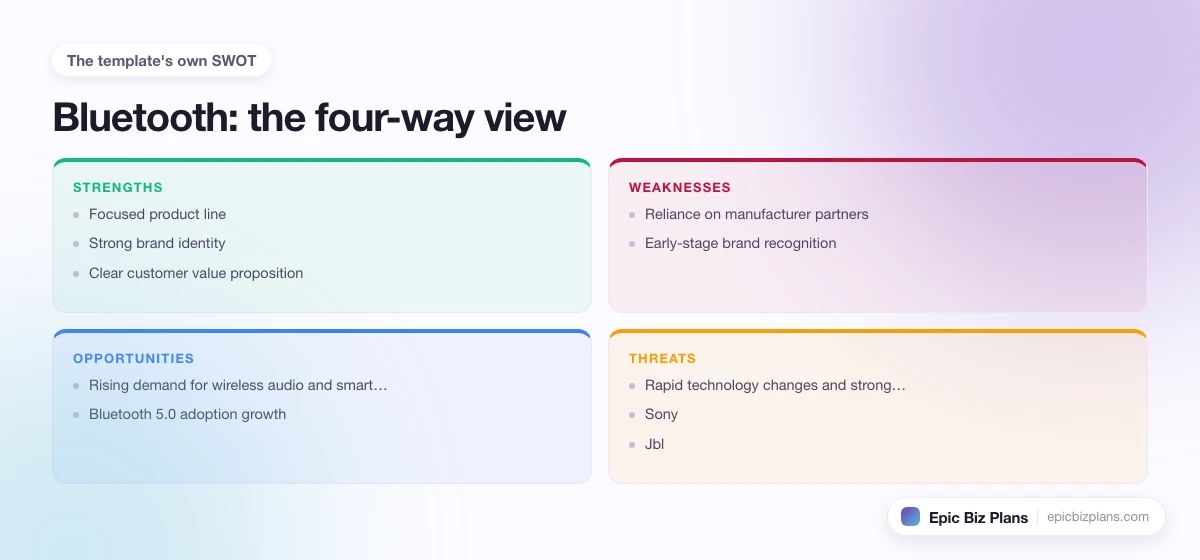
- Strengths: Focused product line, strong brand identity, and clear customer value proposition.
- Weaknesses: Reliance on manufacturer partners, early-stage brand recognition.
- Opportunities: Rising demand for wireless audio and smart home products, Bluetooth 5.0 adoption growth.
- Threats: Rapid technology changes and strong competition from established brands like Bose, Sony, and JBL.
Bluetooth Business Name Ideas
Website
We will build our e-commerce website on Shopify, which handles product management, payment processing, and inventory tracking efficiently. Shopify's app ecosystem also makes it straightforward to add reviews, upsells, and loyalty programs without custom development. Squarespace is an alternative if we prioritize visual presentation over advanced e-commerce features.
Marketing Details
Our marketing plan focuses on three channels: organic search (via Semrush for SEO), email nurturing (via HubSpot), and paid social (TikTok ads targeting 18 to 30-year-olds). We will create content around common wireless connectivity pain points to build organic traffic. TikTok ads will be used for product launches, featuring short demonstrations that highlight ease of use and audio quality.
Industry Trends
The Bluetooth market is benefiting from Bluetooth 5.0 and 5.2 adoption, which offers significantly improved range and data transfer speed. Smart home integration is accelerating, with consumers increasingly expecting their audio and accessory devices to connect reliably with home automation platforms. Wearable technology is another major growth segment: fitness trackers, smartwatches, and health monitors all depend on Bluetooth connectivity, creating ongoing demand for compatible accessories.
Competitor Information
Primary competitors include Bose, Sony, and JBL, which dominate the premium audio space. We will differentiate by targeting mid-range pricing with premium-feeling design, and by building stronger community engagement through social media. Niche markets (such as Bluetooth accessories for gamers or outdoor enthusiasts) represent underserved segments where larger brands lack focused attention. Businesses in related categories like smart home products and consumer gadgets often face the same competitive pressures and should study differentiation strategies closely.
Financial Information
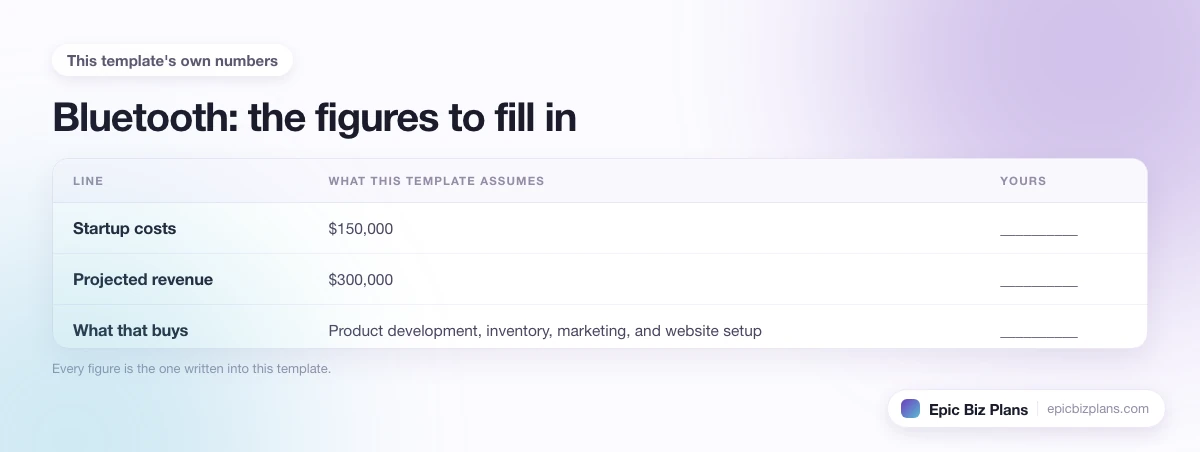
Startup costs are estimated at $150,000, covering product development, inventory, marketing, and website setup. We project first-year revenue of $300,000, with ongoing expenses including manufacturing partnerships, logistics, and marketing running at approximately $180,000. We will monitor cash flow weekly and prepare monthly P&L statements to track margin performance as we scale.
Legal and Compliance
We will register the business and protect our brand through trademark registration. Products will need to meet applicable FCC and CE certification standards for wireless devices before they can be sold in the US and European markets. We will work with a compliance consultant during the product development phase to avoid costly delays.
Operational Plan
Key operations include managing manufacturer relationships, overseeing quality control, and coordinating logistics for both direct-to-consumer and retail fulfillment. We will use a third-party logistics provider for warehousing and shipping to keep overhead low in the early stages. Regular supplier assessments will ensure we maintain product quality as the business scales.
Contingency Planning
Key risks include supply chain disruptions, technology shifts making current products obsolete, and margin pressure from competitive pricing. We will mitigate these by maintaining relationships with multiple manufacturers, investing in R&D to keep our product line current, and building a cash reserve that covers at least three months of operating expenses.
Startup Cost Breakdown
- Product development and prototyping: $40,000 to $60,000
- Initial inventory (first production run): $50,000 to $70,000
- Website and e-commerce setup: $3,000 to $5,000
- Marketing (launch campaign): $15,000 to $25,000
- FCC/CE compliance and testing: $5,000 to $10,000
- Total estimated startup costs: $113,000 to $170,000
Key Success Metrics
- Monthly unit sales growth of 10 to 15% through the first year
- Customer acquisition cost below $25 per order from TikTok and organic channels
- Return rate under 5% (a critical quality indicator in electronics)
- Amazon or Shopify store rating above 4.3 stars within 6 months of launch
- Retail partnership agreements with at least 3 distributors by end of year one
Building a Viable Bluetooth Business
Starting a Bluetooth business is a product-focused venture that demands technical knowledge, strong supply chain management, and precise marketing. The market rewards businesses that are focused, not trying to sell everything to everyone, but serving a specific use case or audience better than anyone else. Your Bluetooth business plan is the document that forces that clarity before you spend a dollar on development.
-
 SemrushSemrush is a platform with literally any online tool you will need to promote your business. Spy on your competitors, get search traffic, keyword research, social info, ad copies and much more. Used by most of the top online companies in the world. Besides all its tools, Semrush also has many available integrations possible with many other tools that will make your work even better.
 -
 Surfer SEOSurfer SEO is an incredibly smart AI tool that will give you exact explanations what to do in order to make your website rank better. They use hundreds of parameters, check your competitors and decide on the best course of action. Whether it be inner links, bold text, paragraphs, headers, images and much more. Surfer is a must-have in 2026.
Types of Opportunities
The Bluetooth market spans audio (headphones, speakers, earbuds), smart home (locks, lighting controllers, sensors), wearables (fitness bands, medical monitors), and automotive accessories. You can also build a service-layer business: Bluetooth consulting for enterprises, or white-label reselling of existing products under your own brand. If you're also building out a tech accessories business or an electronic accessories business, the distribution and retail strategies in your Bluetooth plan will carry over directly.
Adapt and Evolve
Your Bluetooth business plan should be a working document, not a one-time exercise. Update your strategy as Bluetooth standards evolve, as new competitor products enter the market, and as your customer data reveals which features drive retention and repeat purchases. A plan that was accurate at launch may need significant revision six months in.
Practical Use
This plan serves as your roadmap for investor presentations, supplier negotiations, retail partnership pitches, and day-to-day operational decisions. A detailed Bluetooth business plan signals to partners that you understand your market and have a credible path to profitability.
Your Bluetooth business plan is 100% free, with unlimited edits, unlimited downloads, and unlimited chances to get it right. Build something worth connecting to.
