
Blink Business Plan Template
-
 ShopifyPut your brand on Shopify. Launch your online store with tools designed for growth and success. Ready to turn your idea into profit? Start building your e-commerce business today.
 -
 SquarespaceShowcase your brand with Squarespace’s sleek designs. Build a professional online presence with ease. Start with a template that already looks finished.
 -
 WixBring your ideas to life with Wix. Customize every aspect of your site with unmatched flexibility. Start creating your unique online space and let your creativity shine.
 -
 ElementorCraft captivating websites effortlessly with Elementor. Enjoy complete creative control without coding. Make your site stand out to your audience. Start turning your vision into reality now.
- Executive Summary
- Business Info
- SWOT Analysis
- Blink Business Name Ideas
- Website
- Marketing Details
- Industry Trends
- Competitor Information
- Financial Information
- Legal and Compliance
- Operational Plan
- Contingency Planning
- Firmware and Software Update Cadence
- Customer Onboarding and Support
- Build for the Customer You Want to Serve
- Flexibility for Growth
- Practical Applications
- Take the Next Step
A Blink business plan documents how you will build and sell a smart home device line that simplifies daily routines for residential buyers. It records the product range, target customer, pricing, and the channels you intend to use as the brand scales. The plan also names the suppliers, certifications, software stack, and customer support standards that determine whether buyers stay with the brand or churn after the first year. Treat it as a working reference your team returns to when product, pricing, or technical decisions come up.
Smart home buyers care about reliability, ecosystem fit, and clear setup instructions. Your plan should be specific about which standards you support (Matter, Z-Wave, Thread, Wi-Fi), how your devices behave when the network goes down, and how firmware updates are handled. Clear positioning makes everything else easier, from product page copy to retail conversations. Write each section so a buyer, partner, or engineer can understand the brand in a short read-through.
Executive Summary
Our mission is to ship reliable smart home devices that simplify daily life without locking buyers into a single ecosystem. Our vision is to be a trusted brand for buyers who want practical automation that works on day one and keeps working after the first firmware update. Our value proposition centers on hardware quality, open-standard support, and software that is easy to set up and easy to maintain.
We aim to grow revenue 20% annually over the next five years, with the first year focused on three core SKUs and a tight customer support standard. For a deeper look at the category, see our smart home business plan template.
Business Info
We offer smart home devices and the companion software that lets buyers control their home environment from a single app. The initial product line includes a smart hub, a smart sensor pack, and a smart camera, with adjacent SKUs added in year two based on demand. Our target market includes homeowners aged 28 to 55 who value reliability and clear setup over the absolute newest feature.
The business model is direct-to-consumer through our ecommerce site, with selective retail partnerships in year two once core SKUs prove out. Distribution agreements with home builders and integrators give us a parallel revenue stream and a steady source of qualified buyers. For a broader gadget-focused approach, see our smart gadgets business plan template.
SWOT Analysis
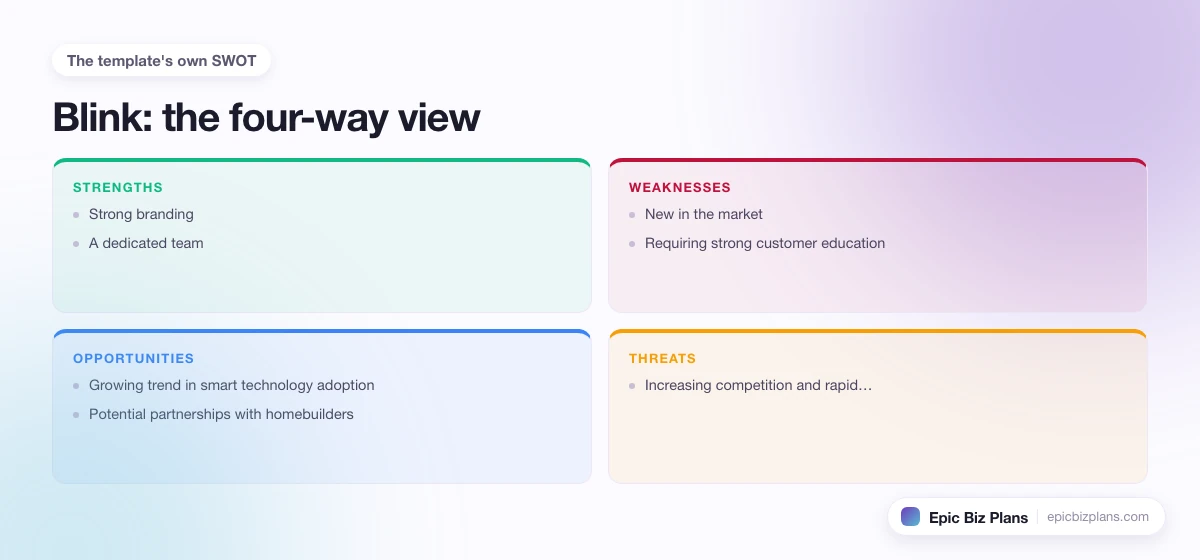
- Strengths: Innovative product design, strong branding, and a dedicated team.
- Weaknesses: New in the market, requiring strong customer education.
- Opportunities: Growing trend in smart technology adoption, potential partnerships with homebuilders.
- Threats: Increasing competition and rapid technological advancements.
Blink Business Name Ideas
Website
We will build our ecommerce site on Shopify because it supports hardware product catalogs, bundle pricing, and multiple payment methods without custom development. Product pages will show specifications, compatibility (Matter, HomeKit, Alexa, Google Home), warranty length, and setup steps in a consistent format so buyers can compare quickly. A separate developer page provides API documentation for integrators. Squarespace remains an option for a content-focused secondary site if we expand into educational material.
Marketing Details
Our marketing plan combines organic search, paid social, email, and reviewer partnerships. We use Semrush for keyword research targeting buying-intent terms ("Matter smart home hub", "wireless door sensor for renters") and HubSpot for email lifecycle campaigns tied to purchase history. Paid ads run on Meta and Google Shopping with targeting tied to specific product use cases rather than generic smart home terms.
Reviewer partnerships matter more than influencer reach in this category, because buyers research devices through long-form video reviews before they purchase. We will send seed units to three to five trusted reviewers per launch and follow up with usage data they can cite. TikTok and Instagram show short setup clips and use cases. For a related electronics-focused angle, see our smart electronics business plan template.
Industry Trends
The smart home category continues to shift toward open standards (Matter, Thread) that work across multiple ecosystems. Buyers expect privacy disclosures, local control options, and clear data retention policies. Voice assistants are now a baseline integration rather than a feature, and battery life is a hard differentiator for sensors and cameras. We will track these shifts each quarter and update product roadmap accordingly.
Competitor Information
Direct competitors include Google Nest, Amazon Echo and Ring, Apple HomeKit accessories, and a set of independent brands focused on specific device categories. Indirect competitors include traditional home appliance manufacturers and DIY automation platforms. We differentiate through reliable hardware, open-standard support, and a customer service team that resolves most issues within one business day. We win on the small details: clear setup, predictable firmware updates, and a return process buyers actually trust.
Financial Information
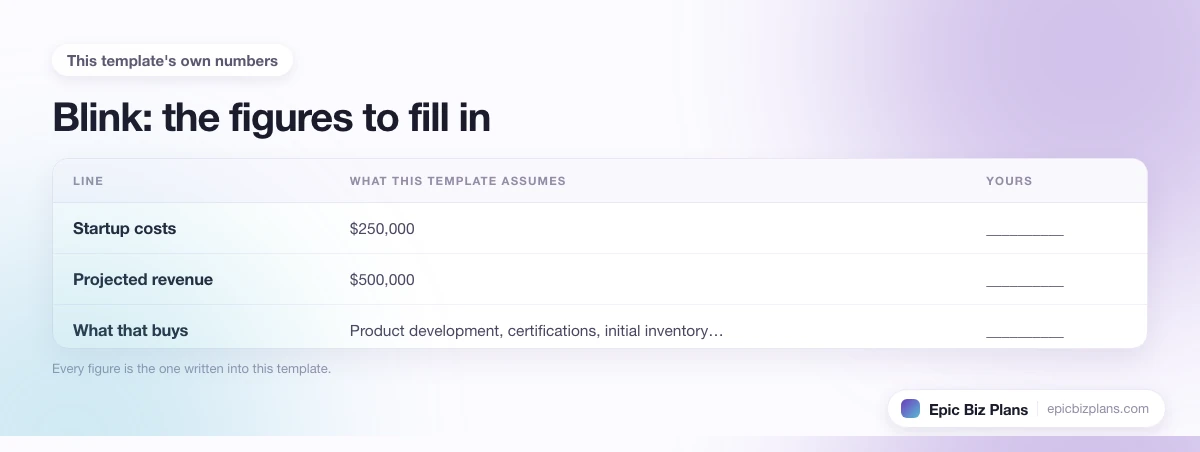
Startup costs are estimated at $250,000, covering product development, certifications, initial inventory, photography, and a launch marketing budget. Year one revenue is forecast at $500,000 with ongoing annual costs near $150,000 for warehousing, salaries, and marketing. Cash flow is reviewed monthly, and a quarterly P&L tracks profitability and informs reorder decisions. Return rate and average revenue per customer are the most important metrics during year one.
Legal and Compliance
We will register the business, file trademarks for the brand and product names, and obtain the certifications required for wireless devices in each market (FCC in the US, CE/UKCA in Europe). Privacy compliance covers GDPR for European buyers and CCPA for California residents, with a clear privacy policy explaining what data is collected, where it is stored, and how long it is kept. Product safety documentation is maintained for every SKU.
Operational Plan
Operations cover product development, contract manufacturing, quality assurance, warehousing, fulfillment, and support. We will qualify two contract manufacturers per core SKU and run incoming quality checks on a random sample of each shipment. Third-party fulfillment handles pick-and-pack once monthly order volume exceeds 500 units. Engineering ships firmware updates on a six-week cycle with security patches released out-of-band when needed.
Contingency Planning
Key risks are component shortages, security incidents in shipping firmware, sudden retail channel changes, and aggressive competitor pricing. We will hold a 90-day cash reserve, qualify backup manufacturers, and document an incident response plan that the team rehearses quarterly. Insurance coverage includes general liability, product liability, and cyber liability, reviewed annually as the customer base grows.
-
 SemrushSemrush is a platform with literally any online tool you will need to promote your business. Spy on your competitors, get search traffic, keyword research, social info, ad copies and much more. Used by most of the top online companies in the world. Besides all its tools, Semrush also has many available integrations possible with many other tools that will make your work even better.
 -
 Surfer SEOSurfer SEO is an incredibly smart AI tool that will give you exact explanations what to do in order to make your website rank better. They use hundreds of parameters, check your competitors and decide on the best course of action. Whether it be inner links, bold text, paragraphs, headers, images and much more. Surfer is a must-have in 2026.
Firmware and Software Update Cadence
Software is part of the product. We will publish a stated firmware update cadence (security patches inside two weeks, feature releases every six weeks) and maintain a public changelog so buyers see the work. Devices ship with a five-year minimum software support commitment, which is highlighted on every product page. This commitment shortens enterprise and integrator sales cycles and reduces churn from buyers who feel abandoned by hardware brands that stop updating.
Customer Onboarding and Support
The first 30 minutes after unboxing determine whether a buyer becomes a happy customer or a return. We will ship every device with a printed quick-start card, an in-app guided setup, and a free 15-minute setup call available within 48 hours of activation. Support runs through a shared inbox and a small phone line during business hours, with a documented playbook for the most common setup issues. Average resolution time and first-contact resolution rate are reviewed weekly.
Build for the Customer You Want to Serve
A Blink business is about more than the devices themselves. It is about the routines, the supplier relationships, and the post-sale support that determine whether buyers stay with you for the next device they need. Whether you build a small accessory line, a complete device ecosystem, or an integrator-focused brand, the smart home category rewards operators who focus on a clear use case. Pick the model you can run consistently for two to three years, not the one with the most ambitious roadmap.
Flexibility for Growth
The plan should grow with the company. As the brand scales, update it to reflect new device lines, revised pricing, new retail partnerships, or new geographic markets. Quarterly reviews keep the plan current and let the team act on what the data is showing. Small, frequent edits beat once-a-year overhauls every time.
Practical Applications
Use the plan for partner conversations, product launch planning, funding rounds, and internal strategy reviews. Each revision is a chance to record what worked and what to drop. Keep the most current version in a shared location so the team references the same numbers and priorities. For broader electronics positioning, our smart home electronics business plan template covers adjacent categories.
Take the Next Step
Your Blink business plan is 100% free, with unlimited edits, unlimited downloads, and unlimited chances to refine it. Begin the process and let the plan grow alongside the business.
