
Bleu Business Plan Template
-
 ShopifyPut your brand on Shopify. Launch your online store with tools designed for growth and success. Ready to turn your idea into profit? Start building your e-commerce business today.
 -
 SquarespaceShowcase your brand with Squarespace’s sleek designs. Build a professional online presence with ease. Start with a template that already looks finished.
 -
 WixBring your ideas to life with Wix. Customize every aspect of your site with unmatched flexibility. Start creating your unique online space and let your creativity shine.
 -
 ElementorCraft captivating websites effortlessly with Elementor. Enjoy complete creative control without coding. Make your site stand out to your audience. Start turning your vision into reality now.
- Executive Summary
- Business Info
- SWOT Analysis
- Bleu Business Name Ideas
- Website
- Marketing Details
- Industry Trends
- Competitor Information
- Financial Information
- Legal and Compliance
- Operational Plan
- Contingency Planning
- Startup Cost Breakdown
- Building Your Future Starts Here
- Embrace Growth and Change
- Put Your Plan to Work for You
A Bleu business plan gives you a working blueprint for launching a brand-driven retail or lifestyle company in a market that rewards distinct identity. Trends shift quickly in fashion-adjacent and consumer goods categories, so your plan needs to spell out who you serve, what you sell, and how your brand will hold its position over time. The sections below cover positioning, product mix, financial targets, and the operational details investors and partners actually ask about.
Every section of your Bleu business plan should reflect real decisions, not generic placeholders. Use it to clarify your pricing model, validate your target customer, map out your first 12 months of cash flow, and pressure-test the assumptions behind your revenue projections. Treat the document as a living tool you revisit each quarter, not a one-time pitch artifact.
Executive Summary
Our mission is to build a brand-led consumer platform that solves specific needs for our customer base while delivering a strong, repeatable product experience. We aim to become a recognized name in our category by focusing on product quality, customer support, and a coherent brand voice across every touchpoint. Our value proposition combines premium-feel design with accessible pricing and a direct relationship with our buyers.
Financially, we target sustainable year-over-year growth of 15% in revenue over the next five years, paired with a gross margin above 50% on our core SKUs. A similar growth model is outlined in our ecommerce business plan template, which covers DTC margin structure in more depth.
Business Info
We will offer a curated product line built around our target market of young professionals and students aged 18 to 34. Our model is direct-to-consumer ecommerce, supplemented by a small number of vetted retail partnerships once brand awareness justifies the expansion. Selling online lets us control the customer experience, capture first-party data, and ship globally without large fixed costs.
SWOT Analysis
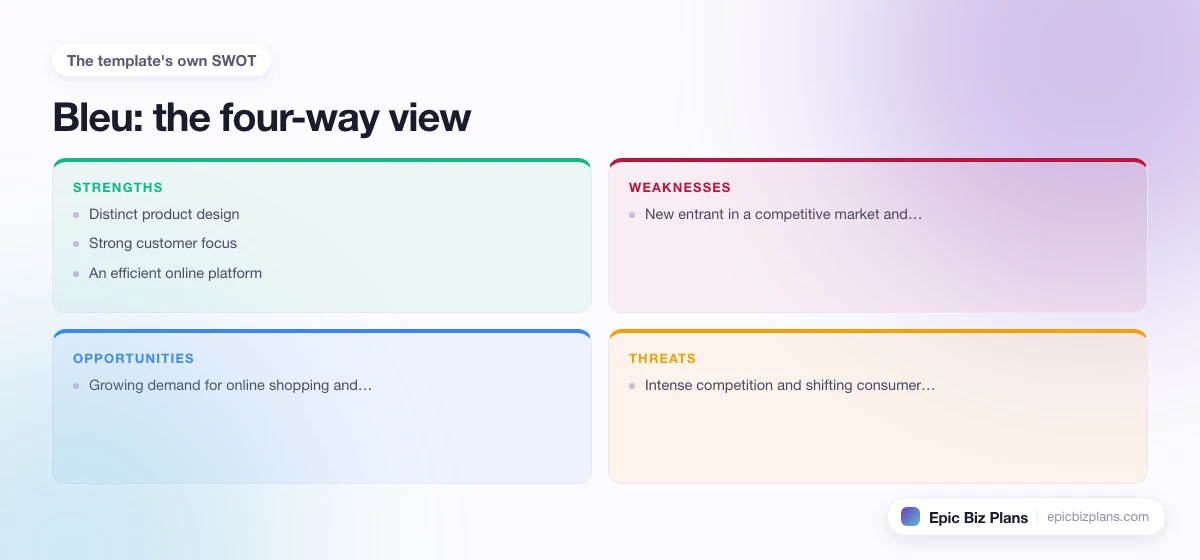
- Strengths: Distinct product design, strong customer focus, and an efficient online platform.
- Weaknesses: New entrant in a competitive market and limited initial brand recognition.
- Opportunities: Growing demand for online shopping and potential for diversification in product offerings.
- Threats: Intense competition and shifting consumer preferences.
Bleu Business Name Ideas
Website
We will build the storefront on Shopify, which gives us the strongest combination of payment processing, inventory tools, and third-party app support for a product-based business. For brand campaigns, lookbooks, and editorial content, we may pair the Shopify store with a Squarespace site that handles design-heavy pages. Our Shopify store business plan template walks through the platform setup decisions in detail.
Marketing Details
Our marketing plan centers on a multi-channel digital approach. We will use Semrush for SEO research and content planning to drive organic traffic to product and category pages. HubSpot will handle email automation, segmenting subscribers by purchase history and engagement so that messaging stays relevant. TikTok and Instagram Reels ads will reach younger buyers with short-form video, while a creator partnership program builds social proof through real product use.
The marketing strategy aligns with the playbook used for fashion and accessories brands, where visual content and user-generated proof drive most early conversions.
Industry Trends
Several trends shape this market right now. Mobile commerce continues to grow as a share of total ecommerce, with younger buyers expecting full checkout flows on phones. Sustainability is moving from a nice-to-have to a baseline expectation, especially for packaging and sourcing. Short-form video drives discovery for new brands, often outperforming static ads. We will track each of these closely and adjust product, packaging, and content decisions based on what shows up in our analytics.
Competitor Information
We will analyze both direct competitors (DTC brands in the same product category) and indirect competitors (larger retailers and marketplaces). Our differentiation strategy rests on three things: tighter product curation, better post-purchase customer service, and a brand voice that feels human rather than corporate. Where larger competitors compete on selection and price, we compete on identity, fit, and quality.
Financial Information
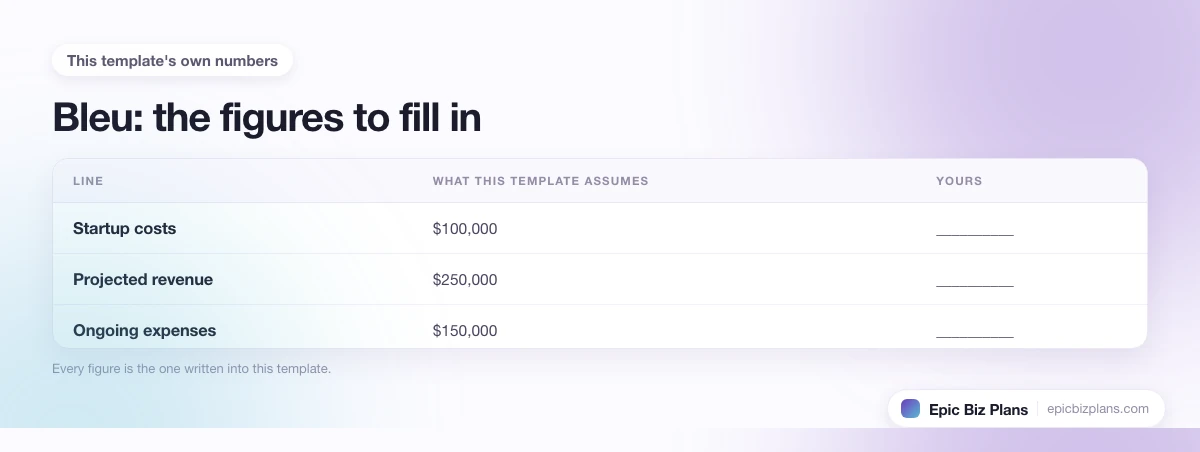
Startup costs are projected at $100,000, covering initial inventory, website build, brand identity, and a three-month marketing budget. Year-one revenue is forecast at $250,000 with operating expenses of $150,000, giving us roughly $100,000 to reinvest into inventory and customer acquisition. We will review the full P&L quarterly and watch cash flow weekly during the first 12 months, since most early-stage retail failures come from inventory-cash mismatches rather than weak demand.
Legal and Compliance
Legal setup includes registering the entity (likely an LLC), securing a federal EIN, and obtaining state and local sales tax permits in jurisdictions where we have nexus. We will register trademarks on the brand name and primary logo from the start, and put written supplier agreements in place for any private-label or co-branded product runs.
Operational Plan
Operations will run on a lean inventory model, with safety stock kept on the top 20% of SKUs that drive most revenue. Fulfillment will start in-house and move to a 3PL once monthly order volume justifies the switch. We will build relationships with at least two suppliers per product category to reduce risk from any single vendor failing on quality or lead time.
Contingency Planning
The main risks are supplier disruptions, sudden shifts in consumer spending, and ad cost inflation on paid social. Mitigation steps include keeping a 60-day cash reserve, diversifying supplier relationships, and building organic acquisition channels (SEO, email, community) so we are not dependent on paid ads alone. We will review the risk register every quarter and update mitigation plans as the business evolves.
Startup Cost Breakdown
Here is how the $100,000 startup budget is allocated for a typical Bleu-branded retail launch:
-
 SemrushSemrush is a platform with literally any online tool you will need to promote your business. Spy on your competitors, get search traffic, keyword research, social info, ad copies and much more. Used by most of the top online companies in the world. Besides all its tools, Semrush also has many available integrations possible with many other tools that will make your work even better.
 -
 Surfer SEOSurfer SEO is an incredibly smart AI tool that will give you exact explanations what to do in order to make your website rank better. They use hundreds of parameters, check your competitors and decide on the best course of action. Whether it be inner links, bold text, paragraphs, headers, images and much more. Surfer is a must-have in 2026.
- Initial inventory: $45,000 (covers the first two production runs across core SKUs)
- Website build and design: $12,000 (Shopify theme customization, photography, copywriting)
- Brand identity and packaging: $8,000 (logo, color system, unboxing experience)
- First-quarter marketing: $20,000 (paid social, influencer seeding, content production)
- Legal, licensing, and trademarks: $3,500
- Software stack (Shopify apps, Semrush, HubSpot, design tools): $4,500 for the first year
- Operating reserve: $7,000 to cover unexpected expenses
Founders building toward a more design-forward identity should also study the trendsetting business plan template, which covers brand positioning for early-mover product launches.
Building Your Future Starts Here
Starting a business is about more than revenue. It is about defining how you want to spend your time, what you want to build, and who you want to build it for. A Bleu business plan turns that vision into a working document with clear targets, timelines, and budgets. Whether you are launching a small online boutique, an artisanal product line, or a content-led brand, the plan gives you something concrete to test against reality.
Embrace Growth and Change
Revisit your Bleu business plan every quarter. Update revenue assumptions based on actual sales, adjust customer acquisition costs based on what your ad accounts report, and refine your product roadmap based on what customers actually buy and return. Keeping the plan accurate keeps it useful, especially during the first 18 months when most of your operating assumptions get rewritten by real data.
Put Your Plan to Work for You
Use your Bleu business plan when pitching investors, applying for small business loans, onboarding new team members, or planning a product launch. A focused, current plan is more useful in those conversations than a polished but stale one, since serious partners want to see how your thinking has changed as you have learned about the market.
This Bleu business plan template is free with unlimited edits and downloads. If you are exploring related directions, the ecommerce retail business plan template covers multi-channel retail in more depth.
