
Black Owned Business Plan Template
-
 ShopifyPut your brand on Shopify. Launch your online store with tools designed for growth and success. Ready to turn your idea into profit? Start building your e-commerce business today.
 -
 SquarespaceShowcase your brand with Squarespace’s sleek designs. Build a professional online presence with ease. Start with a template that already looks finished.
 -
 WixBring your ideas to life with Wix. Customize every aspect of your site with unmatched flexibility. Start creating your unique online space and let your creativity shine.
 -
 ElementorCraft captivating websites effortlessly with Elementor. Enjoy complete creative control without coding. Make your site stand out to your audience. Start turning your vision into reality now.
- Executive Summary
- Business Info
- Products or Services
- Target Market
- Business Model Overview
- SWOT Analysis
- Black Owned Business Name Ideas
- Website
- Marketing Details
- Industry Trends
- Competitor Information
- Financial Information
- Legal and Compliance
- Operational Plan
- Contingency Planning
- Building Something That Lasts
- Adapt and Evolve Your Business Plan
- Practical Use of Your Business Plan
- Your Path Forward
A Black-owned business plan is the foundation for building a company that reflects both your professional goals and your community values. Whether you are entering the food industry, launching a product line, or starting a service-based company, having a written plan gives your business direction from day one. This template covers the key components investors, lenders, and partners expect to see. Adapt it to fit your specific business model and market.
The business plan is not just a formality - it is the tool that forces you to answer hard questions about your target customer, your competitive advantage, and your path to profitability. Black entrepreneurs face a documented funding gap, which makes a well-prepared business plan even more important when approaching banks, community development financial institutions (CDFIs), or grant programs. A clear, specific plan signals credibility and seriousness to anyone reviewing it.
Executive Summary
We will build a business that delivers high-quality products and services to our local community while advancing Black-owned entrepreneurship. Our mission is to create a sustainable operation that supports local economic growth and earns a reputation for authenticity and excellent service. We aim to reach break-even within the first year and grow revenue by at least 25% annually in years two and three.
Our value proposition is straightforward: we offer superior quality, genuine community connection, and a buying experience that larger chain retailers cannot replicate. Customers who choose us do so because the product is better and because they want their money to stay in the community.
Business Info
Products or Services
We will offer a curated range of products and services based on our final industry selection, which may include handmade goods, specialty food products, beauty items, or wellness services. Every offering will be selected based on demonstrated customer demand and alignment with our brand identity.
Target Market
Our primary customers are adults aged 18–45 who prioritize quality, support local businesses, and want their purchases to reflect their values. We will focus on urban and suburban communities with strong cultural identity and a history of supporting independent entrepreneurs. Secondary customers include conscious consumers from outside the community who seek authentic, independently made products.
Business Model Overview
We will use a direct-to-consumer model combining a physical location with an online storefront. This approach builds direct relationships with customers while keeping overhead lower than a traditional retail-only model. Online sales will expand our reach beyond the immediate geographic area.
SWOT Analysis
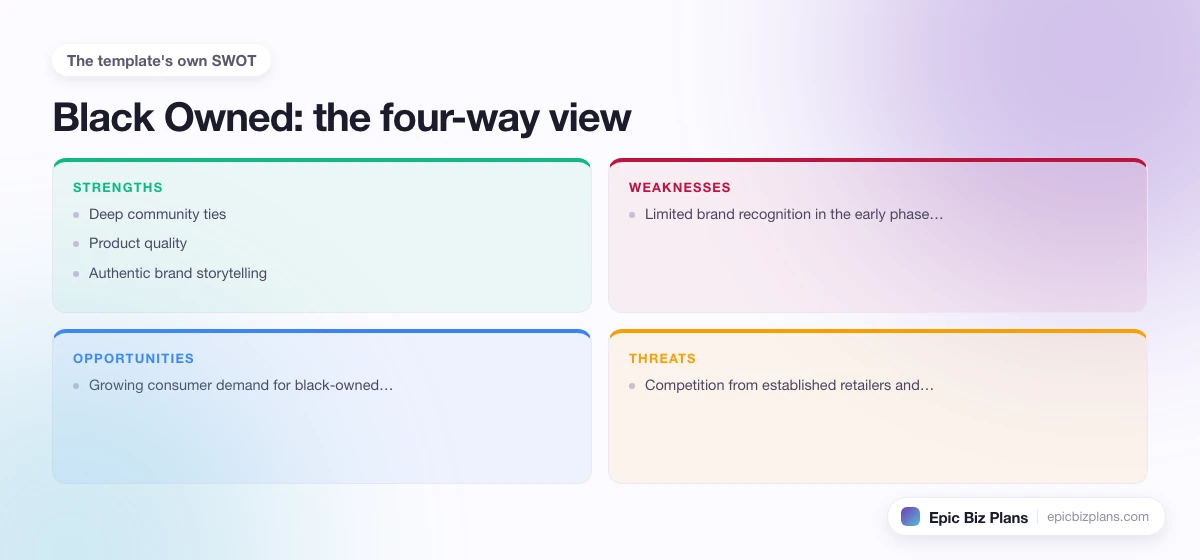
- Strengths: Deep community ties, product quality, and authentic brand storytelling.
- Weaknesses: Limited brand recognition in the early phase and reliance on local foot traffic.
- Opportunities: Growing consumer demand for Black-owned business support and accelerating e-commerce adoption.
- Threats: Competition from established retailers and economic conditions that affect discretionary spending.
Black Owned Business Name Ideas
Website
We will build our online store on Shopify, which provides reliable e-commerce infrastructure, inventory management, and payment processing in one platform. Shopify also supports integration with local delivery services if we offer same-day fulfillment in our area. We will consider Squarespace for a simpler brochure-style site if our business model is primarily service-based rather than product-based.
Marketing Details
Our marketing strategy centers on digital channels that let us reach our target audience cost-effectively. We will use Semrush to identify the search terms our customers use and optimize our website and product listings accordingly. HubSpot will manage email campaigns to keep past customers informed about new products and promotions. TikTok ads will be our primary paid social channel for reaching younger shoppers and building brand awareness through short-form video content.
Black Business Month in August and community events throughout the year will give us additional earned media opportunities. We will prioritize local press coverage and social media partnerships with community influencers who already have our target audience's trust.
Industry Trends
Consumer demand for locally owned businesses and ethically sourced products has grown consistently over the past several years. Buyers are more likely than ever to research ownership before making a purchase, and Black-owned business directories have become a meaningful discovery channel. E-commerce adoption continues to expand, making it practical for a small business to serve customers far beyond its immediate neighborhood. Technology tools for payment, inventory, and customer service have also become more affordable, which levels the playing field against larger competitors.
Competitor Information
Our direct competitors include other local Black-owned businesses selling similar products, as well as large chain retailers with established brand recognition and pricing power. Our strategy is not to compete on price but on quality, story, and customer experience. Personalized service and a genuine connection to the community are advantages that large chains structurally cannot replicate. We will monitor competitors quarterly to identify gaps in their offerings that we can fill.
For founders who want to extend their reach through wholesale or retail partnerships, the wholesale business plan provides a framework for that channel strategy.
Financial Information
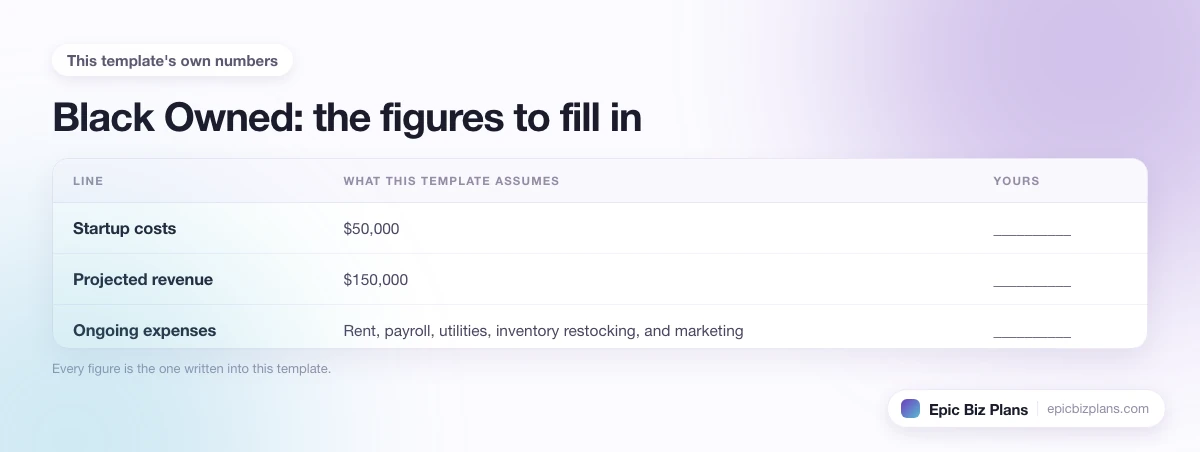
Startup costs are estimated between $50,000 and $100,000, covering inventory, lease deposit, initial marketing, and working capital for the first 90 days. First-year revenue is projected at $150,000, with steady growth as we build brand recognition and expand our online sales. Ongoing expenses include rent, payroll, utilities, inventory restocking, and marketing. We will maintain monthly cash flow statements and a P&L tracker to stay on top of financial performance.
Founders seeking funding should review the small business plan template for guidance on structuring financial projections for lenders and grant applications.
-
 SemrushSemrush is a platform with literally any online tool you will need to promote your business. Spy on your competitors, get search traffic, keyword research, social info, ad copies and much more. Used by most of the top online companies in the world. Besides all its tools, Semrush also has many available integrations possible with many other tools that will make your work even better.
 -
 Surfer SEOSurfer SEO is an incredibly smart AI tool that will give you exact explanations what to do in order to make your website rank better. They use hundreds of parameters, check your competitors and decide on the best course of action. Whether it be inner links, bold text, paragraphs, headers, images and much more. Surfer is a must-have in 2026.
Legal and Compliance
We will register the business under the appropriate structure (LLC or S-Corp), obtain a seller's permit, and secure any industry-specific licenses required for our product category. Trademark filings will protect our business name and logo. We will work with a business attorney to review contracts with suppliers, landlords, and any retail partners before signing.
Operational Plan
Core operations cover product sourcing, inventory management, order fulfillment, and customer service. We will prioritize suppliers who share our commitment to quality and ethical production. Logistics for online orders will be handled through a third-party fulfillment partner to keep shipping times competitive. In-store operations will follow a staffing schedule that provides full coverage during peak hours without overstaffing during slow periods.
Contingency Planning
Supply chain disruptions, slower-than-expected customer acquisition, and economic downturns are the primary risks we have identified. To address supply risk, we will maintain relationships with at least two alternative suppliers for key product lines. We will keep a 90-day operating reserve to handle slow periods without cutting essential spending. If customer acquisition costs exceed projections, we will shift toward lower-cost community marketing channels before scaling paid ads.
Entrepreneurs planning to operate in a specific product vertical may also find value in reviewing the ecommerce retail business plan template for category-specific guidance on merchandising and channel strategy.
Building Something That Lasts
Starting a Black-owned business is one of the most meaningful things you can do for your community and your own future. Every business in this space - from a single-person freelance operation to a multi-location retail brand - contributes to an ecosystem of economic independence that benefits everyone around it. The business types are genuinely wide-ranging: handmade goods, food and beverage, health and wellness, professional services, tech startups, and everything in between. What they share is a commitment to quality and a clear sense of purpose.
Adapt and Evolve Your Business Plan
Your business plan is a working document, not a one-time submission. As your customer base grows and your understanding of the market deepens, you will find things to update - new pricing strategies, product extensions, or sales channels you had not considered at launch. Make a habit of reviewing the plan quarterly and updating it to reflect what you have actually learned. A plan that stays current is far more useful than one filed away after the initial writing.
Practical Use of Your Business Plan
This plan serves multiple practical functions beyond securing funding. Use it to onboard a co-founder, set expectations with an early-stage team, or evaluate a new business opportunity against your stated strategy. Presenting a clear, well-organized plan to potential partners signals professionalism and preparedness. It also gives you a reference point when you need to make a difficult decision and want to check it against your original goals.
Your Path Forward
Your Black Owned business plan is 100% free - with unlimited edits, unlimited downloads, and unlimited chances to get it right. Take the first step with confidence and use this plan to build something you are genuinely proud of.
