
Bird House Business Plan Template
-
 ShopifyPut your brand on Shopify. Launch your online store with tools designed for growth and success. Ready to turn your idea into profit? Start building your e-commerce business today.
 -
 SquarespaceShowcase your brand with Squarespace’s sleek designs. Build a professional online presence with ease. Start with a template that already looks finished.
 -
 WixBring your ideas to life with Wix. Customize every aspect of your site with unmatched flexibility. Start creating your unique online space and let your creativity shine.
 -
 ElementorCraft captivating websites effortlessly with Elementor. Enjoy complete creative control without coding. Make your site stand out to your audience. Start turning your vision into reality now.
- Executive Summary
- Business Info
- Products and Services
- Target Market
- Business Model Overview
- SWOT Analysis
- Bird House Business Name Ideas
- Website
- Marketing Details
- SEO and Content Calendar
- Industry Trends
- Competitor Information
- Financial Information
- Legal and Compliance
- Operational Plan
- Production Capacity and Quality Control
- Contingency Planning
- Shipping and Fulfillment
- Customer Service and Returns
- Year-Two Growth Plan
- The Freedom to Build Your Dream
- Evolving Your Business Plan
- Practical Uses of Your Business Plan
- The Path Awaits
A Bird House business plan gives you a clear path from rough idea to a working operation that ships orders and pays its bills. Backyard birding has grown alongside gardening as a hobby, and shoppers want feeders and houses that look good on the porch and actually shelter the species in their region. Your plan should describe what you sell, who buys it, what it costs to produce, and how you reach the right customers.
A strong plan also keeps you honest about the tradeoffs of a craft-driven product line. Handmade cedar boxes take time, paint and finishes wear out in the rain, and shipping a wooden box across the country is expensive. The sections below walk through the operational, marketing, and financial choices that turn a hobby workshop into a real birdhouse company.
Executive Summary
Our mission is to build high-quality, handcrafted birdhouses that give cavity-nesting birds a safe place to raise broods while adding character to backyards, gardens, and patios. We aim to be a recognized name in the handmade birdhouse category by combining careful joinery, weather-tested materials, and species-correct entrance hole sizes. Our value proposition is simple: a birdhouse that lasts five to ten seasons outdoors, looks like a piece of yard art, and is sized for the birds that actually live in the customer's area. We project profitability inside the first 12 months and target 20% annual revenue growth across the first five years.
Business Info
Products and Services
We will sell three product lines: decorative cottage-style birdhouses for porches and gardens, functional nesting boxes built to NestWatch dimensions for bluebirds, chickadees, wrens, and purple martins, and made-to-order custom houses for customers who want a specific finish, size, or mounting style. Each box ships with a small care card explaining cleaning, mounting height, and the species it best serves. We will also publish short guides on our blog covering predator guards, drainage, and the right time of year to put a new house up.
Target Market
Our buyers are bird enthusiasts, home gardeners, suburban homeowners, and gift shoppers, mostly aged 35 to 70, who are willing to pay $40 to $120 for a piece they will keep outside for years. Geographically, we focus on the eastern and midwestern US first, where bluebird and chickadee interest is strongest, then expand to Pacific Northwest and Texas markets in year two. Secondary buyers include landscape designers and small garden centers that want a handful of houses to resell.
Business Model Overview
We operate primarily as a direct-to-consumer e-commerce brand, with a secondary wholesale channel into independent garden centers and gift shops. Local craft fairs and fall garden festivals serve as both a sales channel and a way to test new designs in front of real customers. The direct channel keeps margins healthy and gives us first-party data on which species and finishes are selling.
SWOT Analysis
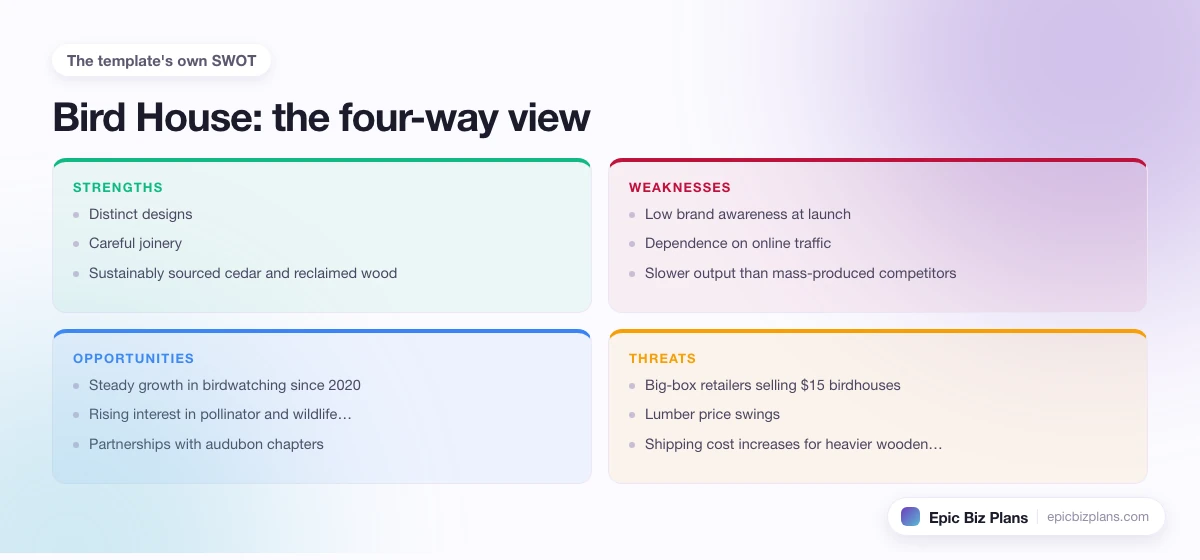
- Strengths: Distinct designs, careful joinery, sustainably sourced cedar and reclaimed wood, and species-correct construction.
- Weaknesses: Low brand awareness at launch, dependence on online traffic, slower output than mass-produced competitors.
- Opportunities: Steady growth in birdwatching since 2020, rising interest in pollinator and wildlife gardens, partnerships with Audubon chapters.
- Threats: Big-box retailers selling $15 birdhouses, lumber price swings, and shipping cost increases for heavier wooden items.
Bird House Business Name Ideas
Website
We will build the storefront on Shopify because product variants, shipping rules, and inventory are easy to manage for a maker selling 30 to 50 SKUs. Shopify's app ecosystem covers reviews, abandoned-cart email, and Instagram product tagging without custom development. If we later add a heavier portfolio of installation photography and design content, a Squarespace marketing site backed by a Shopify checkout is a reasonable second-phase setup. Many of the patterns covered in our handcrafted business plan template apply directly to a maker-led store like ours.
Marketing Details
The marketing plan runs on three channels: organic search, email, and short-form video. We use Semrush to find low-competition queries like "bluebird house plans" or "best birdhouse for chickadees" and build long-form content around each one. HubSpot handles a monthly newsletter with seasonal tips, new product drops, and a small evergreen welcome sequence for first-time subscribers. TikTok and Instagram Reels show the build process, finishes, and birds actually using the houses, which is the single best content type we produce. Outdoor and garden brands also appear in our garden center business plan template, which covers nursery-style retail in more detail.
SEO and Content Calendar
We publish two blog posts per month: one species-focused guide (for example, "How to attract Eastern Bluebirds") and one product-led post (for example, "Choosing a cedar vs. pine birdhouse"). Each post links to relevant product pages and to other guides on the site, building topical authority around backyard birds. Email subscribers get a one-page PDF on cleaning and seasonal maintenance as a sign-up incentive.
Industry Trends
Backyard bird products grew steadily through the early 2020s, with seed and feeder sales at all-time highs and renewed interest in wildlife-friendly yards. Buyers increasingly ask about FSC-certified wood, lead-free finishes, and predator guards, which favors small makers who can answer those questions. Smart birdhouse cameras are a small but growing premium niche worth watching as a possible add-on product. The broader push toward sustainable yard goods is well covered in our green and eco business plan template.
Competitor Information
Our competitors fall into three groups: mass-produced houses sold at hardware stores and big-box garden centers, Etsy makers selling one-off decorative pieces, and a handful of established brands like Nature's Way and Woodlink. Mass-produced houses win on price but use thin pine and one-size-fits-all entrance holes that exclude many target species. Etsy sellers compete on design but rarely build to species-correct dimensions. We position between the two: better-built and more species-aware than the cheap retail boxes, more consistent and brand-driven than a single-maker Etsy shop. The same retail-vs-handmade tension shows up in our woodwork business plan template.
Financial Information
Startup costs cover lumber inventory, a small CNC router or upgraded miter saw, finishing supplies, packaging, photography, the Shopify subscription, and a $3,000 marketing reserve, totaling roughly $15,000. We project year-one revenue of about $50,000 from 700 to 900 units sold across the direct and wholesale channels. Recurring costs (materials, labor, fulfillment, marketing, software) run about $30,000 per year at this volume.
We track gross margin per SKU monthly because finishes and species-specific extras (predator guards, copper roofs) change the cost picture quickly. A simple profit-and-loss spreadsheet, plus a 13-week cash-flow rolling forecast, keep us out of trouble during slow winter months. The financial discipline section in our handmade home decor business plan template goes deeper on costing for low-volume craft products. For a related angle, see our house building template.
Legal and Compliance
We register as an LLC in our home state, collect sales tax through Shopify's automated rules, and carry a basic product liability policy through a small-business insurer. For our designs, we file copyright on original cottage and silo patterns and register the wordmark trademark for the brand once we hit a steady sales rhythm. Wholesale orders to garden centers require a resale certificate on file with us before shipping.
Operational Plan
Production happens in a 400-square-foot home workshop with two work zones: cutting and assembly, then finishing and packing. We batch-cut parts for ten houses at a time to keep machine setup low and assemble in two-day runs. Cedar is sourced from a regional mill that supplies kiln-dried 1x6 and 1x8 stock, with reclaimed barn wood for our rustic line ordered as available. Finished goods ship within three business days through USPS Priority Mail using right-sized boxes and recycled paper void fill.
-
 SemrushSemrush is a platform with literally any online tool you will need to promote your business. Spy on your competitors, get search traffic, keyword research, social info, ad copies and much more. Used by most of the top online companies in the world. Besides all its tools, Semrush also has many available integrations possible with many other tools that will make your work even better.
 -
 Surfer SEOSurfer SEO is an incredibly smart AI tool that will give you exact explanations what to do in order to make your website rank better. They use hundreds of parameters, check your competitors and decide on the best course of action. Whether it be inner links, bold text, paragraphs, headers, images and much more. Surfer is a must-have in 2026.
Production Capacity and Quality Control
At full pace, the workshop produces about 80 standard houses and 15 custom pieces per month. Every finished house gets a three-point check: drainage holes drilled, entrance hole gauge confirmed for the listed species, and roof seams sealed. Reject rate stays under 3% with this routine, and rejected pieces are repurposed as workshop signage or local-fair giveaways.
Contingency Planning
The biggest risks are lumber price spikes, a slow holiday season, and a single-supplier outage on cedar stock. We hedge by holding a four-week lumber buffer, keeping a pricing model that lets us pass through cost increases above 10%, and pre-qualifying a second mill in a neighboring state. A weak Q4 is offset by leaning into Mother's Day and spring garden festivals as our second selling peak.
Shipping and Fulfillment
Wooden birdhouses are bulky relative to their value, so shipping is one of the largest controllable costs. We negotiate a Pirate Ship discount on USPS rates, build flat-pack versions of two best-selling designs to drop dimensional weight, and offer free local pickup within 25 miles of the workshop. International shipping is offered to Canada only at launch, with quoted rates rather than flat shipping.
Customer Service and Returns
Customers email through a single support address that the owner handles personally for the first year. The return policy is 30 days for unused product, with a one-season replacement promise for any joinery failure not caused by impact. Reviews are requested by automated email 21 days after delivery, which gives the buyer time to mount the house and hopefully see a bird use it.
Year-Two Growth Plan
Once year-one targets are met, we add three growth moves: a small wholesale catalog targeting 25 independent garden centers, a licensed-design partnership with a regional Audubon chapter, and a workshop-class offering where local hobbyists pay to build their own house in our shop. Each one is a margin-positive add that uses existing tooling and brand audience without forcing a hire.
The Freedom to Build Your Dream
Starting a birdhouse business is not just a financial move; it is a way to spend your working hours on something tangible, useful, and quietly tied to nature. Whether the goal is a small local maker brand, a steady online shop, or a community of birding hobbyists, the path is wide open. Look at brands like Nature's Way for retail-channel scale, or single-maker Etsy shops for tight design focus, and pick the model that fits the life you want.
Evolving Your Business Plan
Your business plan should change as you learn. Revisit it every six months to update pricing, drop slow products, expand into new regions, or shift the mix between direct and wholesale. A plan that gets revised is a plan that gets used.
Practical Uses of Your Business Plan
Your plan does real work beyond paperwork. Use it to apply for a small-business loan or microgrant, to onboard a part-time helper in the workshop, and to walk a wholesale buyer through why your houses cost more than the import on the next shelf. A clear plan turns conversations that would take an hour into ones that take ten minutes.
The Path Awaits
Your Bird House business plan is 100% free, with unlimited edits, unlimited downloads, and unlimited chances to get it right. Start your plan today and put your first run of houses on a porch this season.
