
Birch Business Plan Template
-
 ShopifyPut your brand on Shopify. Launch your online store with tools designed for growth and success. Ready to turn your idea into profit? Start building your e-commerce business today.
 -
 SquarespaceShowcase your brand with Squarespace’s sleek designs. Build a professional online presence with ease. Start with a template that already looks finished.
 -
 WixBring your ideas to life with Wix. Customize every aspect of your site with unmatched flexibility. Start creating your unique online space and let your creativity shine.
 -
 ElementorCraft captivating websites effortlessly with Elementor. Enjoy complete creative control without coding. Make your site stand out to your audience. Start turning your vision into reality now.
- Executive Summary
- Business Info
- Business Model Overview
- SWOT Analysis
- Birch Business Name Ideas
- Website
- Marketing Details
- Industry Trends
- Competitor Information
- Product Sourcing and Material Standards
- Financial Information
- Legal and Compliance
- Operational Plan
- Contingency Planning
- Start Your Birch Business
- Adapt and Evolve
- Make Your Plan Work
A Birch business plan provides the structure for launching a brand inspired by natural materials, sustainable products, or artisan craftsmanship. Birch - as both a material and a brand concept - connects with consumers who value simplicity, natural aesthetics, and environmentally responsible choices. This template covers product planning, market analysis, financial projections, and operational logistics so you can turn that concept into a functioning business.
Your Birch business plan should define what your brand stands for and how it will translate into products or services that customers actually want to buy. Whether you are building a line of birch-wood home goods, curating an eco-friendly product collection, or creating a lifestyle brand around natural living, the plan needs to answer fundamental questions about your market, your margins, and your path to profitability.
Executive Summary
Birch will offer high-quality, eco-friendly products that improve daily life while reflecting a commitment to sustainability. Our goal is to become a recognized name in the sustainable products space by delivering well-designed items that customers are proud to use and recommend. We target first-year revenue of $500,000 and a profit margin of at least 20%, built on a product line that balances environmental responsibility with practical value.
Business Info
We specialize in sustainable household products, including reusable bags, eco-friendly home goods, and zero-waste personal care items. Our target market is environmentally conscious consumers aged 25-45 who are willing to pay a reasonable premium for products that align with their values. Entrepreneurs focused on handmade products may also find our handcrafted business plan template useful for planning artisan-focused ventures.
Business Model Overview
We will operate primarily through ecommerce, selling directly to consumers through our own online store. This model keeps overhead manageable while allowing us to build a direct relationship with our customer base. Wholesale partnerships with boutique retailers will serve as a secondary revenue channel.
SWOT Analysis
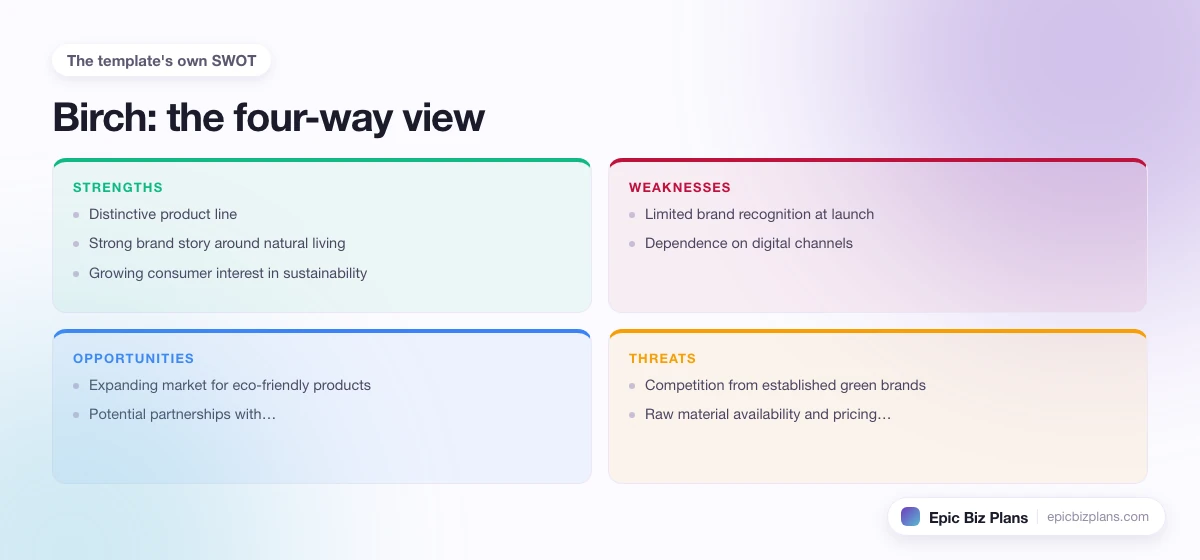
- Strengths: Distinctive product line, strong brand story around natural living, growing consumer interest in sustainability.
- Weaknesses: Limited brand recognition at launch, dependence on digital channels.
- Opportunities: Expanding market for eco-friendly products, potential partnerships with sustainability-focused retailers.
- Threats: Competition from established green brands, raw material availability and pricing fluctuations.
Birch Business Name Ideas
Website
We will build our ecommerce store on Shopify, which provides the product management, payment processing, and shipping integration tools we need to launch efficiently. The platform scales well as order volume grows and supports the visual product presentation that eco-conscious buyers expect when shopping online.
Marketing Details
Our marketing strategy combines SEO-driven content with targeted social media advertising. Semrush will guide our keyword research and competitive analysis. HubSpot will manage email campaigns for product launches, seasonal promotions, and customer retention sequences. TikTok ads will reach younger audiences through short-form video content showcasing our products in everyday use. Brands building around home goods will find similar marketing channels effective for reaching design-conscious buyers.
Industry Trends
Demand for sustainable consumer products continues to grow as environmental awareness becomes a mainstream purchasing factor. Biodegradable packaging and zero-waste product design are no longer niche - they are expected by an increasing share of consumers. Subscription models for household essentials are gaining traction and offer a path to predictable recurring revenue. Birch-wood and natural material products specifically have seen increased interest as consumers move away from plastic alternatives.
Competitor Information
Direct competitors include established eco-friendly brands with strong online presences and retail distribution. We will differentiate through product design that prioritizes both function and aesthetics, transparent sourcing documentation, and a brand voice that feels approachable rather than preachy. Building genuine community through content and customer stories will create loyalty that price-based competitors cannot match.
Product Sourcing and Material Standards
Every product in our catalog will meet documented sustainability standards for materials, manufacturing processes, and packaging. We will work with suppliers who hold recognized environmental certifications and can provide chain-of-custody documentation for natural materials. For birch-wood products specifically, we will source from sustainably managed forests with FSC or equivalent certification. Regular supplier audits will ensure ongoing compliance. Businesses focused on woodwork products will face similar sourcing and certification requirements.
Financial Information
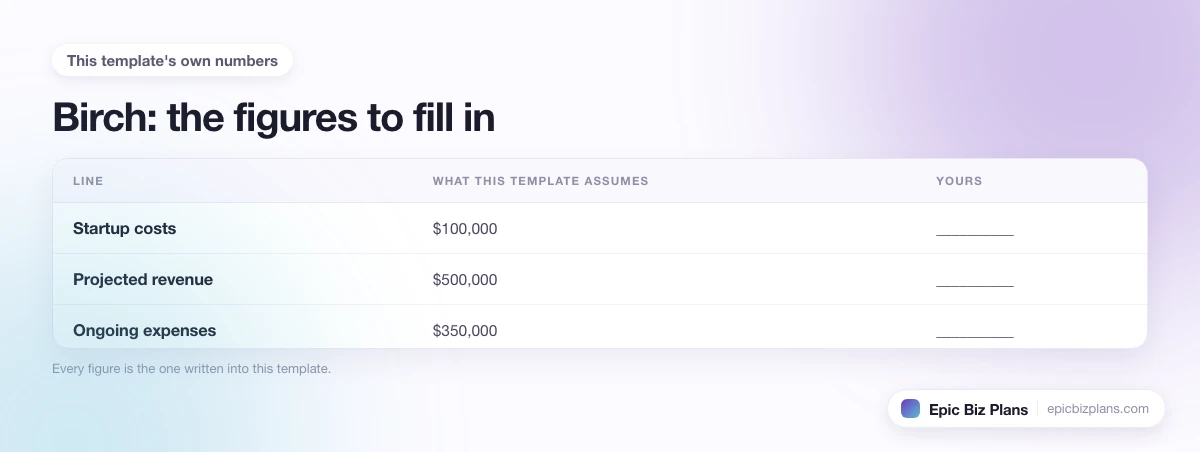
Startup costs are estimated at $100,000, covering product development, website build, initial inventory, and launch marketing. First-year revenue is projected at $500,000 with ongoing expenses of approximately $350,000 including production, marketing, and operations. Monthly cash flow monitoring and quarterly P&L reviews will guide financial decisions and ensure we maintain healthy margins as we scale.
Legal and Compliance
We will register the business, obtain all required licenses, and pursue trademark protection for our brand name and product designs. Any environmental or sustainability claims will be verified against applicable standards to ensure accuracy. Product safety testing will be completed for all items before they are listed for sale.
Operational Plan
Core operations include material sourcing, product manufacturing coordination, quality control, and order fulfillment. We will establish partnerships with at least three reliable suppliers to maintain flexibility and reduce supply chain risk. Our logistics strategy will prioritize carbon-neutral shipping options and minimal packaging waste. If your product line includes furniture or larger items, our furniture assembly business plan covers the additional logistics considerations for bulkier products.
Contingency Planning
Supply chain disruptions and material cost increases are the primary risks. We will diversify our supplier base, maintain safety stock of best-selling items, and keep a three-month operating expense reserve. Quarterly market reviews will identify emerging trends and potential threats early enough to adjust our product roadmap and pricing accordingly.
Start Your Birch Business
A Birch business plan gives you the framework to build a brand rooted in natural materials, sustainable practices, and thoughtful design. Whether you are creating artisan birch-wood furniture, curating a collection of eco-friendly household products, or building a lifestyle brand around conscious living, this plan keeps your strategy organized and your goals measurable.
-
 SemrushSemrush is a platform with literally any online tool you will need to promote your business. Spy on your competitors, get search traffic, keyword research, social info, ad copies and much more. Used by most of the top online companies in the world. Besides all its tools, Semrush also has many available integrations possible with many other tools that will make your work even better.
 -
 Surfer SEOSurfer SEO is an incredibly smart AI tool that will give you exact explanations what to do in order to make your website rank better. They use hundreds of parameters, check your competitors and decide on the best course of action. Whether it be inner links, bold text, paragraphs, headers, images and much more. Surfer is a must-have in 2026.
Adapt and Evolve
Update your Birch business plan as you learn from your customers, test new product categories, and explore additional sales channels. A plan that reflects your current market reality is far more valuable than one that stays unchanged. Revisit it quarterly and adjust based on actual performance data.
Make Your Plan Work
Use your Birch business plan to present to potential partners, outline your product roadmap, secure funding, or align your team on priorities for the coming quarter. A well-maintained plan makes every business decision more informed and every conversation more productive.
Your Birch business plan is 100% free - with unlimited edits, unlimited downloads, and unlimited chances to get it right.
