
Biometrics Business Plan Template
-
 ShopifyPut your brand on Shopify. Launch your online store with tools designed for growth and success. Ready to turn your idea into profit? Start building your e-commerce business today.
 -
 SquarespaceShowcase your brand with Squarespace’s sleek designs. Build a professional online presence with ease. Start with a template that already looks finished.
 -
 WixBring your ideas to life with Wix. Customize every aspect of your site with unmatched flexibility. Start creating your unique online space and let your creativity shine.
 -
 ElementorCraft captivating websites effortlessly with Elementor. Enjoy complete creative control without coding. Make your site stand out to your audience. Start turning your vision into reality now.
- Executive Summary
- Business Info
- Business Model Overview
- SWOT Analysis
- Biometrics Business Name Ideas
- Website
- Marketing Details
- Industry Trends
- Competitor Information
- Financial Information
- Key Metrics to Track
- Legal and Compliance
- Operational Plan
- Contingency Planning
- Why Start a Biometrics Business?
- Exploring Business Models in Biometrics
- Adapting Your Biometrics Business Plan
- Practical Uses for Your Business Plan
- Embrace the Future
A biometrics business plan maps how you will sell identity verification and security technology to clients who need it. The market spans fingerprint, facial, and iris recognition used in finance, healthcare, government, and access control. Buyers in this space care about accuracy, data privacy, and compliance, so your plan has to address all three. This template gives you the structure to define your products, pricing, and go-to-market approach.
Treat the plan as a tool you will revise as the technology and regulations change. Spell out whether you sell hardware, license software, or offer ongoing support, since each model has a different cost and sales cycle. Privacy law is central here, so build compliance into the plan rather than bolting it on later. Related security models like the security solutions business plan template and the IT security business plan template can help you frame adjacent offerings.
Executive Summary
We will establish a biometrics company focused on identity verification and security technology. Our mission is to deliver modern biometric technologies, including fingerprint recognition, facial recognition, and iris scanning, to various industries, such as finance, healthcare, and security services. We will strive to enhance user experience while ensuring strong security and privacy.
Our vision is to become a leader in the biometrics sector by using advanced technology and customer-centered services. Our financial goals include achieving profitability within the first three years while maintaining a steady growth rate of 15% annually.
Business Info
We will offer a range of biometric products and services, including hardware devices and software solutions for identity verification. Our target market includes corporations, government agencies, and various industries requiring secure access control systems.
Business Model Overview
We will operate on a B2B model, delivering biometric solutions tailored to meet the specific needs of our clients. Our revenue streams will include sales of biometric devices, licensing of our software, and ongoing maintenance and support services.
SWOT Analysis
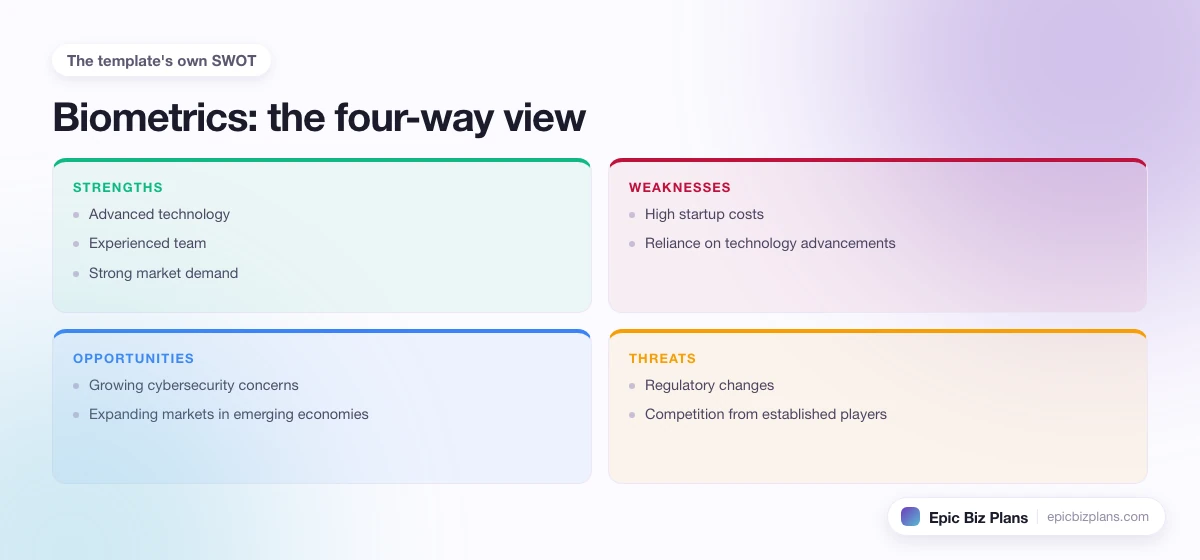
- Strengths: Advanced technology, experienced team, strong market demand.
- Weaknesses: High startup costs, reliance on technology advancements.
- Opportunities: Growing cybersecurity concerns, expanding markets in emerging economies.
- Threats: Regulatory changes, competition from established players.
Biometrics Business Name Ideas
Website
We will build our website using Shopify or Squarespace as we will be offering both products and strong online services. These platforms will enable us to create an efficient eCommerce experience, ensuring smooth transactions and customer engagement. Additionally, we will improve our website for mobile use to enhance accessibility.
Marketing Details
Our marketing strategy will focus on a blend of digital marketing and social media outreach. We will use Semrush for SEO to improve our online visibility and HubSpot for email campaigns to nurture leads and maintain customer relationships. Furthermore, we will use TikTok ads to target younger demographics, enhancing our brand awareness and engagement in a competitive market.
Industry Trends
The biometrics industry is witnessing rapid growth, driven by technological advancements and increased emphasis on security. Trends include the use of artificial intelligence for higher accuracy, the rise of mobile biometric solutions, and a growing focus on user privacy. Companies adding machine-learning features can study the AI business plan template, while those facing data-protection demands can review the cybersecurity consulting business plan template. We will keep monitoring these trends and adapt our offerings accordingly.
Competitor Information
We will analyze both main and indirect competitors to identify market gaps and opportunities for differentiation. Our main competitors will include established companies in the biometrics space that emphasize security and reliability. We will differentiate ourselves by offering superior customer service, tailored solutions, and competitive pricing structures that cater to the specific needs of various industries.
Financial Information
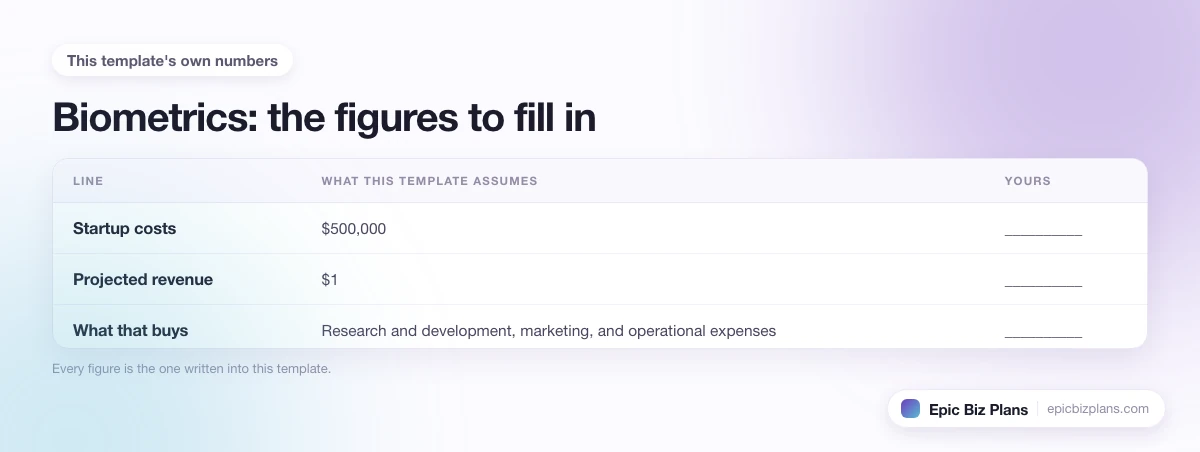
Our startup costs are estimated at $500,000, which will cover research and development, marketing, and operational expenses. We project revenue of $1 million in the first year, with an expected annual growth of 15%. Ongoing expenses will be closely monitored to maintain a healthy cash flow, with detailed P&L statements prepared quarterly.
Key Metrics to Track
A B2B biometrics company lives on a few core numbers, so track them from day one. Customer acquisition cost and average contract value show whether your sales effort pays off, while net revenue retention shows if clients renew and expand. Gross margin on hardware versus software tells you where the real profit sits. False acceptance and false rejection rates matter too, since accuracy directly affects client trust and renewals.
Legal and Compliance
We will ensure compliance with all legal requirements, including business registration, intellectual property protection, and data privacy regulations. We will consult legal professionals to handle the complexities of the biometric industry and secure necessary certifications for our products.
Operational Plan
Our key operations will include product development, customer service, and sales. We will establish partnerships with suppliers for hardware components and employ a skilled team for software development. Logistics will be optimized to ensure timely delivery of products and services to our clients.
Contingency Planning
We will identify potential risks, including technological disruptions and market volatility, and develop strategies to mitigate these risks. This includes diversifying our product offerings, maintaining a cash reserve for unforeseen challenges, and continuously assessing market conditions to adapt our business strategies accordingly.
-
 SemrushSemrush is a platform with literally any online tool you will need to promote your business. Spy on your competitors, get search traffic, keyword research, social info, ad copies and much more. Used by most of the top online companies in the world. Besides all its tools, Semrush also has many available integrations possible with many other tools that will make your work even better.
 -
 Surfer SEOSurfer SEO is an incredibly smart AI tool that will give you exact explanations what to do in order to make your website rank better. They use hundreds of parameters, check your competitors and decide on the best course of action. Whether it be inner links, bold text, paragraphs, headers, images and much more. Surfer is a must-have in 2026.
Why Start a Biometrics Business?
Demand for secure identity verification keeps rising as more services move online. A biometrics business lets you sell into finance, healthcare, government, and access control, all of which need reliable authentication. The work is technical and regulated, but the contracts tend to be large and recurring. That mix of steady demand and high contract value is what makes the sector worth entering.
Exploring Business Models in Biometrics
There are several ways to enter the biometrics market. You might build hardware, license recognition software, or run a consulting practice that helps clients deploy and secure biometric systems. Some firms sell directly to enterprises, others partner with integrators who bundle biometrics into larger security systems. Pick the model that matches your technical strength and your capital, then size the plan around it. A consulting-led approach pairs well with the software consulting business plan template.
Adapting Your Biometrics Business Plan
As you progress, remember that your biometrics business plan should evolve, too. Adjust it to fit different audiences, pricing strategies, regions, or sales channels. Continuous updates will ensure it remains relevant and effective in meeting your growing ambitions.
Practical Uses for Your Business Plan
Use this biometrics business plan to present to partners, plan your launch, apply for funding, or clarify your strategy. Investors in deep-tech expect detail on accuracy, privacy, and compliance, so make those sections strong. The clearer the plan, the easier those conversations become.
Embrace the Future
This biometrics business plan is free to use, with unlimited edits and downloads. Start with the executive summary, then work through your product, compliance, and financial sections in order.
