
Biogas Business Plan Template
-
 ShopifyPut your brand on Shopify. Launch your online store with tools designed for growth and success. Ready to turn your idea into profit? Start building your e-commerce business today.
 -
 SquarespaceShowcase your brand with Squarespace’s sleek designs. Build a professional online presence with ease. Start with a template that already looks finished.
 -
 WixBring your ideas to life with Wix. Customize every aspect of your site with unmatched flexibility. Start creating your unique online space and let your creativity shine.
 -
 ElementorCraft captivating websites effortlessly with Elementor. Enjoy complete creative control without coding. Make your site stand out to your audience. Start turning your vision into reality now.
Biogas production converts organic waste - agricultural byproducts, food scraps, and energy crops - into a usable renewable energy source through anaerobic digestion. It is one of the few energy businesses that simultaneously addresses waste management and clean energy generation, which makes it attractive to both public sector partners and private investors. A well-structured biogas business plan helps you navigate the capital requirements, regulatory landscape, and partnership development that define success in this space.
This biogas business plan covers the core components of a viable operation: from sourcing organic feedstock and establishing processing facilities to marketing your energy output and managing compliance. Whether you are planning a small community-scale digester or a larger agricultural biogas facility, this plan gives you a foundation to build from and refine as your project develops.
Executive Summary
We will establish a biogas production business that converts locally sourced organic waste into renewable energy for residential and commercial customers. Our mission is to provide cost-effective, eco-friendly energy alternatives while helping local farms, restaurants, and municipalities reduce their waste management costs. Our value proposition is grounded in local feedstock partnerships that keep input costs low and create mutual benefit for our waste-producing partners. We project break-even within the first two years of operation, with steady revenue growth as production capacity increases.
The business will serve both B2B and B2C markets, supplying energy directly to local users and selling carbon credits where applicable. Entrepreneurs exploring other clean energy ventures should also review this wind energy business plan to understand how renewable energy project financing and permitting differ across technology types.
Business Info
We will provide biogas production services, processing organic waste from agricultural operations, food service businesses, and households into usable energy. Our target clients include local farms needing waste disposal solutions, restaurants with significant food waste, and municipalities seeking cost-effective alternatives to landfill diversion. The business will operate on both B2B and B2C models - building partnership agreements with waste producers and direct supply contracts with energy users.
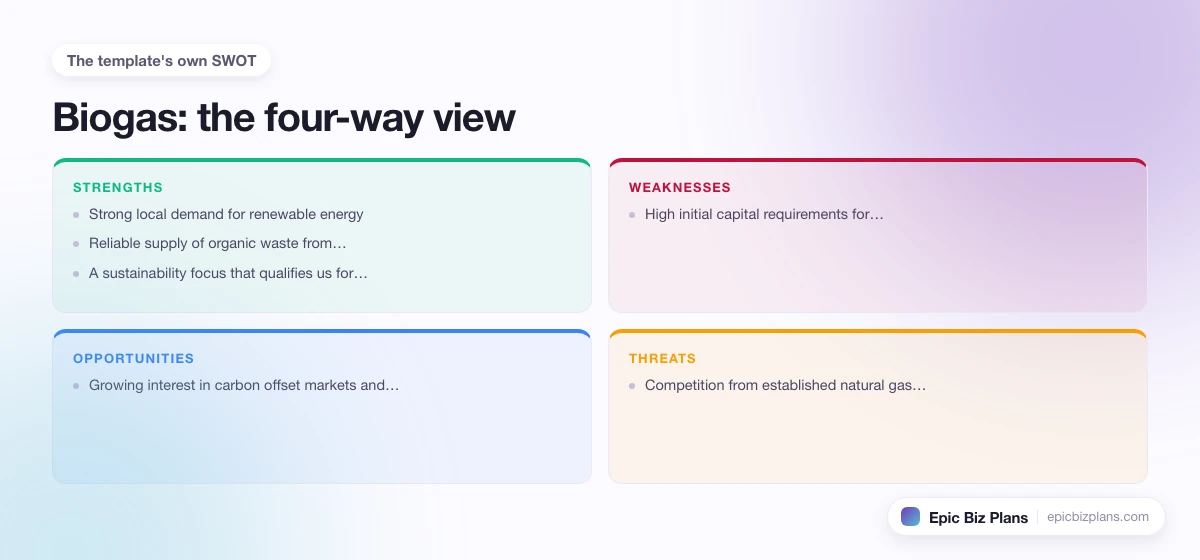
SWOT Analysis
- Strengths: Strong local demand for renewable energy, reliable supply of organic waste from agricultural partners, and a sustainability focus that qualifies us for government incentive programs.
- Weaknesses: High initial capital requirements for digester equipment and site preparation; regulatory approval timelines can delay launch.
- Opportunities: Growing interest in carbon offset markets and government subsidies for clean energy projects create additional revenue streams beyond direct energy sales.
- Threats: Competition from established natural gas suppliers on price; fluctuations in feedstock availability if agricultural partners face their own operational challenges.
Biogas Business Name Ideas
Website
We will build our website on Squarespace for its clean design templates that suit an environmental services business, with a secondary consideration for Wix if we need more flexible page structures for educational content about biogas technology. The site will include a service overview for waste producers, a project portfolio as we complete installations, and a contact form for partnership inquiries. Clear communication about our environmental impact - waste diverted, CO2 reduced, households served - will be central to the site design.
Marketing Details
Our marketing strategy targets two distinct audiences: waste producers who need a reliable disposal partner, and energy buyers seeking alternatives to fossil fuels. We will use Semrush for SEO to capture search traffic from businesses researching waste management and renewable energy options. Email outreach through HubSpot will target farm owners, restaurant operators, and facilities managers with educational content on biogas economics and environmental benefits. TikTok advertising will reach younger, sustainability-conscious audiences who influence purchasing decisions within their organizations.
Industry Trends
The biogas sector is growing steadily, driven by advances in anaerobic digestion efficiency, declining equipment costs, and stronger legislative support for renewable energy at the state and federal level. Biogas purification technology improvements now allow smaller-scale operations to produce biomethane that meets pipeline injection standards, opening new revenue channels. Businesses building waste-to-value models in adjacent sectors should also review this green and eco business plan for circular economy frameworks applicable across multiple industries. Carbon credit markets are increasingly accessible to small energy producers, adding a meaningful secondary income stream.
Competitor Information
Direct competitors include established agricultural biogas operations and regional waste management companies that have begun integrating digestion technology. Indirect competitors are conventional natural gas suppliers who can undercut us on short-term price but cannot match our environmental credentials. Our competitive edge lies in local feedstock partnerships that reduce input costs, a community-centered model that generates goodwill, and our ability to offer waste producers a cost advantage over landfill disposal. We will differentiate through service reliability and transparent impact reporting.
Financial Information
Startup costs are projected at approximately ,000, covering digester equipment, site preparation, permitting, and initial operational expenses. We project first-year revenue of ,000 from energy sales and waste tipping fees, growing as production capacity expands in years two and three. Ongoing expenses include labor, equipment maintenance, feedstock logistics, and marketing. Our financial model targets positive cash flow by the end of year two, with a conservative growth trajectory that accounts for seasonal variability in feedstock supply.
Legal and Compliance
Operating a biogas facility requires permits across multiple regulatory domains, including waste management licenses, air quality permits, and energy production certifications. We will work with environmental compliance consultants during the pre-launch phase to map all required approvals and build realistic timelines. Intellectual property protections will cover any proprietary processing modifications we develop over time. Employment agreements will include clear terms for staff working in proximity to processing equipment.
Operational Plan
Core operations revolve around three activities: feedstock collection from partner sites, anaerobic digestion processing at our facility, and distribution of produced biogas to customers. We will establish collection routes with local farms and restaurants, scheduling regular pickups to ensure consistent feedstock flow. Processing facility management will follow strict safety and maintenance protocols to maximize uptime. Distribution logistics will depend on the form of output - direct pipeline connections for local industrial users or compressed biogas delivery for smaller customers.
Contingency Planning
If feedstock supply drops due to seasonal variation or partner disruptions, we will maintain relationships with secondary waste suppliers to fill gaps quickly. Regulatory changes affecting permitting requirements will be monitored closely, with a legal advisor on retainer to respond rapidly. A financial reserve covering six months of operational expenses will buffer against revenue delays in the early stages of energy sales contracts.
Building a Biogas Business That Lasts
A biogas business that serves its community well tends to build strong, long-term relationships with the farms, restaurants, and municipalities it works with. Those relationships are the foundation of a defensible business - they create predictable feedstock supply, reliable energy customers, and local advocates who refer new partners. Focus on those relationships from day one, and the financial results will follow.
Adapt and Evolve
As you grow, consider expanding into biomethane upgrading if local pipeline infrastructure allows it, or adding educational programs that position your operation as a community resource on sustainability. Operators in complementary sectors, such as the energy solutions business plan space, frequently find joint venture opportunities with biogas producers as energy transition demands increase. Updating your business plan annually ensures your strategy reflects current market conditions, new technology options, and evolving regulatory requirements.
-
 SemrushSemrush is a platform with literally any online tool you will need to promote your business. Spy on your competitors, get search traffic, keyword research, social info, ad copies and much more. Used by most of the top online companies in the world. Besides all its tools, Semrush also has many available integrations possible with many other tools that will make your work even better.
 -
 Surfer SEOSurfer SEO is an incredibly smart AI tool that will give you exact explanations what to do in order to make your website rank better. They use hundreds of parameters, check your competitors and decide on the best course of action. Whether it be inner links, bold text, paragraphs, headers, images and much more. Surfer is a must-have in 2026.
Practical Applications
Use your biogas business plan to present to agricultural development funds, environmental grant programs, or private investors with an interest in clean energy infrastructure. The plan also serves as the operational reference document for your team - keeping everyone aligned on feedstock targets, production goals, and compliance obligations. Each revision brings your operation closer to the community impact you set out to create.
Your biogas business plan is 100% free - with unlimited edits, unlimited downloads, and unlimited chances to get it right. Build the future you want, and let your commitment to sustainability lead the way.
