
Biodiversity Business Plan Template
-
 ShopifyPut your brand on Shopify. Launch your online store with tools designed for growth and success. Ready to turn your idea into profit? Start building your e-commerce business today.
 -
 SquarespaceShowcase your brand with Squarespace’s sleek designs. Build a professional online presence with ease. Start with a template that already looks finished.
 -
 WixBring your ideas to life with Wix. Customize every aspect of your site with unmatched flexibility. Start creating your unique online space and let your creativity shine.
 -
 ElementorCraft captivating websites effortlessly with Elementor. Enjoy complete creative control without coding. Make your site stand out to your audience. Start turning your vision into reality now.
- Executive Summary
- Business Info
- Target Market
- Business Model Overview
- SWOT Analysis
- Website
- Marketing Details
- Industry Trends
- Competitor Information
- Financial Information
- Legal and Compliance
- Operational Plan
- Contingency Planning
- Common Mistakes to Avoid
- Build a Biodiversity Business That Holds Up Commercially
- Types of Biodiversity Businesses
- Continuous Growth and Adaptation
- Take Action
A Biodiversity business plan covers a venture built around the protection, restoration, or sustainable use of natural ecosystems and the species within them. The category includes consulting on biodiversity offsets, retailing of eco-friendly goods, environmental education, ecological restoration services, and habitat-focused agriculture. Each model has a different revenue logic, but they share a common need: credible scientific grounding paired with a clear commercial offer.
Your Biodiversity business plan needs to describe a real customer base - corporate clients meeting sustainability targets, public sector buyers funding conservation, or individual consumers paying for sustainable products - and a delivery model that produces measurable outcomes. Vague claims about "making a difference" will not survive due diligence with funders or sophisticated buyers; specifics will.
Executive Summary
Our mission is to support biodiversity outcomes through products, education, and consulting that help individuals, businesses, and communities act on conservation priorities. The vision is a market in which biodiversity considerations are standard practice, not optional extras, and we want to be among the providers companies turn to when they need that work delivered well.
Financially, we expect to reach break-even within the first two years and a 15% profit margin by the end of year three. The mix shifts toward consulting and recurring education subscriptions over time, which improves margin and reduces the seasonal pressure that pure product sales would create.
Business Info
The business will sell eco-friendly products, deliver educational workshops, and provide biodiversity-focused consulting to organizations working on conservation, sustainability reporting, or land management. Founders working on the agricultural side of biodiversity should also review the organic farming business plan for an operational model focused on land-based revenue and certified production. Those drawn to a single-species conservation retail niche can see how it works in practice in the moth business plan template.
Target Market
The target market includes environmentally engaged consumers buying retail products, schools and universities buying educational programs, NGOs and government agencies funding conservation work, and corporate clients seeking advisory support on biodiversity disclosure and reporting. Each segment has a different sales cycle, which the plan accounts for in the financial model.
Business Model Overview
Revenue comes from three streams: direct online product sales, subscriptions to a continuing-education program for professionals, and consulting fees for advisory engagements. Operating three streams from day one is ambitious; the realistic build is to launch with one and add the others as capacity allows.
SWOT Analysis
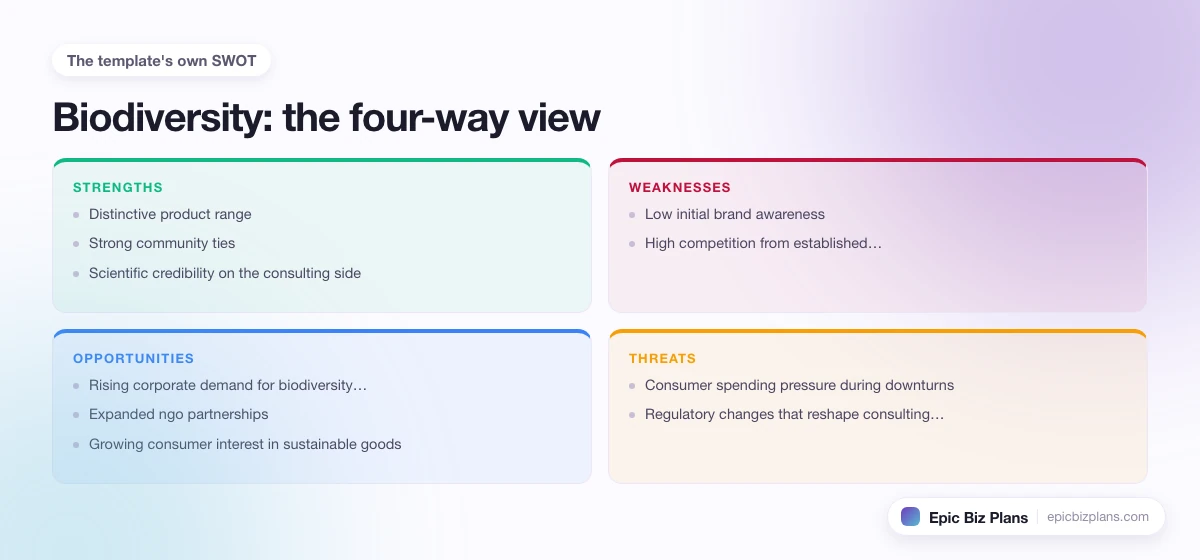
- Strengths: Distinctive product range, strong community ties, scientific credibility on the consulting side.
- Weaknesses: Low initial brand awareness, high competition from established sustainability brands.
- Opportunities: Rising corporate demand for biodiversity reporting support, expanded NGO partnerships, growing consumer interest in sustainable goods.
- Threats: Consumer spending pressure during downturns, regulatory changes that reshape consulting demand.
Biodiversity Business Name Ideas
Website
The website will be built on Shopify for the e-commerce side, which gives us the inventory management, shipping integrations, and checkout reliability needed for a multi-SKU product range. Squarespace is a strong alternative when content marketing - long-form articles, species guides, restoration case studies - is the primary acquisition channel and the product range is small enough to be presented as a curated catalog.
Marketing Details
Marketing combines content-led search, paid social, and direct outreach to organizational buyers. Semrush will guide an SEO program targeting the questions buyers actually search - biodiversity reporting frameworks, native planting selections, restoration project examples - rather than generic sustainability terms. HubSpot will run nurture sequences for prospects who download whitepapers or sign up for the workshop series.
TikTok ads can reach younger consumers interested in environmental issues, where short videos showing real fieldwork or product origins outperform polished brand content. For founders specifically positioning around the broader category framing, the sustainability business plan covers a marketing strategy aligned with corporate sustainability buyers.
Industry Trends
Biodiversity has moved from a niche conservation topic to a mainstream corporate disclosure subject, driven by frameworks like TNFD and growing regulatory expectations on nature-related risk. Demand for advisory services has grown alongside this shift, particularly from companies in agriculture, food, real estate, and extractive industries. Technology developments - eDNA sampling, satellite monitoring, AI-assisted species identification - are making it cheaper to produce credible biodiversity data, which expands what consultants can offer at the SME tier. The forestry business plan describes a related operating model for ventures focused specifically on woodland restoration and timber economics.
Competitor Information
Competitors fall into three groups: established eco-product brands with built-in audience and supply chains, large environmental consultancies with scale advantages on government contracts, and smaller boutique consultancies competing on specialism. Differentiation comes from a clearly defined niche - for example, biodiversity reporting for mid-market food companies - backed by published case work and a defensible methodology.
Financial Information
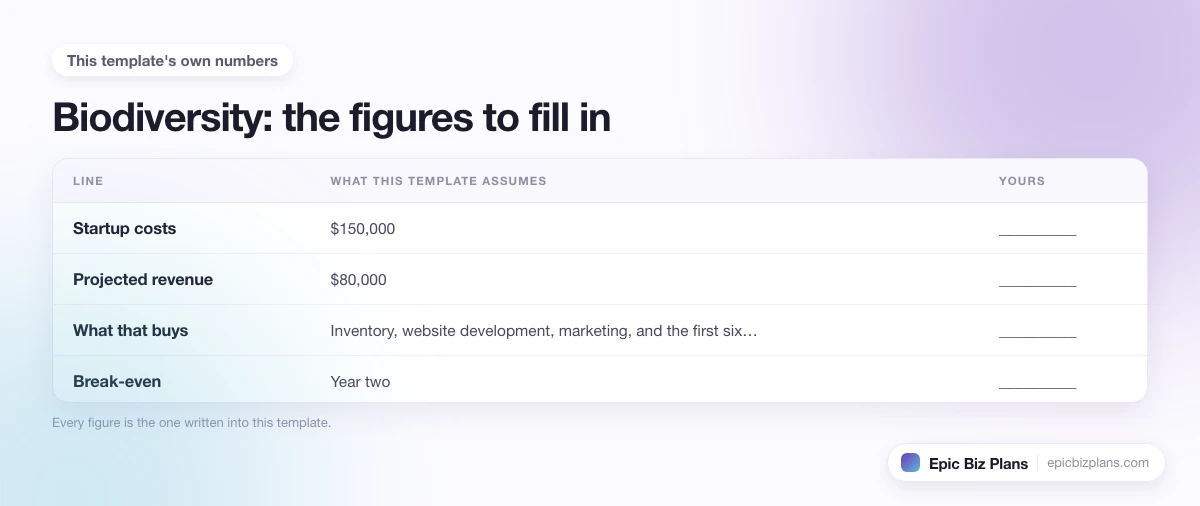
Startup costs are projected at $150,000, covering inventory, website development, marketing, and the first six months of operating expenses. Year-one revenue projections are $80,000 with break-even targeted in year two as consulting revenue ramps up and product margins improve with volume. Ongoing operating costs run around $50,000 annually before staff additions, weighted toward inventory, marketing, and content production.
Cash flow will be tight in the first year. Tracking weekly bank balance against a rolling 13-week cash forecast is the simplest discipline that keeps a sustainability-sector startup from running out of working capital before consulting revenue scales.
-
 SemrushSemrush is a platform with literally any online tool you will need to promote your business. Spy on your competitors, get search traffic, keyword research, social info, ad copies and much more. Used by most of the top online companies in the world. Besides all its tools, Semrush also has many available integrations possible with many other tools that will make your work even better.
 -
 Surfer SEOSurfer SEO is an incredibly smart AI tool that will give you exact explanations what to do in order to make your website rank better. They use hundreds of parameters, check your competitors and decide on the best course of action. Whether it be inner links, bold text, paragraphs, headers, images and much more. Surfer is a must-have in 2026.
Legal and Compliance
The business will register with the relevant authorities, secure appropriate trade and consulting licenses, and meet local environmental regulations. Trademark protection covers the brand and any product line names. Where consulting involves protected species or land subject to regulation, additional permits may be required and will be confirmed engagement-by-engagement before work begins.
Operational Plan
Operations cover three workflows: product sourcing and fulfillment, workshop delivery, and consulting engagement management. Product fulfillment runs through a third-party logistics partner once order volume justifies it; until then, in-house pick-and-pack keeps costs low. Workshops can be delivered live or as recorded modules, which improves margin and removes the geographic limit on participation. Consulting engagements use standardized methodology templates so that a small team can deliver work without quality drift.
Contingency Planning
Risks include supply chain shocks affecting eco-product sourcing, regulatory shifts that change consulting demand, and macroeconomic pressure on discretionary consumer spending. Mitigation includes maintaining at least two sources for any high-volume product line, diversifying consulting revenue across sectors, and balancing consumer-facing revenue with B2B revenue that holds up better through downturns.
Common Mistakes to Avoid
The most common early mistake in biodiversity ventures is conflating mission with strategy. Caring deeply about biodiversity does not, on its own, create a defensible business - paying customers do. Founders who skip the work of identifying which buyer is willing to pay, for what specific outcome, and at what price end up with strong brand statements and weak revenue.
A second mistake is underpricing consulting work. Biodiversity advisory is technically demanding and reputationally exposed; pricing it like generalist sustainability consulting leaves margin on the table and signals lower seniority than the work usually requires. The sustainable business plan covers pricing patterns that align better with the value delivered in this category.
Build a Biodiversity Business That Holds Up Commercially
Biodiversity ventures succeed when the founder pairs scientific credibility with commercial discipline. The plan is the document where that pairing becomes specific: who the customer is, what outcome they are buying, how the team produces it, and at what margin. Whether the business is product-led, education-led, or consulting-led, those questions are the ones that decide whether it survives the first three years.
Types of Biodiversity Businesses
Common formats include retail brands selling sustainably sourced products, professional services firms advising corporates on biodiversity disclosure, restoration contractors delivering on-the-ground habitat work, and educational businesses producing content for schools, universities, or working professionals. Each format has a different cash-flow shape, which the plan should reflect honestly.
Continuous Growth and Adaptation
Treat the plan as a working document. As the audience clarifies, as pricing experiments produce data, and as new regulatory requirements create new buyer demand, the plan should be updated to reflect what has been learned. Quarterly reviews are usually the right cadence for a growing services business.
Take Action
Your Biodiversity business plan is 100% free - with unlimited edits, unlimited downloads, and unlimited chances to get it right. Start with the version that reflects the business as it is today and update it as decisions get made and customers begin to teach you what they will actually pay for.
