
Bin Business Plan Template
-
 ShopifyPut your brand on Shopify. Launch your online store with tools designed for growth and success. Ready to turn your idea into profit? Start building your e-commerce business today.
 -
 SquarespaceShowcase your brand with Squarespace’s sleek designs. Build a professional online presence with ease. Start with a template that already looks finished.
 -
 WixBring your ideas to life with Wix. Customize every aspect of your site with unmatched flexibility. Start creating your unique online space and let your creativity shine.
 -
 ElementorCraft captivating websites effortlessly with Elementor. Enjoy complete creative control without coding. Make your site stand out to your audience. Start turning your vision into reality now.
- Executive Summary
- Business Info
- Products and Services
- Target Market
- Business Model Overview
- SWOT Analysis
- Business Name Ideas
- Website
- Marketing Details
- Industry Trends
- Competitor Information
- Financial Information
- Legal and Compliance
- Operational Plan
- Contingency Planning
- Build Your Bin Business With Confidence
- Diverse Business Opportunities
- Keep Your Plan Current
- Closing Thoughts
A Bin business plan gives a waste and recycling venture the structure it needs to compete in a fast-moving market. This is not just any plan; it is a blueprint that reflects your brand and speaks to the customers you want to reach. Demand for smarter recycling solutions keeps growing, and a clear plan helps you meet it. The sections below cover what to include.
A standout Bin business plan lays out your vision, strategy, and approach in plain terms. It is the place to set goals, define your market, and explain what sets you apart. In a crowded field, that clarity is what makes a plan worth presenting. From here, each section gets specific about how the business runs.
Executive Summary
Our mission is to build a practical, user-friendly recycling bin company that improves how people manage waste. We want to raise environmental awareness and lift recycling rates in urban areas. Our vision centers on a cleaner future by making the recycling process simpler for households and businesses. Our value comes from bins with smart features that show users how to recycle correctly and cut contamination.
We set financial goals that include $500,000 in revenue within the first year and steady, sustainable expansion after that.
Business Info
Products and Services
We will offer a range of recycling bins with smart features that guide users toward proper waste disposal. Our bins include sensors to detect content type, real-time monitoring, and displays that share recycling tips. These features turn an everyday object into a small teaching tool. The result is cleaner streams and less contamination at the source.
Target Market
Our primary market includes environmentally aware households, businesses, municipalities, and schools seeking better recycling solutions. We will also reach community groups focused on sustainability. These buyers want measurable results, not just good intentions. Our data features give them exactly that, much like a broader recycling business serves cities at scale.
Business Model Overview
We will run a direct-to-consumer model, selling through our online platform and partnerships with local governments and corporations. Secondary revenue comes from data-sharing agreements with waste management companies and educational programs. This mix balances product sales with recurring service income. It also deepens our ties with the institutions that drive bulk orders.
SWOT Analysis
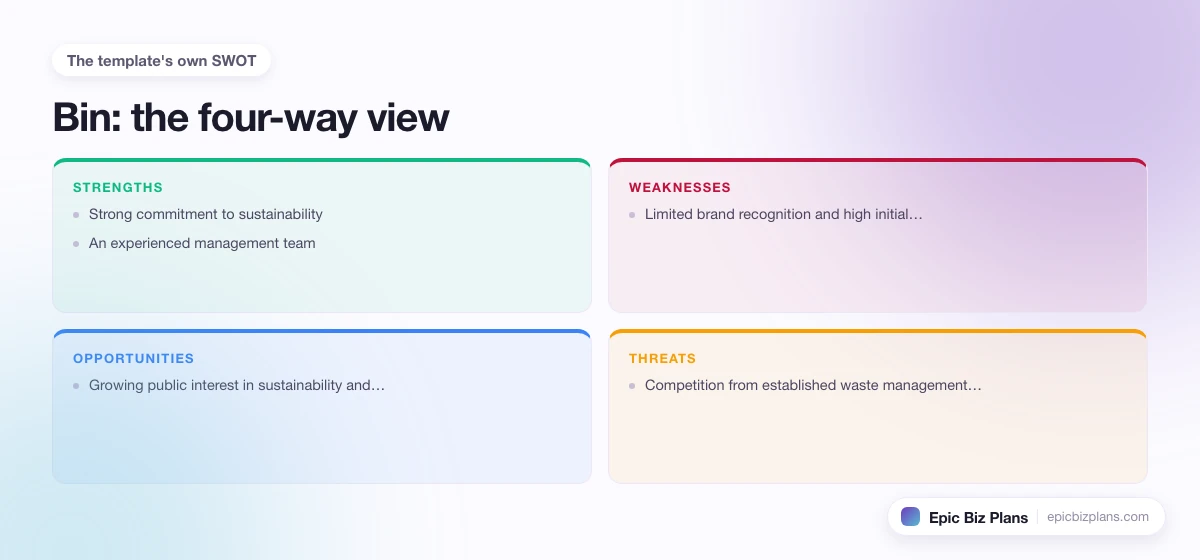
- Strengths: Innovative products, strong commitment to sustainability, and an experienced management team.
- Weaknesses: Limited brand recognition and high initial capital expenditure.
- Opportunities: Growing public interest in sustainability and government incentives for eco-friendly businesses.
- Threats: Competition from established waste management companies and changes in environmental regulations.
Business Name Ideas
Website
We will build our online presence on Shopify, a strong e-commerce platform that fits our product range. Shopify lets us manage inventory, sales, and customer data while keeping checkout simple. We will also consider Squarespace for its design tools, which suit showcasing physical products. The site will feature clear product specs and a path to bulk inquiries.
Marketing Details
Our marketing will use digital techniques, starting with SEO through Semrush to grow online visibility. We will run email campaigns through HubSpot to keep customers informed about new products and recycling tips. Educational content helps prospects understand why smart bins are worth the cost. That same content supports outreach to municipal buyers.
For social media, we will use TikTok ads to reach younger audiences with short, educational clips about recycling and sustainability. Ventures focused on the broader category, like a sustainability business, show how cause-driven content builds an audience.
Industry Trends
The waste management industry is shifting toward smart bins and AI-integrated solutions. Growing demand for sustainable products pushes companies like ours to keep improving. Local governments are adopting stricter recycling rules, which creates a favorable market for our offerings. Operators running a waste removal business see the same regulatory tailwind.
Competitor Information
We will study direct competitors offering similar waste solutions and indirect ones providing traditional recycling services. To stand apart, we focus on better product functionality, customer education, and reliable ongoing support. We will document recycling-rate improvements so buyers can see real outcomes. A nearby trash can business competes on price, which is exactly where our data features add value.
Financial Information
To launch, we estimate startup costs near $250,000, covering product development, marketing, and initial inventory. We project $500,000 in first-year revenue from strong online sales and partnerships. The mix of hardware and recurring data revenue supports steadier cash flow. We will keep our pricing tied to the value buyers measure.
Ongoing expenses include production, marketing, salaries, and overhead. We will monitor cash flow closely and produce quarterly profit and loss statements to assess financial health and efficiency.
Legal and Compliance
We will meet local and national rules on business registration, environmental law, and waste management standards. We will also pursue intellectual property protection for our designs and technology to hold a competitive edge. Clear compliance matters when selling to municipalities. It also reassures private buyers concerned about regulation.
-
 SemrushSemrush is a platform with literally any online tool you will need to promote your business. Spy on your competitors, get search traffic, keyword research, social info, ad copies and much more. Used by most of the top online companies in the world. Besides all its tools, Semrush also has many available integrations possible with many other tools that will make your work even better.
 -
 Surfer SEOSurfer SEO is an incredibly smart AI tool that will give you exact explanations what to do in order to make your website rank better. They use hundreds of parameters, check your competitors and decide on the best course of action. Whether it be inner links, bold text, paragraphs, headers, images and much more. Surfer is a must-have in 2026.
Operational Plan
Our operations cover sourcing sustainable materials and working with manufacturers to hold quality standards. We will build a reliable supply chain for timely delivery and set logistics protocols for distribution to customers and partners. Bulk institutional orders need predictable lead times, so we plan around them. Strong supplier relationships keep production steady.
Contingency Planning
We recognize risks such as shifts in consumer behavior, supply chain disruptions, and technology failures. To reduce them, we will keep backup contingency plans, maintain flexible operations, and build strong supplier relationships for continuity. A short cash reserve covers gaps during slower order periods. Comparing notes with an e-waste business helps us plan for material and recycling shifts.
Build Your Bin Business With Confidence
This is more than a bin business plan; it is a roadmap to your goals, your daily work, and the freedom to build something of your own. Whether you are starting a waste management service, an online shop for sustainable bins, or a local store focused on eco-friendly products, the venture can connect with customers on several levels. A clear plan keeps that vision grounded.
Diverse Business Opportunities
From large recycling operations to small neighborhood thrift stores, the options run wide. Consider niche markets like custom-designed bins or subscription services delivering eco-friendly waste solutions. Picture the effect on your community when bin management makes sustainability easier. Each idea opens a different path to customers.
Keep Your Plan Current
As your business grows, your bin business plan should grow with it. Update it for different audiences, pricing models, products, and sales channels so you stay relevant. Treat it as a living document that helps you plan, apply for funding, and present to new partners. Regular review keeps it useful.
Closing Thoughts
Your bin business plan is 100% free, with unlimited edits, unlimited downloads, and unlimited chances to get it right. Now is the time to put your ideas into action and build toward your vision. Start filling it in today.
