
Billing Service Business Plan Template
-
 ShopifyPut your brand on Shopify. Launch your online store with tools designed for growth and success. Ready to turn your idea into profit? Start building your e-commerce business today.
 -
 SquarespaceShowcase your brand with Squarespace’s sleek designs. Build a professional online presence with ease. Start with a template that already looks finished.
 -
 WixBring your ideas to life with Wix. Customize every aspect of your site with unmatched flexibility. Start creating your unique online space and let your creativity shine.
 -
 ElementorCraft captivating websites effortlessly with Elementor. Enjoy complete creative control without coding. Make your site stand out to your audience. Start turning your vision into reality now.
- Executive Summary
- Business Info
- Products and Services
- Target Market
- Business Model Overview
- SWOT Analysis
- Billing Service Business Name Ideas
- Website
- Marketing Details
- Pricing Strategy
- Industry Trends
- Competitor Information
- Technology Stack and Security
- Financial Information
- Legal and Compliance
- Operational Plan
- Contingency Planning
- Building a Billing Service Business
- Adapt as You Grow
- Put Your Plan to Work
A billing service handles one of the most critical functions in any business: getting paid accurately and on time. A strong Billing Service business plan outlines how you will help clients manage invoicing, payment processing, and accounts receivable. Small and mid-sized businesses are your primary market, as many lack the staff or systems to handle billing efficiently in-house.
Your plan should define your service packages, pricing model, and the technology platform you will use to deliver results. The billing services market is competitive but steady, with recurring revenue potential that makes it attractive for long-term business building. Use this template to detail every aspect of your operation from client acquisition to service delivery.
Executive Summary
We aim to establish a reliable billing service for small and medium-sized enterprises. Our mission is to simplify the billing process so business owners can focus on their core work while we handle invoicing, payment collection, and financial reporting. Our vision is to become the leading billing service provider in our region, known for accuracy and responsive support. Owners building a wider subscription-based service company can also review the Cascade business plan template.
Our platform automates invoice generation, payment tracking, and reconciliation. We prioritize transparency, personalized service, and compliance with financial regulations. First-year financial goals include gross revenue of $200,000 with a 20% profit margin.
Business Info
Products and Services
We offer invoice generation, payment processing, accounting software integration, and financial reporting. Our services serve SMEs across retail, healthcare, and professional services sectors. Billing service businesses that want to specialize in the healthcare vertical should review the medical billing business plan for a detailed framework covering HIPAA compliance, medical coding, insurance claim workflows, and the revenue cycle management model specific to healthcare providers. Each client receives a customized setup based on their billing volume and complexity. The medical billing business plan template covers the specialized requirements of healthcare billing specifically.
Target Market
Our target market consists of small and medium-sized businesses that need outsourced billing support. We focus on service-based industries and retail businesses where billing complexity creates administrative burden. Companies with 5-100 employees are our sweet spot, as they generate enough invoices to need help but typically cannot justify a full-time billing department.
Business Model Overview
We operate on a subscription model, charging monthly fees based on features and invoice volume. Premium tiers include custom integrations and dedicated account managers. This recurring revenue model provides predictable cash flow and strong client retention.
SWOT Analysis
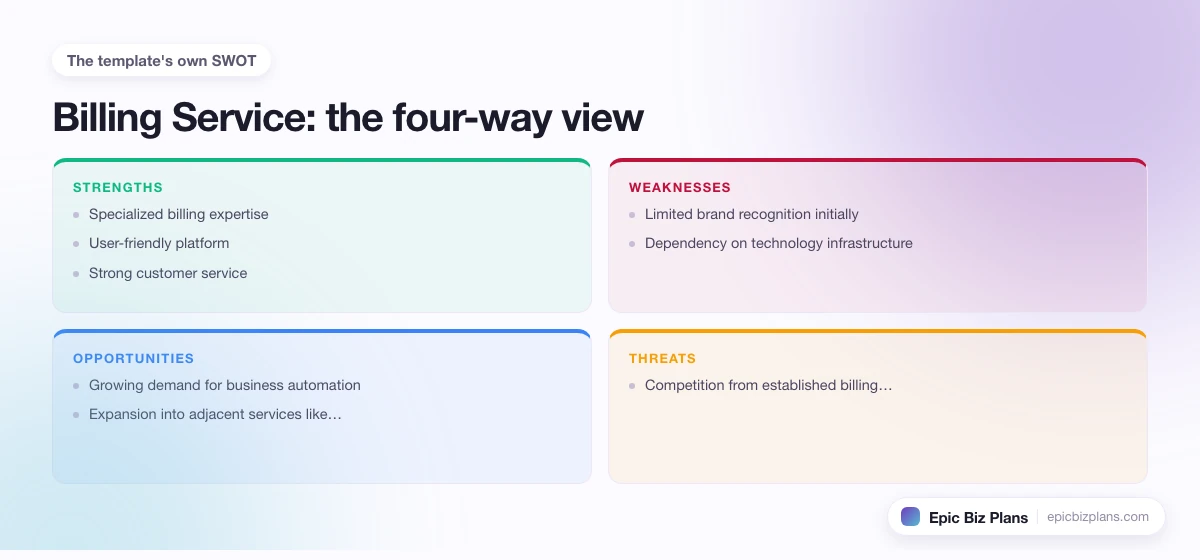
- Strengths: Specialized billing expertise, user-friendly platform, strong customer service.
- Weaknesses: Limited brand recognition initially, dependency on technology infrastructure.
- Opportunities: Growing demand for business automation, expansion into adjacent services like bookkeeping.
- Threats: Competition from established billing platforms and potential regulatory changes.
Billing Service Business Name Ideas
Website
We will build our website using Wix, which provides an intuitive platform for creating a professional service-oriented site. The site will showcase our service tiers, display client testimonials, and include a contact form for consultations. If we expand into online billing solutions with eCommerce elements, we will consider integrating with Shopify.
Marketing Details
Our marketing strategy targets business owners searching for billing help online. We will use Semrush for SEO to rank for terms like "outsourced billing service" and "small business invoicing help." HubSpot will manage our email campaigns, nurturing leads with case studies and service comparisons.
LinkedIn will be our primary social platform for reaching business decision-makers. We will also produce educational content about billing best practices to establish authority. Targeted ads on Google and Facebook will supplement organic efforts during the launch phase.
Pricing Strategy
Structure your pricing around invoice volume tiers rather than flat rates. A basic tier might cover up to 100 invoices per month, while enterprise tiers handle 500 or more with additional reporting and integration features. This approach lets you serve small startups and growing companies without leaving money on the table.
Offer a free trial or discounted first month to reduce friction for new clients. Once a business integrates your billing system into their workflow, switching costs make retention natural. Annual prepayment discounts can also improve your cash flow while locking in longer commitments. The payment processing business plan template covers related pricing considerations for financial service businesses.
Industry Trends
The billing service industry is evolving with cloud computing, AI-powered automation, and real-time payment processing. These technologies improve accuracy and reduce manual work, allowing billing services to handle more clients with smaller teams. Mobile payment integration and compatibility with popular accounting software like QuickBooks and Xero are becoming standard expectations from clients.
Competitor Information
Main competitors include established platforms like FreshBooks, Bill.com, and local bookkeeping firms that offer billing as part of a broader package. We differentiate through personalized onboarding, hands-on support, and pricing that works for smaller businesses often overlooked by enterprise-focused competitors. Building strong client relationships through dedicated account management is our core advantage.
Technology Stack and Security
Choose a billing platform that supports automated invoice generation, payment reminders, and integration with major accounting software. Options include building on existing platforms like Stripe Billing or developing a custom solution using frameworks that support PCI DSS compliance for payment data handling.
-
 SemrushSemrush is a platform with literally any online tool you will need to promote your business. Spy on your competitors, get search traffic, keyword research, social info, ad copies and much more. Used by most of the top online companies in the world. Besides all its tools, Semrush also has many available integrations possible with many other tools that will make your work even better.
 -
 Surfer SEOSurfer SEO is an incredibly smart AI tool that will give you exact explanations what to do in order to make your website rank better. They use hundreds of parameters, check your competitors and decide on the best course of action. Whether it be inner links, bold text, paragraphs, headers, images and much more. Surfer is a must-have in 2026.
Security is paramount when handling financial data. Implement SSL encryption, two-factor authentication, and regular security audits. Data backup and disaster recovery plans are essential for maintaining client trust. If you store payment information, PCI DSS compliance is mandatory and requires ongoing verification.
Financial Information
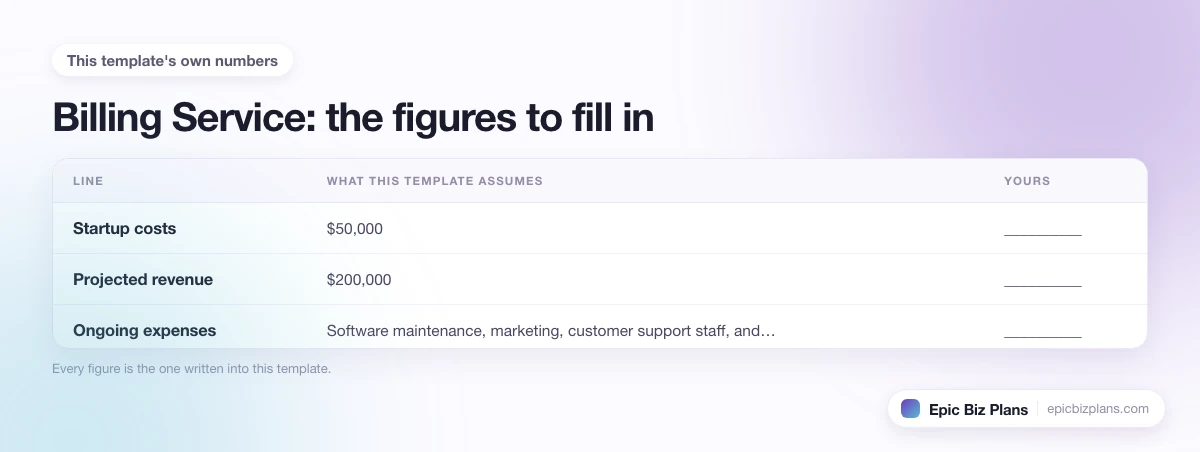
Startup costs are estimated at $50,000, covering technology development, marketing, and initial operating expenses. First-year revenue is projected at $200,000, growing steadily as we add clients and expand services. Ongoing expenses include software maintenance, marketing, customer support staff, and hosting costs. We aim to achieve positive cash flow by the end of year one. The data management business plan template covers similar financial planning for technology service businesses.
Legal and Compliance
We will register our business entity and obtain necessary licenses for operating a financial services company. Compliance with data protection regulations including GDPR (if serving EU clients) and state-level privacy laws is required. We will pursue trademark protection for our business name and logo as the brand grows.
Operational Plan
Key operations include platform maintenance, client onboarding, ongoing account management, and customer support. We will integrate with payment gateways and accounting software to provide a connected experience for our clients. Regular software updates and feature releases will keep our platform competitive.
Contingency Planning
Risks include system outages, data breaches, and regulatory changes affecting financial services. We will mitigate these through redundant hosting, comprehensive security measures, and regular compliance reviews. A documented incident response plan will ensure transparency with clients during any service disruption. The customer service business plan template addresses the client communication aspects of contingency planning.
Building a Billing Service Business
Starting a billing service business means solving a real problem that almost every small business faces. Whether you are managing invoices for a local retail shop, processing payments for a medical practice, or providing automated billing for a SaaS company, the work is essential and recurring. That combination of necessity and repeat business makes billing services an attractive model.
Adapt as You Grow
As your client base expands, revisit your business plan to add new service tiers, enter new industries, or explore adjacent offerings like bookkeeping or financial reporting. Each revision sharpens your strategy and helps you capitalize on emerging opportunities.
Put Your Plan to Work
Use your Billing Service business plan to present to potential partners, apply for funding, or onboard your first clients with confidence. A clear plan demonstrates professionalism and builds trust with prospects.
Your Billing Service business plan is 100% free with unlimited edits, unlimited downloads, and unlimited chances to get it right. Start building your billing business today.
