
Bike Accessories Business Plan Template
-
 ShopifyPut your brand on Shopify. Launch your online store with tools designed for growth and success. Ready to turn your idea into profit? Start building your e-commerce business today.
 -
 SquarespaceShowcase your brand with Squarespace’s sleek designs. Build a professional online presence with ease. Start with a template that already looks finished.
 -
 WixBring your ideas to life with Wix. Customize every aspect of your site with unmatched flexibility. Start creating your unique online space and let your creativity shine.
 -
 ElementorCraft captivating websites effortlessly with Elementor. Enjoy complete creative control without coding. Make your site stand out to your audience. Start turning your vision into reality now.
- Executive Summary
- Business Info
- SWOT Analysis
- Bike Accessories Business Name Ideas
- Website
- Marketing Details
- Industry Trends
- Competitor Information
- Financial Information
- Legal and Compliance
- Operational Plan
- Contingency Planning
- Transform Your Passion into a Business
- Exploring the Niche
- Adapting Your Business Plan
- Practical Applications
- Bold Steps Ahead
The global bicycle accessories market is valued in the billions and continues to grow as cycling gains popularity for commuting, fitness, and recreation. Selling bike accessories - helmets, lights, locks, bags, and maintenance tools - offers strong margins and repeat-purchase potential from an enthusiastic customer base.
This bike accessories business plan template covers market positioning, product selection, financial projections, and operations. Whether you are launching a Shopify store focused on commuter gear or supplying local bike shops with premium accessories, use this plan to set realistic targets and build a scalable operation.
Executive Summary
This business will sell high-quality bike accessories through an eCommerce store and wholesale partnerships with local bicycle shops. The product line includes helmets, LED lights, U-locks, saddlebags, pumps, and multi-tools. The target market spans commuters, recreational riders, and cycling enthusiasts aged 18 to 55. First-year revenue is projected at $500,000, with 15 percent annual growth driven by repeat purchases, seasonal promotions, and product line expansion.
Business Info
The product catalog will cover safety gear (helmets, reflective vests, mirrors), lighting (front and rear LED lights, spoke lights), security (U-locks, cable locks, GPS trackers), storage (frame bags, panniers, handlebar rolls), and maintenance tools (tire levers, patch kits, chain lubricant). Private-label options for select products will improve margins over time. The business will sell directly to consumers online and fulfill wholesale orders for regional bike shops. Entrepreneurs in adjacent niches like a motorcycle accessories business plan will recognize many of these sourcing and distribution strategies.
SWOT Analysis
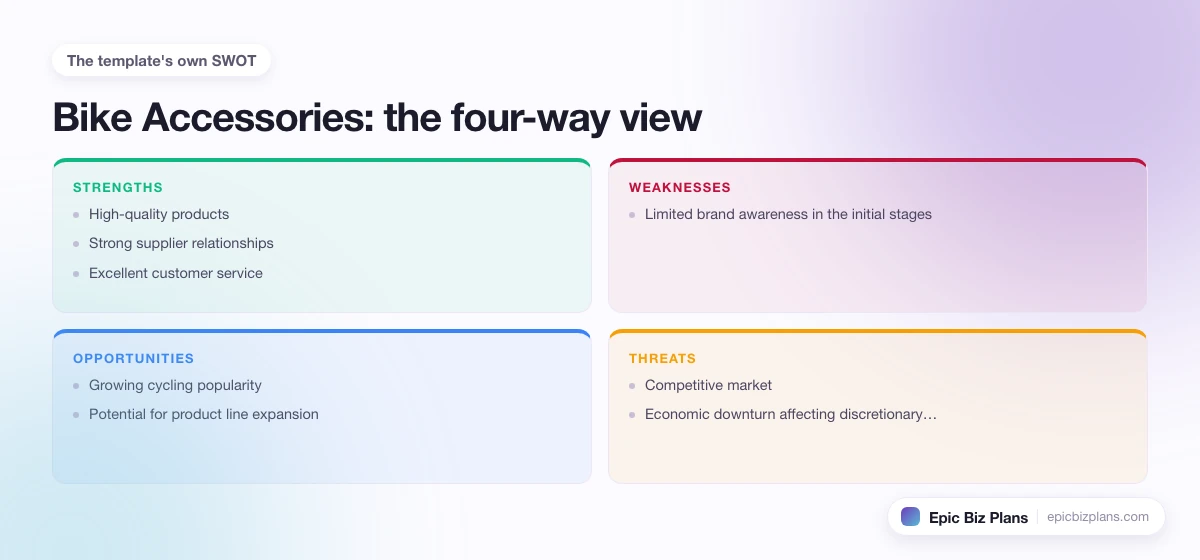
- Strengths: High-quality products, strong supplier relationships, excellent customer service.
- Weaknesses: Limited brand awareness in the initial stages.
- Opportunities: Growing cycling popularity, potential for product line expansion.
- Threats: Competitive market, economic downturn affecting discretionary spending.
Bike Accessories Business Name Ideas
Website
We will build our eCommerce website using Shopify, which provides us with an easy-to-use platform tailored for businesses selling products online. We will consider using Squarespace as an additional option if we expand our range of products or services, focusing on both functionality and aesthetic appeal.
Marketing Details
SEO will target product-specific long-tail keywords like "best commuter bike light" and "lightweight U-lock review." Product listing ads on Google Shopping will capture high-intent buyers searching for specific accessories. Social media content on Instagram and YouTube will feature gear reviews, installation tutorials, and ride-along footage that showcases products in real conditions. An email list built through a first-purchase discount offer will drive repeat orders through new product announcements and seasonal sales. Sellers building an e-bike business plan can apply similar marketing tactics to reach overlapping audiences.
Industry Trends
Urban cycling infrastructure investment is accelerating in cities worldwide, which expands the addressable market for commuter accessories. Retailers selling complete bikes alongside accessories can review a cycle business plan. Smart accessories - GPS-enabled locks, Bluetooth-connected lights, and power-meter pedals - are growing faster than the overall category. Sustainability-conscious riders increasingly favor accessories made from recycled materials or sold by brands with transparent supply chains. E-bike adoption is creating demand for accessories designed for heavier, faster bicycles, including reinforced racks and high-visibility lighting.
Competitor Information
Direct competitors include Amazon third-party sellers, specialty online retailers like Bike Nashbar and Chain Reaction Cycles, and local bike shop accessory sections. Differentiation will come from curated product selection, detailed buying guides that build trust, and superior customer support including video installation help. Private-label products will compete on margin while branded products will attract search traffic. Monitoring competitor pricing weekly through tools like Keepa and Google Shopping alerts will inform promotional strategy.
Financial Information
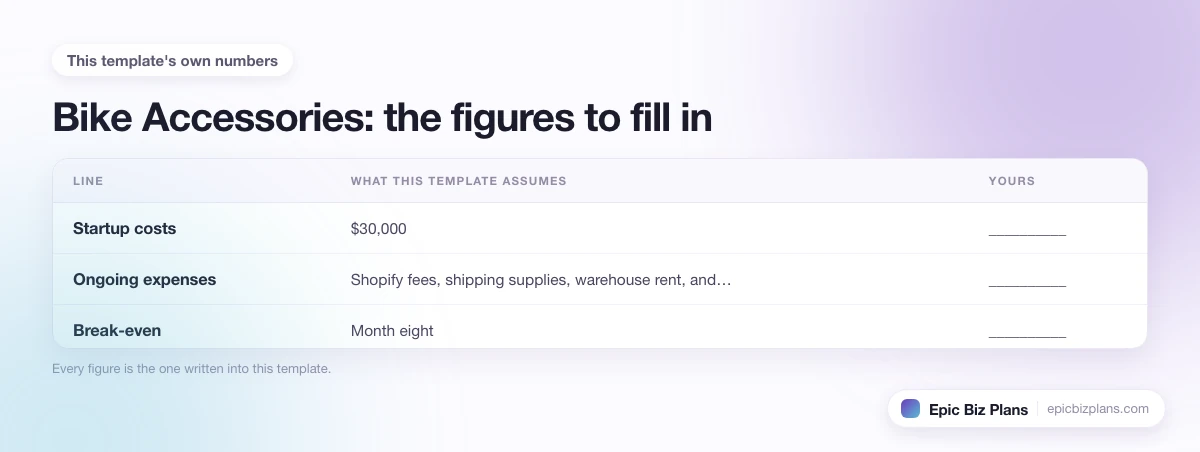
Startup costs include initial inventory ($30,000 to $50,000), Shopify setup and theme customization ($2,000), product photography ($1,500), and a three-month marketing budget ($15,000). Cost of goods sold averages 45 to 55 percent of retail price depending on the category. Gross margins on private-label products reach 60 to 65 percent. Monthly operating expenses include Shopify fees, shipping supplies, warehouse rent, and marketing spend, totaling approximately $12,000 per month at scale. Break-even is projected at month eight with 800 orders per month at an average order value of $45. Founders exploring related ventures like a sport shoes business plan will find comparable eCommerce financial structures.
Legal and Compliance
The business will register as an LLC and obtain a sales tax permit for all states where nexus exists. Products sold as safety equipment (helmets in particular) must meet CPSC certification standards in the US and CE marking requirements for European sales. Product liability insurance is essential given the safety-critical nature of many accessories. Import compliance and customs documentation will be managed for any products sourced from overseas manufacturers.
Operational Plan
Inventory will be managed through a Shopify-integrated system that tracks stock levels and triggers reorder alerts at defined thresholds. Initial fulfillment will be handled in-house from a small warehouse, with a transition to a third-party logistics provider once order volume exceeds 50 shipments per day. Supplier relationships with three to five manufacturers will reduce single-source risk. Quality control checks on each incoming shipment will catch defects before products reach customers. A fitness equipment business plan follows a similar warehouse-to-customer fulfillment model.
Contingency Planning
Primary risks include supplier delays, seasonal sales dips during winter months, and shipping cost increases. Mitigation strategies include maintaining a 30-day safety stock for top-selling SKUs, launching winter promotions focused on indoor trainers and gift bundles, and negotiating volume shipping rates with carriers. A cash reserve equal to three months of fixed costs will protect against unexpected revenue drops.
Transform Your Passion into a Business
A bike accessories business lets you serve a passionate customer base that buys repeatedly. Riders replace consumables like brake pads and tire tubes regularly, upgrade lighting and storage gear seasonally, and shop for gifts for other cyclists. Building trust through honest product reviews and reliable shipping creates a loyal customer base that grows through word of mouth.
Exploring the Niche
Opportunities within the bike accessories niche range from curated subscription boxes of maintenance supplies to custom-designed accessories for specific bike models. Some sellers focus exclusively on commuter safety gear, including riders served by an e-scooter business plan, while others build brands around cycling lifestyle products like apparel-compatible bags and weather-resistant phone mounts. The key is choosing a product focus that aligns with a specific rider persona.
Adapting Your Business Plan
Your bike accessories business plan should evolve as you learn which products and marketing channels drive the highest return. Update inventory strategy based on sell-through data, test new product categories each quarter, and expand into wholesale or international markets when your domestic operation is profitable and repeatable.
-
 SemrushSemrush is a platform with literally any online tool you will need to promote your business. Spy on your competitors, get search traffic, keyword research, social info, ad copies and much more. Used by most of the top online companies in the world. Besides all its tools, Semrush also has many available integrations possible with many other tools that will make your work even better.
 -
 Surfer SEOSurfer SEO is an incredibly smart AI tool that will give you exact explanations what to do in order to make your website rank better. They use hundreds of parameters, check your competitors and decide on the best course of action. Whether it be inner links, bold text, paragraphs, headers, images and much more. Surfer is a must-have in 2026.
Practical Applications
Use your bike accessories business plan as a roadmap for presenting to partners, planning a successful launch, securing funding, or simply clarifying your strategy. It serves as a living reference for quarterly reviews and annual goal-setting.
Bold Steps Ahead
Remember, your Bike Accessories business plan is 100% free - with unlimited edits, unlimited downloads, and unlimited chances to get it right. Start building the future you envision today.
