
Belief Business Plan Template
-
 ShopifyPut your brand on Shopify. Launch your online store with tools designed for growth and success. Ready to turn your idea into profit? Start building your e-commerce business today.
 -
 SquarespaceShowcase your brand with Squarespace’s sleek designs. Build a professional online presence with ease. Start with a template that already looks finished.
 -
 WixBring your ideas to life with Wix. Customize every aspect of your site with unmatched flexibility. Start creating your unique online space and let your creativity shine.
 -
 ElementorCraft captivating websites effortlessly with Elementor. Enjoy complete creative control without coding. Make your site stand out to your audience. Start turning your vision into reality now.
- Executive Summary
- Business Info
- Business Model Overview
- SWOT Analysis
- Website
- Marketing Details
- Industry Trends
- Competitor Information
- Financial Information
- Legal and Compliance
- Operational Plan
- Contingency Planning
- Building a Lifestyle Around Your Passion
- Navigating the Business Landscape
- Adapting Your Belief Business Plan
- Believe in Your Vision
A belief-driven business is built around a specific conviction about how something should be done better - whether that's a cleaner supplement formula, a more honest coaching approach, or a wellness product that actually delivers on its promises. The most successful businesses in the wellness and mindfulness space do not just sell products; they represent a point of view that their customers share. Defining that point of view clearly is what separates a commodity business from one that builds genuine loyalty.
This belief business plan provides a complete structure for launching a direct-to-consumer wellness business centered on values-driven products and services. The framework below covers the strategic, financial, and operational foundations your business needs - adapt each section to reflect your specific product category and mission.
Executive Summary
Belief will focus on direct-to-consumer wellness products including herbal supplements, mindfulness tools, and personal coaching services for health-conscious adults aged 25 to 45. Our mission is to support customers in building consistent wellness practices through products and guidance that are grounded in evidence and transparency. Our value proposition is straightforward: high-quality formulations with honest labeling, no misleading claims, and a brand that communicates what is actually in its products and why. We project ,000 in first-year revenue with a 20% year-over-year growth target as our subscription base compounds.
Business Info
Belief will operate a direct-to-consumer model through our Shopify e-commerce platform, with subscription options as the primary retention mechanism. Our initial product range includes three herbal supplement formulas, a meditation practice kit, and a personal coaching service offered in monthly packages. Our target customers are wellness-oriented professionals who have tried mass-market products and are looking for a brand they can trust long-term. Entrepreneurs in the broader wellness space should also review this wellness centre business plan for service-based wellness models and community-building strategies that complement product businesses.
Business Model Overview
We will generate revenue through one-time product purchases, monthly supplement subscriptions, and personal coaching packages. Subscriptions are our primary growth lever - customers who subscribe generate three to four times the lifetime value of one-time buyers.
SWOT Analysis
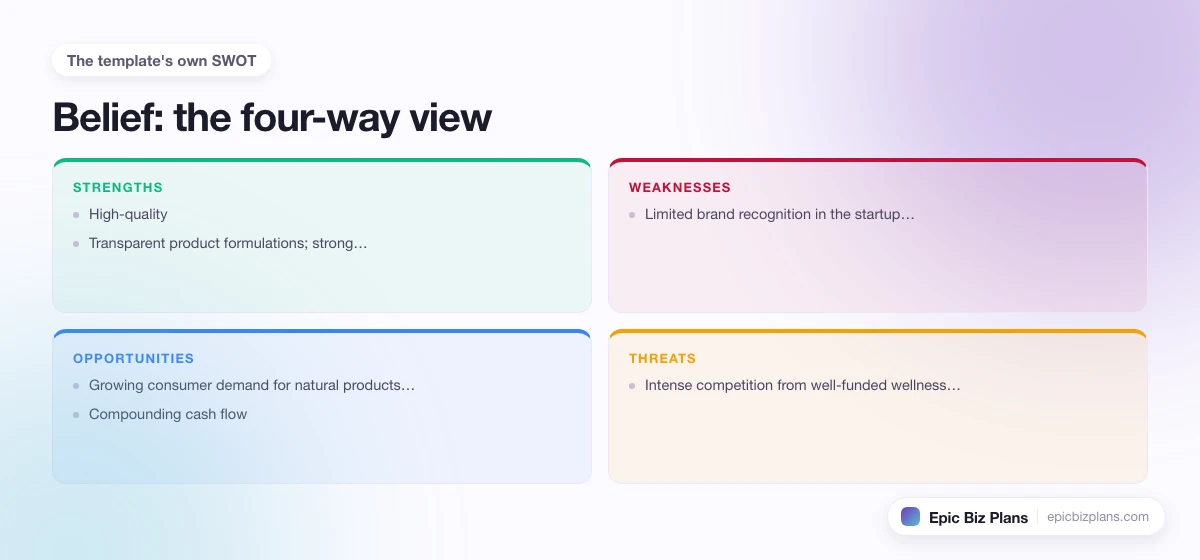
- Strengths: High-quality, transparent product formulations; strong brand identity built around authentic wellness values.
- Weaknesses: Limited brand recognition in the startup phase; customer acquisition costs in the wellness space are high due to established competition.
- Opportunities: Growing consumer demand for natural products and digital wellness services; subscription revenue model creates predictable, compounding cash flow.
- Threats: Intense competition from well-funded wellness brands; regulatory scrutiny of supplement health claims requires careful label compliance.
Belief Business Name Ideas
Website
We will build our website on Shopify, leveraging its subscription app integrations and robust product management tools. The site design will prioritize clean aesthetics and educational content that helps customers understand what they are buying and why it matters. Every product page will include a full ingredient list with sourcing notes, third-party testing certifications, and genuine customer reviews. A dedicated journal section will build content authority around the wellness topics our products address.
Marketing Details
Our marketing strategy focuses on building organic authority through educational content while using targeted paid channels to accelerate customer acquisition. We will use Semrush to identify the specific wellness queries our target customers search for and build a content library that provides genuine answers. HubSpot will manage our email workflows - from welcome sequences for new subscribers to re-engagement campaigns for customers who have lapsed. TikTok campaigns will target the 25-35 wellness audience through short-form educational content that demonstrates our product philosophy rather than just pushing a purchase.
Industry Trends
The wellness industry is seeing sustained growth in digital coaching services, personalized supplement protocols, and products that bridge physical and mental health. Consumers are increasingly willing to pay a premium for brands that demonstrate ingredient transparency and clinical backing - a shift away from proprietary blends and unverifiable claims. Businesses entering the wellness space alongside complementary health-focused brands should also review this herbal medicine business plan for regulatory frameworks around natural health product marketing and distribution. Mental wellness and stress management products are among the fastest-growing subcategories.
Competitor Information
Established wellness brands like Ritual, Care/of, and Thrive Market have built strong direct-to-consumer positions through editorial-quality content and subscription models. We will compete not by matching their marketing budgets but by going deeper on specificity - building expertise in a narrower product category and becoming the authoritative source on those topics for our target audience. Local and independent wellness brands compete in the same space with similar positioning; our advantage will be content quality and community engagement depth.
Financial Information
Startup costs are projected at ,000, covering product development and initial inventory, website setup, brand design, and a six-month marketing budget. We target ,000 in first-year revenue from a mix of one-time purchases and growing subscription revenue. Ongoing monthly expenses of approximately ,000 cover product costs, fulfillment, marketing, and operational overhead. Our financial model projects positive cash flow by month six as subscription revenue begins to compound from retained customers.
Legal and Compliance
All supplement products will comply with FDA dietary supplement regulations, including proper structure-function claim disclaimers and third-party testing for potency and contaminants. Business registration, trademark protection for the Belief brand name, and product liability insurance will all be established before launch. We will retain a regulatory compliance consultant to review all label copy and marketing claims before any product goes live. Regular legal consultations will ensure our policies and claims remain compliant as regulations evolve.
Operational Plan
Our operations model begins with contract manufacturing - partnering with an FDA-registered supplement manufacturer to produce initial product runs. This approach reduces startup capital requirements and allows us to iterate formulations based on customer feedback before investing in proprietary production. Inventory will be managed through Shopify's built-in tools, with reorder triggers set to maintain 60-day safety stock on core SKUs. Coaching services will be delivered by certified wellness coaches contracted on a per-client basis during the initial growth phase.
Contingency Planning
If a specific product receives a regulatory challenge regarding a health claim, our pre-established relationship with a regulatory consultant will allow us to respond quickly with label corrections and, if needed, a temporary product pause rather than a costly recall. Customer acquisition cost increases in paid channels will be managed by doubling down on organic content and referral programs. A six-month operating reserve will protect cash flow during any disruption to subscription renewal rates.
Building a Lifestyle Around Your Passion
A values-driven wellness business attracts customers who share those values - and those customers are more loyal, more likely to refer others, and more forgiving of the inevitable early imperfections of a new brand. The belief at the center of your business is not just a marketing story; it should shape every product decision, every customer service interaction, and every piece of content you create. Get that right, and your business becomes something customers feel genuinely connected to.
-
 SemrushSemrush is a platform with literally any online tool you will need to promote your business. Spy on your competitors, get search traffic, keyword research, social info, ad copies and much more. Used by most of the top online companies in the world. Besides all its tools, Semrush also has many available integrations possible with many other tools that will make your work even better.
 -
 Surfer SEOSurfer SEO is an incredibly smart AI tool that will give you exact explanations what to do in order to make your website rank better. They use hundreds of parameters, check your competitors and decide on the best course of action. Whether it be inner links, bold text, paragraphs, headers, images and much more. Surfer is a must-have in 2026.
Navigating the Business Landscape
Wellness businesses take many forms: product-focused brands, coaching practices, digital platforms, community memberships, and brick-and-mortar centers. Identifying which model fits your strengths and resources is one of the most important decisions your business plan needs to answer. Entrepreneurs who combine product sales with service-based revenue - like supplement subscriptions paired with coaching - often find that each component reinforces the other's retention. Brands expanding into mental wellness programming should explore the mental health awareness business plan for community engagement models and digital program frameworks.
Adapting Your Belief Business Plan
Return to your business plan at least quarterly in the first year. Customer feedback, conversion rates, and product performance data will all tell you things your initial assumptions missed. Use those signals to update your strategy deliberately - and document the changes so you can track what you learned and why you adjusted course.
Believe in Your Vision
Your Belief business plan is 100% free - with unlimited edits, unlimited downloads, and unlimited chances to get it right. Take that first step and let your conviction become the foundation of something real.
