
Baby Sitting Business Plan Template
-
 ShopifyPut your brand on Shopify. Launch your online store with tools designed for growth and success. Ready to turn your idea into profit? Start building your e-commerce business today.
 -
 SquarespaceShowcase your brand with Squarespace’s sleek designs. Build a professional online presence with ease. Start with a template that already looks finished.
 -
 WixBring your ideas to life with Wix. Customize every aspect of your site with unmatched flexibility. Start creating your unique online space and let your creativity shine.
 -
 ElementorCraft captivating websites effortlessly with Elementor. Enjoy complete creative control without coding. Make your site stand out to your audience. Start turning your vision into reality now.
- Executive Summary
- Business Info
- SWOT Analysis
- Baby Sitting Business Name Ideas
- Employee or Contractor: The Decision That Sets Your Prices
- Website
- Insurance: Read the Exclusion Before You Buy the Policy
- Marketing Details
- Industry Trends
- Competitor Information
- Financial Information
- Legal and Compliance
- Operational Plan
- Contingency Planning
- Summing It All Up
- Multiple Service Formats to Consider
- Update Your Plan as You Learn
- Use Your Plan With Key Stakeholders
A babysitting business plan is a practical document that defines how you will build, market, and operate a childcare service that parents can trust with their children. The childcare market has consistent demand because working parents need reliable care options regardless of broader economic conditions. A well-run babysitting service with a strong reputation in its community can build a stable, profitable business through word-of-mouth referrals alone, but a clear plan helps you get there faster and avoid the mistakes that cause most new services to struggle in year one.
The most important thing parents want from a babysitter or babysitting service is reliability and trust. Credentials, background checks, genuine references, and clear communication policies are not optional extras in this business. They are the minimum baseline for being taken seriously. Two things decide whether the business is viable underneath all of that: how your caregivers are legally classified, and whether your insurance actually covers the thing you are most afraid of.
Executive Summary
Our mission is to provide safe, reliable babysitting services for families in our community, delivered by trained, background-checked caregivers who communicate proactively with parents. We are building a service that working parents can depend on, not a side job that cancels at the last minute, but a professional childcare operation with defined standards, clear policies, and consistent caregiver quality.
Year one revenue target is $50,000, growing steadily as our client base expands and our reputation builds. We will reach break-even within the first year and target a 20% profit margin by year three. Our competitive advantage is the professionalism of our operation: thorough caregiver vetting, clear parent communication, flexible scheduling, and active reputation management that keeps existing clients loyal and generates consistent referrals. For related planning reference, see the nanny service business plan and daycare business plan.
Business Info
We provide in-home babysitting services for children aged 0 to 12. Sitters who expand into broader parenting resources can plan that growth with our parent business plan. Service options include hourly bookings for one-time needs, regular weekly scheduling for families with ongoing needs, and date-night packages for parents who want predictable evening coverage. Regular weekly clients are the highest-value segment because they provide predictable revenue and typically become long-term customers who refer their networks.
Target market is two-income professional households with children in urban and suburban areas. These families need reliable childcare on a recurring basis, are willing to pay above the casual babysitter rate for a properly vetted, professionally managed service, and are the most likely segment to become long-term, loyal clients.
SWOT Analysis
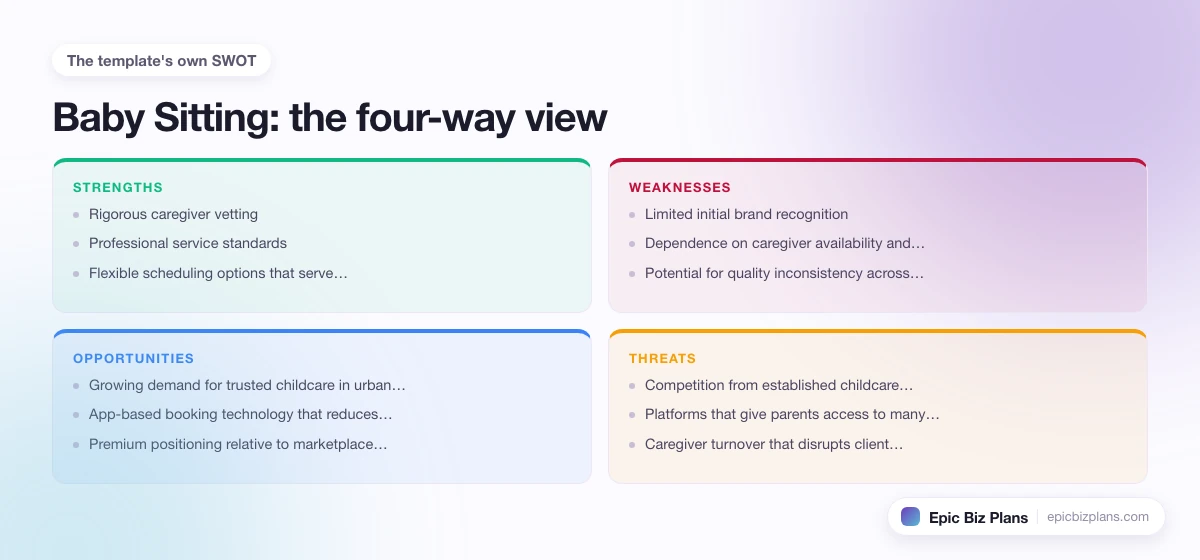
- Strengths: Rigorous caregiver vetting, professional service standards, flexible scheduling options that serve different family needs.
- Weaknesses: Limited initial brand recognition, dependence on caregiver availability and reliability, potential for quality inconsistency across multiple caregivers as the service scales.
- Opportunities: Growing demand for trusted childcare in urban areas, app-based booking technology that reduces administrative burden, premium positioning relative to marketplace platforms.
- Threats: Competition from established childcare agencies, platforms that give parents access to many individual caregivers at lower prices, caregiver turnover that disrupts client relationships.
Baby Sitting Business Name Ideas
Employee or Contractor: The Decision That Sets Your Prices
Almost every new babysitting service treats its caregivers as independent contractors, and in most cases that classification does not hold. Where you set the schedule, assign the family, set the rate, require your vetting and training, and place a backup sitter when someone calls in sick, you are exercising the control that defines an employment relationship. The label on the contract does not decide it; the working arrangement does.
Which model you choose changes three things at once, so decide it before you price anything:
- Agency model, caregivers employed by you. You carry payroll taxes at 7.65% employer FICA plus federal and state unemployment, workers' compensation in most states, and payroll administration. Your billing rate has to cover roughly 15% to 25% above the wage before any margin. In exchange you can direct the work, enforce standards, and build genuine consistency, which is the whole basis of the premium positioning.
- Placement model, family employs the caregiver. You introduce and vet, the family pays the sitter directly, and you charge a placement or membership fee. Your compliance burden drops sharply, but so does your control and your recurring revenue.
- The household employer rules apply to your clients either way. A family paying any one household employee $3,000 or more in cash wages during 2026, up from $2,800 in 2025, owes Social Security and Medicare on all of it and files Schedule H with their return. A separate $1,000-in-a-quarter test triggers federal unemployment tax. A caregiver under 18 is exempt unless household work is their main occupation, which is why the teenage-sitter end of the market sits outside all of this.
Telling a regular client about the $3,000 threshold before they cross it is a genuine service, and it distinguishes a professional operation from a listings site. It also protects you, since the family that gets a surprise tax bill blames whoever placed the sitter.
Website
We will build our website using Wix, which provides a straightforward interface suited to our team's technical capabilities and lets us present services, caregiver profiles, pricing, and client testimonials effectively. For a service business built on trust, the website needs to clearly communicate caregiver credentials, background check policies, insurance coverage, and parent references. These elements do more to convert a first-time visitor into a client than any design element.
Insurance: Read the Exclusion Before You Buy the Policy
General liability is the policy every new childcare business buys, and on its own it does not cover the claim that would end the business. The standard abuse or molestation exclusion removes coverage for injury arising out of actual or threatened abuse or molestation of anyone in the care, custody, or control of the insured. That description covers every single booking you will ever take.
Three outcomes are common when an operator actually reads their policy: a full exclusion, coverage added back by endorsement at a sublimit far below the main policy limit and commonly around $25,000, or coverage that protects the business entity but not the individual caregiver named in the claim. Standalone abuse and molestation cover is written in much larger limits, and it is the line item that belongs in this plan rather than a generic insurance figure.
Ask a broker four specific questions before binding anything. Is abuse and molestation excluded, sublimited, or covered at full limits? Does the policy defend the individual caregiver as well as the business? Does professional liability cover allegations of negligent hiring and negligent supervision, which is how most claims against an agency are actually framed? And does coverage extend to work performed in the client's home rather than on premises you control? Budget realistically: a properly covered childcare operation pays materially more than the $500 to $1,500 a year a bare general liability quote suggests.
Marketing Details
Our primary marketing channels are direct community outreach, parent network referrals, and local search. Babysitting services are fundamentally local businesses. Parents in a neighborhood share recommendations with each other, and a reputation built in one ZIP code spreads quickly through school parent groups, neighborhood apps, and word of mouth. Our marketing prioritizes building that local reputation before investing heavily in broader digital advertising.
Search volumes justify a local listing strategy rather than a national one: "babysitting" draws roughly 22,200 US searches a month and "babysitters near me" about 18,100, while "nanny agency near me" runs around 2,900 with advertiser bids up to $14. The gap between those bids and the low bids on general babysitting terms tells you where the money is: agency and placement intent converts, casual sitter searching does not. An email tool manages client communication, covering booking confirmations, caregiver updates, and occasional newsletters that keep us in mind with families who are not currently active. Short video content aimed at young parents, including care tips, caregiver introductions, and how our vetting works, builds familiarity before a family needs us. Operators selling parent and infant products alongside care services can pull marketing benchmarks from our mom and baby business plan template.
-
 SemrushSemrush is a platform with literally any online tool you will need to promote your business. Spy on your competitors, get search traffic, keyword research, social info, ad copies and much more. Used by most of the top online companies in the world. Besides all its tools, Semrush also has many available integrations possible with many other tools that will make your work even better.
 -
 Surfer SEOSurfer SEO is an incredibly smart AI tool that will give you exact explanations what to do in order to make your website rank better. They use hundreds of parameters, check your competitors and decide on the best course of action. Whether it be inner links, bold text, paragraphs, headers, images and much more. Surfer is a must-have in 2026.
Industry Trends
App-based childcare platforms have made it easier for parents to find individual babysitters quickly, but they have also created frustrations: variable quality, last-minute cancellations, and limited accountability. This has created a consistent market for managed babysitting services that offer a curated roster of vetted caregivers, consistent standards, and a business the parent can hold accountable rather than a platform that disclaims responsibility for individual sitter behavior.
Specialized caregiving, including tutoring alongside sitting, language immersion care, and care for children with specific needs, is a growing niche within the broader childcare market. These specializations justify premium pricing and create a more defensible competitive position than generalist babysitting services competing on price.
Competitor Information
Our primary competitors are marketplace platforms, local established babysitting agencies, and informal individual babysitters who rely on neighborhood networks. The platforms have broad awareness but inconsistent quality and no accountability. Individual caregivers in neighborhood networks are often the cheapest option but are unavailable during high-demand periods and have no backup if they cancel. Established local agencies have the quality positioning we aspire to but may have years of market presence and established client rosters.
Our differentiation is a combination of the accountability and quality standards of an established agency with the responsiveness and personal service of a smaller operation. We will be more flexible than large agencies, maintain higher standards than platform-based individual sitters, and communicate better than both. Building and displaying a strong base of verified parent testimonials is essential to making this positioning credible.
Financial Information
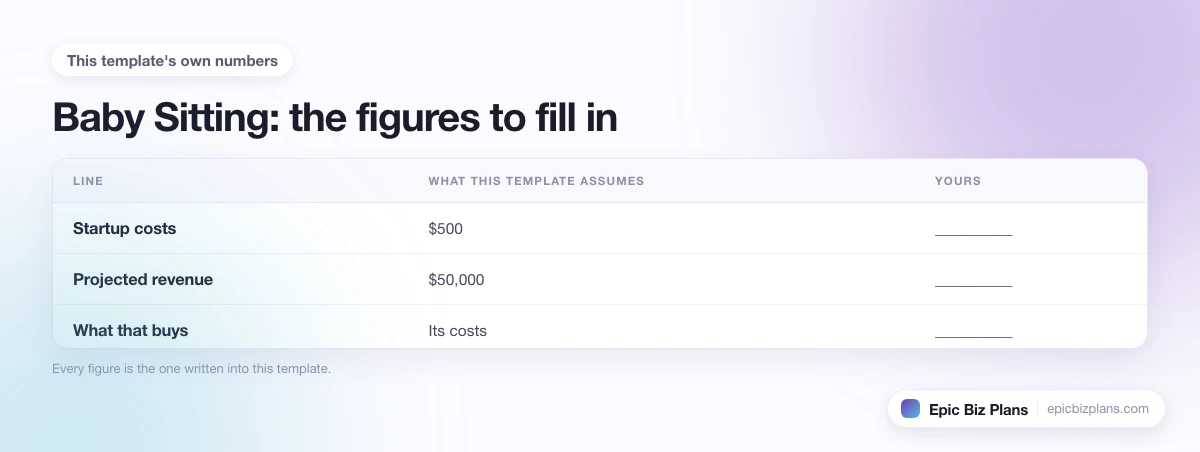
Startup costs include background check fees for the initial caregiver roster ($500 to $1,000), website development ($500 to $1,000), local marketing materials ($500), and administrative tools for scheduling and client management ($50 to $150 a month). Insurance is budgeted separately and realistically, per the coverage discussion above, since a bare general liability quote understates what this business actually needs. Total startup capital for a solo or small team launch lands between $5,000 and $10,000 depending on the insurance placement.
Year one revenue of $50,000 at an average billing rate of $18 to $25 an hour requires roughly 2,000 to 2,800 service hours. With a roster of three to five active caregivers each working 15 to 20 hours a week on our booked services, this is achievable in a market with adequate demand. The margin arithmetic matters more than the hour count: billing $25 and paying $18 leaves $7, and employer payroll taxes take roughly $1.40 of it before insurance, background checks, scheduling software, and your own time. An agency model that does not bill at least 1.4 times the caregiver wage is not covering its costs.
Legal and Compliance
Childcare regulation varies sharply by state, and the distinction that matters is what you are. Care delivered in the child's own home by a sitter is usually outside childcare facility licensing. Running a business that recruits, vets, and places caregivers with families frequently falls under separate rules for placement or employment agencies, including registration, bonding, and disclosure requirements about fees and refunds. Confirm which regime applies in your state before you accept your first booking, because the penalty for getting it wrong is not just a fine but the loss of the credibility the whole business rests on.
Background screening should go further than a single national database search, which is where many services stop. A defensible check combines a fingerprint-based criminal history search, a state child abuse and neglect registry check in every state the caregiver has lived in, a sex offender registry search, a driving record where transport is involved, and direct reference calls. Current CPR and pediatric first aid certification should be verified rather than self-reported, and re-verified at renewal. Document every step and keep the records, because the claim that ends an agency is negligent hiring, and the defence is the file.
Operational Plan
Caregiver recruitment, vetting, and training is the central operational function of this business. Our vetting process includes a criminal background check, reference calls with at least three previous families, an in-person interview, verification of CPR and first aid certification, and a trial booking with supervisor oversight. Only caregivers who complete the full process will be placed with client families, and the completed file is retained for the life of the relationship and beyond.
Scheduling is managed through booking software that lets clients request specific caregivers, confirms availability in real time, and sends automated reminders to both caregivers and clients. We maintain a backup caregiver list for every confirmed booking so a caregiver illness or emergency does not result in a cancelled appointment for a family who has made plans around our service.
-
ShopifyPut your brand on Shopify. Launch your online store with tools designed for growth and success. Ready to turn your idea into profit? Start building your e-commerce business today.
-
SquarespaceShowcase your brand with Squarespace’s sleek designs. Build a professional online presence with ease. Start with a template that already looks finished.
-
WixBring your ideas to life with Wix. Customize every aspect of your site with unmatched flexibility. Start creating your unique online space and let your creativity shine.
-
ElementorCraft captivating websites effortlessly with Elementor. Enjoy complete creative control without coding. Make your site stand out to your audience. Start turning your vision into reality now.
Contingency Planning
Caregiver turnover is the most significant operational risk in this business. Our mitigation includes maintaining a roster larger than current booking volume so we always have capacity and backup, offering competitive pay and consistent scheduling to reduce churn, and building client relationships with multiple caregivers so a single departure does not cause a client departure.
If client acquisition proves slower than projected, we will focus on a narrower geographic area to build density of clients and caregivers in one community before expanding. A service with 20 regular clients in two neighborhoods is more operationally efficient and more referral-productive than 20 clients spread across 10 neighborhoods. We will also hold a written incident procedure covering injury, allegation, and media contact, agreed with our insurer in advance, because the first hour of a serious incident is not the time to be improvising.
Summing It All Up
The babysitting business plan gives you a complete framework for building a childcare service that families in your community trust, return to regularly, and recommend to their friends. Trust is the product in this business, and the plan is how you build the systems and practices that create it consistently at scale.
Multiple Service Formats to Consider
Babysitting businesses can take several forms: a solo caregiver building a personal client base, a small agency with a roster of caregivers and an owner-operator managing bookings and quality, or a technology-enabled platform connecting vetted caregivers with local families. Each has different startup costs, margin profiles, and scaling dynamics. The solo model requires minimal capital, the agency model requires more initial investment but scales more reliably, and the platform model is the most capital-intensive and hardest to build without technical resources. Operators considering a live-in or full-time placement model should compare structures in the nanny business plan template.
Update Your Plan as You Learn
Once you are operating, update this plan quarterly with real data on your average booking value, caregiver booked-hours ratio, client retention rate, and primary acquisition sources. These metrics tell you where to invest and where to pull back. Most babysitting businesses grow primarily through referrals. If your referral rate is high, invest in serving existing clients better; if it is low, find out why and fix the service issue before spending more on marketing.
Use Your Plan With Key Stakeholders
Your babysitting business plan can be used to apply for small business grants and loans, to present your service to corporate HR departments who might include it in employee benefits packages, or to negotiate partnerships with pediatric offices, family-focused businesses, or community organizations that refer families to your service. A thorough plan demonstrates that you run a serious, accountable business, which matters when you are asking others to trust you with their children.
Your babysitting business plan is 100% free, with unlimited edits, unlimited downloads, and unlimited chances to refine it as your service grows.
