
Athlete Business Plan Template
-
 ShopifyPut your brand on Shopify. Launch your online store with tools designed for growth and success. Ready to turn your idea into profit? Start building your e-commerce business today.
 -
 SquarespaceShowcase your brand with Squarespace’s sleek designs. Build a professional online presence with ease. Start with a template that already looks finished.
 -
 WixBring your ideas to life with Wix. Customize every aspect of your site with unmatched flexibility. Start creating your unique online space and let your creativity shine.
 -
 ElementorCraft captivating websites effortlessly with Elementor. Enjoy complete creative control without coding. Make your site stand out to your audience. Start turning your vision into reality now.
- Executive Summary
- Business Info
- SWOT Analysis
- Atleta Ideas para nombres de negocio
- Website
- Marketing Details
- Industry Trends
- Competitor Information
- Financial Information
- Legal and Compliance
- Operational Plan
- Contingency Planning
- Sponsorship and Partnerships
- Customer Experience and Retention
- Your Athlete Business Plan: The Path to Freedom and Passion
- Adapting Your Business Plan
- Practical Uses for Your Plan
The sports business sits at the intersection of performance, brand, and community, and your athlete business plan is the document that ties them together. Whether you are an active competitor stepping into entrepreneurship or a sports founder building a brand around training and gear, the plan needs to reflect your personal identity and the audience you want to reach. It also needs to answer the practical questions: what you sell, who buys it, and how you make money doing it.
Nobody wins in this category by luck. It comes from clear positioning, disciplined execution, and a plan you actually open when a decision needs making. Treat the plan as a working tool: bold where it helps the brand, concrete where it helps the operation. Done right, it becomes the basis for partnerships, sponsorships, funding conversations, and team alignment.
Executive Summary
We will build a sports-related business focused on supporting athletes at every level. The mission is to provide quality athletic gear and training resources that help customers train better and recover faster. The vision is to become a brand recognized for product quality and useful programming, not just marketing volume.
Our value proposition combines well-made products with personalized training advice, so customers get more than a transaction. Financially, we aim to reach break-even within the first year and grow to roughly $500,000 in revenue by year two, supported by a clear product roadmap and a measured paid marketing budget. Founders selling branded athletic gear may also find the Champion business plan template useful for structuring a sports apparel line.
Business Info
Our primary focus is developing and selling athletic gear (apparel, footwear, and training accessories) alongside online programs that help customers use the gear correctly. We will target athletes aged 15-35, including amateur competitors, fitness enthusiasts, and pro players who want better tools and clearer guidance. Many of these same athletes also seek out a sports massage therapy practice for recovery. The business will run as a direct-to-consumer e-commerce operation, with selected partnerships at gyms and clubs. Stores focused on strength training equipment can structure that catalog using a lifting business plan.
SWOT Analysis
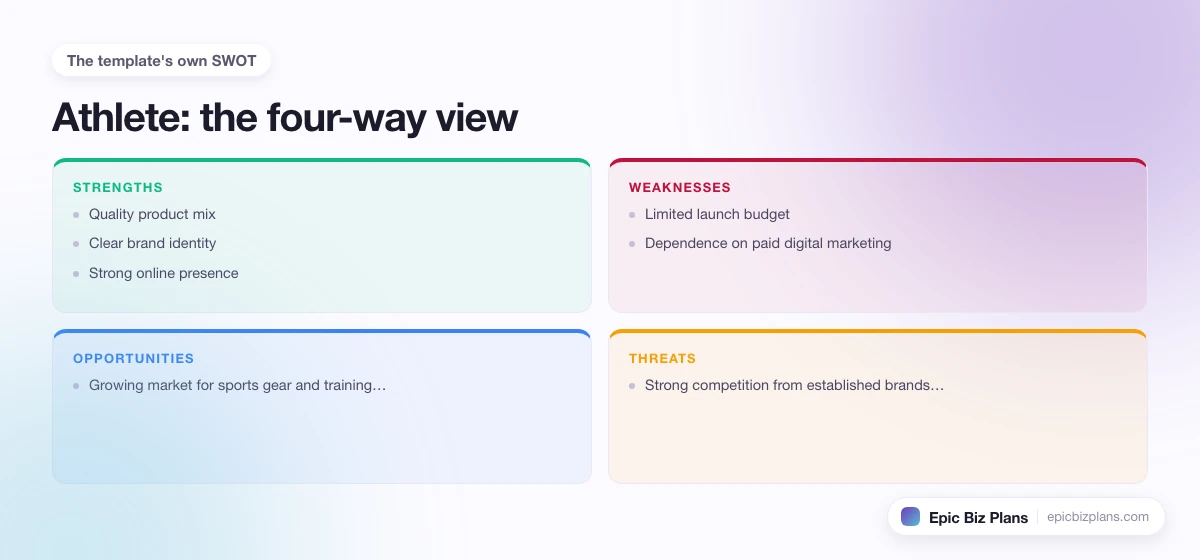
- Strengths: Quality product mix, clear brand identity, strong online presence.
- Weaknesses: Limited launch budget, dependence on paid digital marketing.
- Opportunities: Growing market for sports gear and training services tied to broader trends covered in our health and fitness business plan template.
- Threats: Strong competition from established brands and shifts in consumer spending.
Atleta Ideas para nombres de negocio
Website
We will build the e-commerce site on Shopify because it handles product catalogs, payments, and shipping cleanly out of the box. If we shift toward a portfolio or content-led brand experience, Wix is a reasonable secondary option. Either way, the site needs to be fast, mobile-first, and easy for customers to find products and book training programs without friction.
Marketing Details
Our marketing strategy combines digital channels and direct community engagement. We will use Semrush for keyword research and ongoing SEO so the site shows up for buying-intent searches. Email campaigns will run through HubSpot, with segmented lists for new customers, returning buyers, and program subscribers. Cross-category tactics that work for adjacent brands like our sport clothes business plan template apply here too.
To reach younger athletes, we will run TikTok and Instagram campaigns with product clips, training breakdowns, and athlete partnerships. The goal is to create content that earns attention rather than relying purely on paid impressions, which keeps customer acquisition cost manageable as the brand grows.
Industry Trends
The sports industry keeps growing on the back of new fabrics, wearables, and recovery products like percussion guns and cold plunges. Athletes care about training data, sustainable production, and gear that performs in real conditions. Buyers are also more willing to pay for products from brands they trust, which makes content quality and customer service real differentiators rather than nice-to-haves.
Competitor Information
We will analyze direct and indirect competitors in athletic gear and training services. Main competitors include established global brands with massive distribution. Our edge comes from product quality, smaller-batch design, and personal service that big brands struggle to deliver. Founders who want to draw lessons from the broader gear category can also reference our sport shoes business plan template.
Financial Information
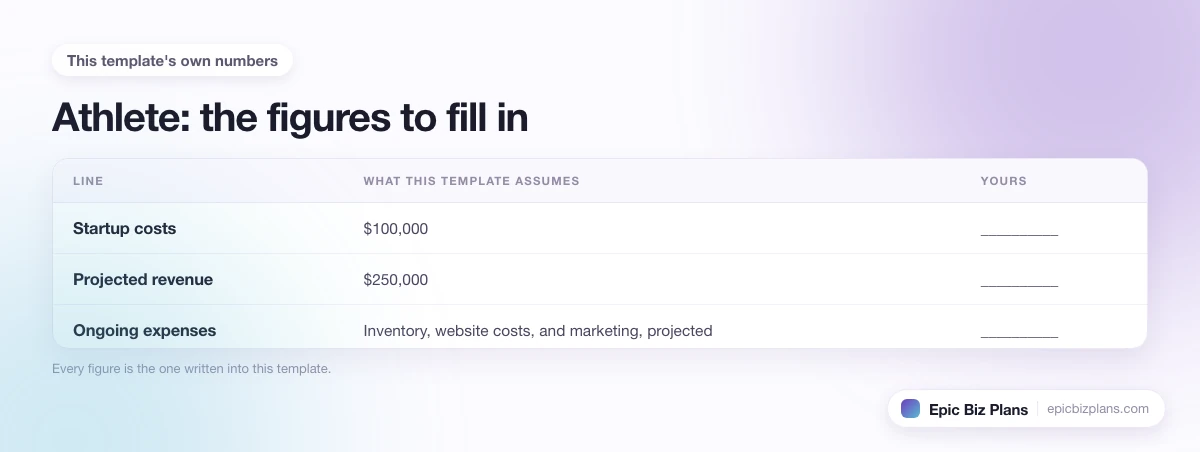
Startup costs are projected near $100,000, covering product development, marketing, and operational expenses. We target first-year revenue of $250,000 and a roughly 100% increase in year two. Ongoing expenses include inventory, website costs, and marketing, projected around $150,000 annually.
We will maintain a cash flow statement and a monthly P&L review so we can adjust spending and inventory commitments before they become problems. Margin discipline matters more than top-line growth, especially in the first 18 months.
Legal and Compliance
Essential legal requirements include registering the business, obtaining required licenses, and trademarking the brand and product names. We will also protect intellectual property tied to proprietary designs and training programs through written agreements with contractors and athletes.
Operational Plan
Key operations include sourcing materials, product development, and supply chain management. We will work with manufacturers who have a track record of consistent quality and on-time deliveries. Logistics will focus on accurate inventory levels, fast shipping, and a returns process that does not punish honest customers. Our independent sportswear startup plan breaks down sampling timelines and landed costs for a first production run.
Contingency Planning
Athletes looking to build a performance entertainment business or live event brand around their skills should also review the pro wrestling business plan for event production budgeting, talent contract frameworks, and ticket revenue models. We recognize potential risks such as market shifts and supply chain disruptions. To address them, we will develop backup suppliers and keep inventory levels flexible so we can adapt as demand changes. We will also maintain a basic crisis playbook so the team can respond quickly to product, supply, or PR issues.
-
 SemrushSemrush is a platform with literally any online tool you will need to promote your business. Spy on your competitors, get search traffic, keyword research, social info, ad copies and much more. Used by most of the top online companies in the world. Besides all its tools, Semrush also has many available integrations possible with many other tools that will make your work even better.
 -
 Surfer SEOSurfer SEO is an incredibly smart AI tool that will give you exact explanations what to do in order to make your website rank better. They use hundreds of parameters, check your competitors and decide on the best course of action. Whether it be inner links, bold text, paragraphs, headers, images and much more. Surfer is a must-have in 2026.
Sponsorship and Partnerships
Brand growth in this category often runs through partnerships rather than pure paid media. We will target sponsorships with local clubs, training facilities, and amateur events that align with our customer base. Athlete partnerships will favor athletes whose values match the brand and whose audiences match our target market, even if their follower counts are smaller. Sponsorship contracts will include clear deliverables, usage rights, and exit terms.
Customer Experience and Retention
Retention is where the business gets profitable. We will run a small loyalty program tied to gear purchases and training program subscriptions, plus repair and refresh offers that keep customers engaged after the initial purchase. Coaches and trainers building related operations can adapt similar tactics from our coach business plan template, which covers retention for service-led sports businesses.
Your Athlete Business Plan: The Path to Freedom and Passion
An athlete business plan is more than charts and numbers. It is the working blueprint for the lifestyle and brand you want to build. This is your chance to turn skill, training, and audience into a business that actually pays. The options range from a gym, a fitness app, a small apparel brand, or a niche e-commerce store focused on a specific sport or training problem.
Adapting Your Business Plan
Treat the plan as a living document. As the business grows, so should the plan. Adjust it for new audiences, test pricing changes, add products, or open new sales channels when the data supports it. Plans that stay rigid usually get outpaced by plans that get updated.
Practical Uses for Your Plan
Use the plan to talk to partners, organize your launch, talk to investors, or get the team aligned on priorities. It is your reference document, the place you go when you need to remember what you decided and why.
Your athlete business plan is 100% free, with unlimited edits, unlimited downloads, and unlimited chances to get it right.
