
Arrow Business Plan Template
-
 ShopifyPut your brand on Shopify. Launch your online store with tools designed for growth and success. Ready to turn your idea into profit? Start building your e-commerce business today.
 -
 SquarespaceShowcase your brand with Squarespace’s sleek designs. Build a professional online presence with ease. Start with a template that already looks finished.
 -
 WixBring your ideas to life with Wix. Customize every aspect of your site with unmatched flexibility. Start creating your unique online space and let your creativity shine.
 -
 ElementorCraft captivating websites effortlessly with Elementor. Enjoy complete creative control without coding. Make your site stand out to your audience. Start turning your vision into reality now.
- Executive Summary
- Business Info
- SWOT Analysis
- Arrow Business Name Ideas
- Website
- Marketing Details
- Industry Trends
- Competitor Information
- Financial Information
- Legal and Compliance
- Operational Plan
- Contingency Planning
- Embrace Your Vision
- Your Growth Path
- Putting Your Plan to Work
- Seize the Opportunity
Arrow is building an eco-friendly tech accessories brand for consumers who want products that work well and align with their values. The market for sustainable tech accessories-phone cases, chargers, headphones, and similar items-is growing steadily as more buyers actively choose products that minimize environmental impact without sacrificing quality or style. This business plan lays out how to build a profitable brand in that space, from product development through marketing and financial management.
The core challenge in this market is standing out. Eco-friendly positioning is increasingly common, which means the claim alone doesn't differentiate you anymore-your products, your supply chain transparency, and your brand story all need to back it up. This plan is built around that reality.
Executive Summary
Our mission is to produce high-quality, eco-conscious tech accessories that consumers are proud to own and use. We will focus on phone cases, chargers, and headphones made from sustainable materials and manufactured by partners who meet our environmental and labor standards. Our target customer is an environmentally conscious buyer aged 18 to 40 who shops online, follows sustainability-focused brands on social media, and is willing to pay a modest premium for products that align with their values.
We project $500,000 in revenue in year one, with startup costs of $75,000 and a projected profit margin of 30%. Growth will be driven by a strong direct-to-consumer online presence and a marketing strategy built around social proof and sustainability credentials.
Business Info
Arrow will sell eco-friendly tech accessories directly to consumers through our own website and selected online marketplaces. Our product line will start focused-phone cases, cables, and charging accessories-and expand based on customer demand and supplier capabilities. Keeping the initial range tight lets us maintain quality control and build deep expertise in a few categories before branching out.
SWOT Analysis
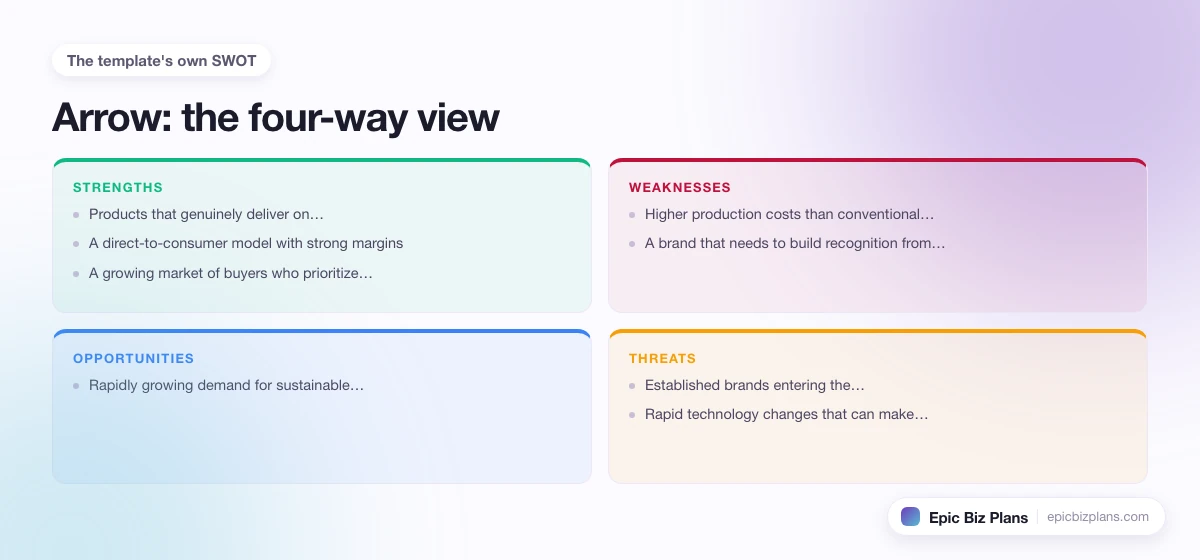
- Strengths: Products that genuinely deliver on sustainability claims, a direct-to-consumer model with strong margins, and a growing market of buyers who prioritize eco-conscious purchasing.
- Weaknesses: Higher production costs than conventional alternatives, and a brand that needs to build recognition from scratch.
- Opportunities: Rapidly growing demand for sustainable consumer tech products and the ability to reach global customers through eCommerce.
- Threats: Established brands entering the sustainability space with larger marketing budgets, and rapid technology changes that can make accessories obsolete quickly.
Arrow Business Name Ideas
Website
We will build our store on Shopify, which provides everything we need to manage product listings, inventory, payments, and fulfillment in one place. Shopify's app ecosystem also lets us add features like carbon offset integrations and sustainability certifications displays that are important for our brand positioning. Product photography and detailed materials information will be central to our site design, because our target customers want to know exactly what they're buying and why it's better than the conventional alternative.
Marketing Details
Our marketing strategy focuses on three channels: organic social, paid TikTok, and email. We will use Semrush to identify the search terms our target customers use when looking for sustainable tech accessories, and build product pages and blog content that rank for those queries over time. Email marketing through HubSpot will keep our customer base informed about new products, sustainability updates, and promotions.
TikTok ads targeting 18-to-35-year-old consumers with an interest in sustainability and technology will be our primary paid channel. Short-form video content that shows our materials, manufacturing process, and products in real use scenarios builds the kind of trust that drives purchase decisions for a brand customers haven't heard of before. For related business strategies in the accessories space, see our tech accessories business plan and our electronic accessories business plan template.
Industry Trends
Consumer awareness of the environmental footprint of consumer electronics has grown significantly, and that awareness is translating into purchasing behavior. Buyers increasingly read product descriptions looking for materials sourcing information, certifications, and end-of-life disposal options. Brands that provide that information clearly and honestly are winning customers that generic competitors cannot reach.
The tech accessories market also benefits from consistent refresh cycles-people replace their phones regularly, which means they replace their cases and accessories regularly too. This creates a natural repeat-purchase dynamic that, combined with strong customer service, can generate significant lifetime value from individual buyers.
Competitor Information
Our direct competitors include other eco-focused tech accessory brands and the growing number of mainstream brands adding sustainable product lines. We will differentiate through supply chain transparency-we will document and communicate exactly where our materials come from and how they're processed-and through product quality that stands up to comparison with conventional alternatives. Our indirect competitors are conventional tech accessory brands. We compete with them by making the sustainability premium feel worthwhile through better materials and a stronger brand story. See our phone case business plan for a focused look at that specific product category.
Financial Information
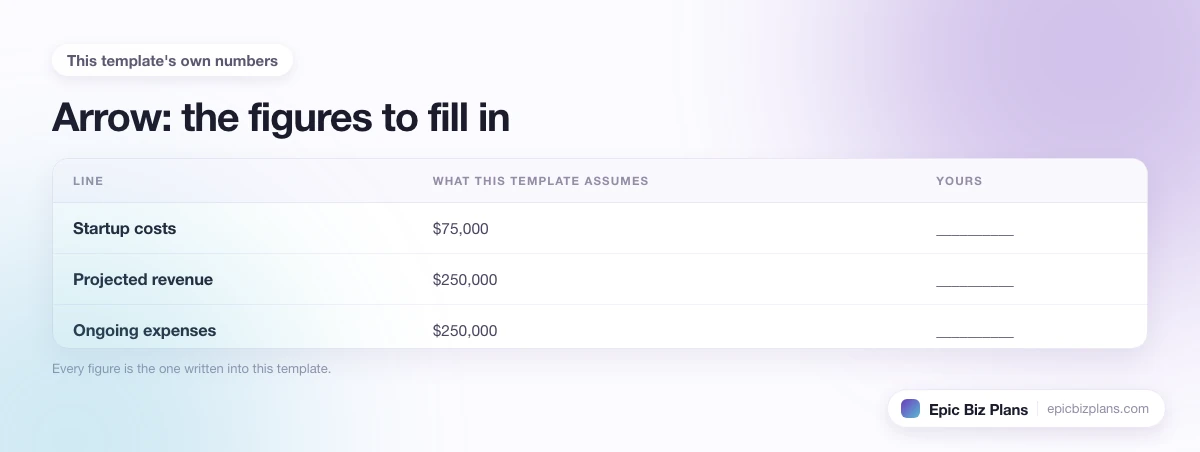
Startup costs of $75,000 cover product design and sourcing, initial inventory, website development, branding, and marketing. We project $500,000 in year-one revenue with ongoing expenses of approximately $250,000, yielding a 30% profit margin as we scale. Monthly P&L reviews will track our actual performance against these targets and help us reallocate budget quickly if a product or channel underperforms.
Legal and Compliance
We will register the business and obtain all required licenses. Our brand name and key product lines will be trademarked before launch. Product safety certifications will be obtained for all items before they go on sale, as consumer electronics accessories are subject to regulatory requirements in most major markets. Any sustainability claims in our marketing will be accurate and documentable, because misleading environmental claims create both reputational and legal risk.
Operational Plan
Operations will center on supplier management, quality control, and order fulfillment. We will partner exclusively with manufacturers who can document their environmental and labor standards, and we will conduct periodic audits to verify those standards are being maintained. Quality checks on incoming inventory will happen before items are listed for sale. Fulfillment will be handled through a third-party logistics provider experienced with eCommerce at our scale, allowing us to focus on product and marketing rather than warehouse operations.
Contingency Planning
The risks most likely to affect us are supply chain disruptions for sustainable materials, rapid technology changes that render specific accessories obsolete, and economic pressure that causes buyers to trade down to cheaper alternatives. We will maintain backup supplier relationships for all core materials, design products to be compatible across multiple device generations where possible, and build a customer base loyal enough to the brand that price sensitivity is reduced. A three-month operating cash reserve will cover unexpected disruptions.
-
 SemrushSemrush is a platform with literally any online tool you will need to promote your business. Spy on your competitors, get search traffic, keyword research, social info, ad copies and much more. Used by most of the top online companies in the world. Besides all its tools, Semrush also has many available integrations possible with many other tools that will make your work even better.
 -
 Surfer SEOSurfer SEO is an incredibly smart AI tool that will give you exact explanations what to do in order to make your website rank better. They use hundreds of parameters, check your competitors and decide on the best course of action. Whether it be inner links, bold text, paragraphs, headers, images and much more. Surfer is a must-have in 2026.
Embrace Your Vision
An eco-friendly tech accessories business works because the market is real and growing. Consumers who care about sustainability are actively looking for alternatives to conventional products in every category, including tech accessories-and most of what's currently available doesn't fully meet their expectations. If you can build a brand that genuinely delivers on its sustainability promises while selling products that perform well, you have a real competitive position in a market with strong demand and room to grow.
Your Growth Path
Start focused, learn fast, and expand methodically. Your first product line should be narrow enough that you can source and quality-control it well. As you learn which products sell best and which sustainability claims resonate most with your customers, you'll have the information you need to expand intelligently rather than speculatively.
Putting Your Plan to Work
Use this business plan when approaching manufacturers or suppliers, presenting to investors, applying for business financing, or onboarding early team members. A clear plan signals that you understand your market and have thought through the details that matter most for execution.
Seize the Opportunity
Your Arrow business plan is 100% free - with unlimited edits, unlimited downloads, and unlimited chances to get it right. Start building today and use it as the foundation for a brand built on genuine sustainability and quality.
