
Arborist Business Plan Template
-
 ShopifyPut your brand on Shopify. Launch your online store with tools designed for growth and success. Ready to turn your idea into profit? Start building your e-commerce business today.
 -
 SquarespaceShowcase your brand with Squarespace’s sleek designs. Build a professional online presence with ease. Start with a template that already looks finished.
 -
 WixBring your ideas to life with Wix. Customize every aspect of your site with unmatched flexibility. Start creating your unique online space and let your creativity shine.
 -
 ElementorCraft captivating websites effortlessly with Elementor. Enjoy complete creative control without coding. Make your site stand out to your audience. Start turning your vision into reality now.
- Executive Summary
- Business Info
- SWOT Analysis
- Arborist Business Name Ideas
- Website
- Marketing Details
- Industry Trends
- Competitor Information
- Financial Information
- Safety and Certification Program
- Legal and Compliance
- Operational Plan
- Contingency Planning
- Build Something That Lasts
- Adapt and Grow
- Practical Applications
- Confidently Step Forward
A well-built Arborist business plan gives you a structured starting point for a tree care company in a market that rewards skill and reliability. The arboriculture industry has steady demand from residential, commercial, and municipal clients, but margin and safety are tight enough that operating without a plan is a costly habit. Document your service mix, your pricing, your equipment investment, and your customer acquisition approach in concrete terms before you bid your first job.
This document is more than a pitch piece for lenders. It is the working reference that tells you what to budget for insurance, what your crew utilization needs to look like, and which neighborhoods produce the highest-margin work. Tree care is a relationship business; repeat clients and word-of-mouth referrals drive the strongest revenue, so your plan must address how you build and keep that reputation.
Executive Summary
We will build an arborist services company focused on tree health management, trimming, removal, and consultation. Our mission is to provide reliable, safe tree care that improves the long-term health of residential and commercial properties. Our long-term vision is to become the go-to arborist in our regional market, known for technical skill and a strong safety record.
Our value proposition combines certified expertise, responsive customer service, and sustainable practices that protect tree health beyond a single visit. Financially, we aim to reach break-even within the first year and target 15% annual revenue growth after that.
Business Info
Our services will include tree trimming, pruning, health assessments, and emergency tree removal for residential homeowners, commercial property owners, and municipal clients. Our model generates revenue through individual service jobs, annual maintenance contracts, and consultation work. For operators expanding into adjacent landscape categories, the landscaping business plan template covers parallel service planning.
SWOT Analysis
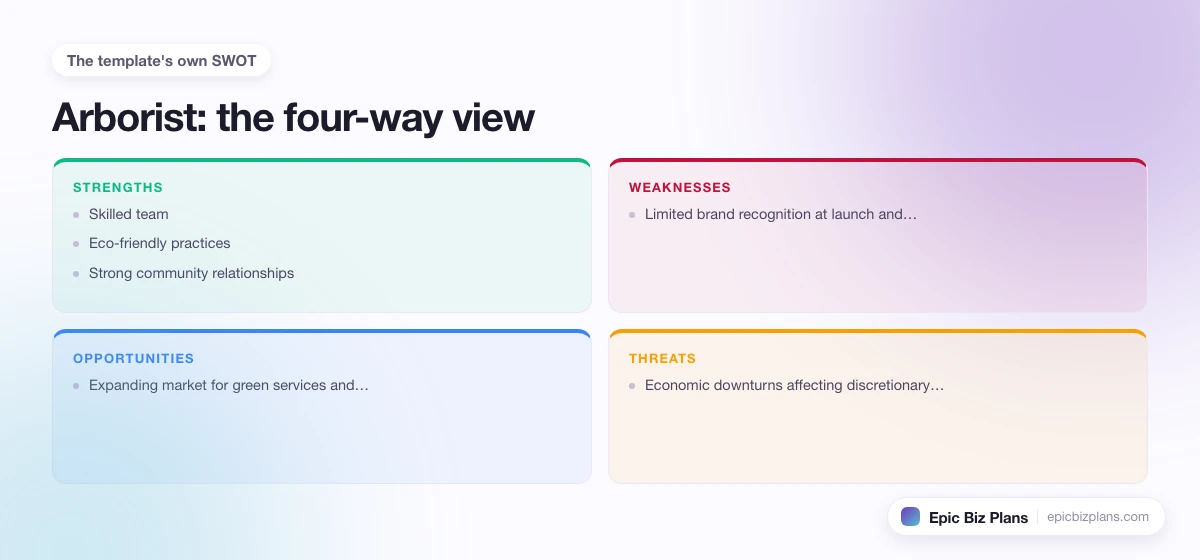
- Strengths: Skilled team, eco-friendly practices, and strong community relationships.
- Weaknesses: Limited brand recognition at launch and seasonal demand patterns.
- Opportunities: Expanding market for green services and growing awareness of tree health.
- Threats: Economic downturns affecting discretionary spending and competition from larger firms.
Arborist Business Name Ideas
Website
We will build our website on Wix because of its user-friendly interface and low maintenance overhead for non-technical staff. The site will show our services, certifications, before-and-after photos, and customer testimonials so prospects can qualify themselves before calling. We will publish educational content on tree care to support SEO and demonstrate expertise. If we outgrow Wix, we will consider moving to WordPress for added flexibility.
Marketing Details
Our marketing strategy combines local SEO, paid social, and email. Semrush will guide our keyword research so we appear for region-specific searches like our city plus tree removal, stump grinding, or arborist consultation. HubSpot will handle email campaigns for past clients with seasonal maintenance reminders and storm-preparation tips.
TikTok and Instagram ads can build broader brand visibility, particularly with short clips of crew work and time-lapse removals that convert well in this category. Google Business Profile reviews matter enormously for local service businesses, so we will actively request reviews after every completed job.
Industry Trends
The arboriculture industry continues to shift toward sustainable practices and tech-supported diagnostics. Drone surveying for canopy assessment and software for tree inventory management are now reasonably priced for smaller operators, and clients increasingly expect tree care providers to use them. Urban greening initiatives by local governments also create steady municipal contract opportunities that did not exist a decade ago.
Competitor Information
We will analyze direct competitors (established local arborist firms and landscaping companies that include tree care) and indirect competitors (handyman services offering basic tree work). Our differentiation will come from certified arborist credentials, documented safety practices, and educational outreach that builds long-term trust with clients. For operators expanding into specialty tree services, the tree removal business plan template and the tree trimming business plan template cover service-specific pricing in more depth.
Financial Information
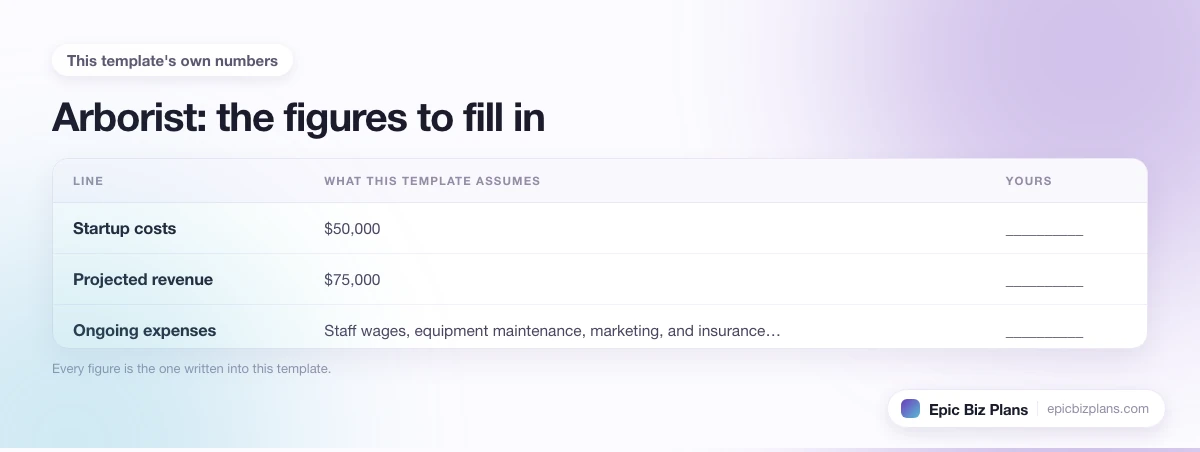
Startup costs are estimated at $50,000, covering equipment, licensing, insurance, marketing, and website development. First-year revenue is projected at $75,000, with gradual growth as we expand the client base and add maintenance contract revenue. Ongoing expenses include staff wages, equipment maintenance, marketing, and insurance premiums. We aim for positive cash flow in year one and will maintain monthly P&L statements to track financial health.
Safety and Certification Program
Safety drives long-term profitability in arborist work more than almost any other factor. We will require ISA (International Society of Arboriculture) certification for all lead arborists and maintain current OSHA compliance across the crew. Insurance premiums respond directly to incident history, so a clean record protects margin year after year.
Our safety program will include daily pre-job briefings, documented equipment inspections, and refresher training on rigging, climbing, and chainsaw operation. Any subcontracted work will require proof of certification and insurance before crews step on a job site. The cost of one serious incident dwarfs the cost of running a strict program, both in direct expense and in the reputational damage that takes years to repair.
Legal and Compliance
We will register the business under the right local entity, secure all required permits for tree removal, and maintain general liability and workers compensation coverage. Trademark protection for the company name will be filed in year one. Any proprietary treatment approaches or branded service packages will follow as the business expands.
Operational Plan
Key operations cover customer service from initial consultation through project completion, equipment maintenance, and crew scheduling. We will build relationships with at least two suppliers for tools, safety gear, and treatment products to avoid stockouts. An efficient scheduling system will manage appointments and protect crew utilization, since idle equipment and labor are the fastest path to margin loss in this business. Operators considering related forestry work should also review the forestry business plan template.
-
 SemrushSemrush is a platform with literally any online tool you will need to promote your business. Spy on your competitors, get search traffic, keyword research, social info, ad copies and much more. Used by most of the top online companies in the world. Besides all its tools, Semrush also has many available integrations possible with many other tools that will make your work even better.
 -
 Surfer SEOSurfer SEO is an incredibly smart AI tool that will give you exact explanations what to do in order to make your website rank better. They use hundreds of parameters, check your competitors and decide on the best course of action. Whether it be inner links, bold text, paragraphs, headers, images and much more. Surfer is a must-have in 2026.
Contingency Planning
Recognized risks include economic downturns affecting residential discretionary spending, severe weather disrupting service delivery, and rising competition in the local market. Mitigation includes flexible pricing for off-season work, diversified service offerings, and a cash reserve covering at least three months of fixed costs. Maintaining a steady marketing presence even during slow periods keeps the funnel filled when conditions improve.
Build Something That Lasts
Starting an arborist business is about more than tree work; it is about building a reputation that brings repeat customers and referrals year after year. From small local services focused on residential trimming to larger operations handling municipal contracts and emergency response, the niche has room for many specific positions. The operators who succeed are the ones who execute consistently against a clear plan.
Adapt and Grow
Your arborist business plan should evolve as the business grows. Reach new audiences, refine pricing, add equipment, or expand into new service areas as the data supports it. Updating the plan keeps you aligned with current reality rather than assumptions you made at launch.
Practical Applications
Your arborist business plan serves several functions. Use it for partner conversations, launch planning, financing discussions, or simply keeping your own strategy clear month to month. Each iteration builds on what you have learned from running the business.
Confidently Step Forward
Your arborist business plan is 100% free, with unlimited edits, unlimited downloads, and unlimited chances to get it right. Start building the tree care business you have been planning.
