
Approval Business Plan Template
-
 ShopifyPut your brand on Shopify. Launch your online store with tools designed for growth and success. Ready to turn your idea into profit? Start building your e-commerce business today.
 -
 SquarespaceShowcase your brand with Squarespace’s sleek designs. Build a professional online presence with ease. Start with a template that already looks finished.
 -
 WixBring your ideas to life with Wix. Customize every aspect of your site with unmatched flexibility. Start creating your unique online space and let your creativity shine.
 -
 ElementorCraft captivating websites effortlessly with Elementor. Enjoy complete creative control without coding. Make your site stand out to your audience. Start turning your vision into reality now.
- Executive Summary
- Business Info
- Products and Services
- Target Market
- Business Model Overview
- SWOT Analysis
- Approval Business Name Ideas
- Website
- Marketing Details
- Industry Trends
- Competitor Information
- Financial Information
- Legal and Compliance
- Operational Plan
- Contingency Planning
- Building Your Dream with Purpose
- Embrace Growth and Evolution
- Practical Paths Forward
- Take Charge of Your Future
An approval business plan is the document a founder uses to win a "yes" from a bank, an SBA lender, an investor, or a landlord. The bar is different from an internal operating plan: lenders and investors look for clear unit economics, realistic projections, a credible team, and an honest accounting of risks. The plan below is structured to address the questions an underwriter or investor actually asks rather than the marketing story a founder might prefer to tell.
This template assumes you are seeking outside capital or formal approval (a lease, a license, a partnership) and need a plan that holds up under questioning. Treat it as a working document you tighten with each rejection or round of feedback. Founders who get approved typically rewrite their plan three to five times before it lands; the discipline of that process is what makes the final version credible. For a closely related angle, see our ratification business plan template.
Executive Summary
The business will offer a clearly defined product or service to a specific target market, with a sustainable path to profitability within 24 months. Our value proposition is documented with measurable customer outcomes rather than generic claims, and our financial projections are grounded in comparable benchmarks rather than aspirational numbers. We seek $X in approval (loan, investment, or lease commitment) to fund startup costs and reach the operating milestones outlined below.
Business Info
Products and Services
The catalog is described in concrete terms: SKU count, price points, cost of goods, and the specific customer problem each item solves. Service businesses describe their service tiers, average ticket, and gross margin per service hour. We avoid vague language like "innovative solutions" because lenders read past it and investors discount it.
Target Market
The primary customer segment is described with verifiable demographics, geographic concentration, and total addressable market size sourced from published research. Secondary segments are listed but explicitly deprioritized for the first 18 months. Founders building a smaller-scale, owner-operated version of this should also review our small business plan template.
Business Model Overview
Revenue comes from clearly identified channels with documented pricing, expected order frequency, and customer lifetime value. We avoid the common mistake of presenting too many revenue streams at launch; lenders prefer one or two clearly working channels over five hypothetical ones. Founders pursuing formal financing should also review our funding business plan template.
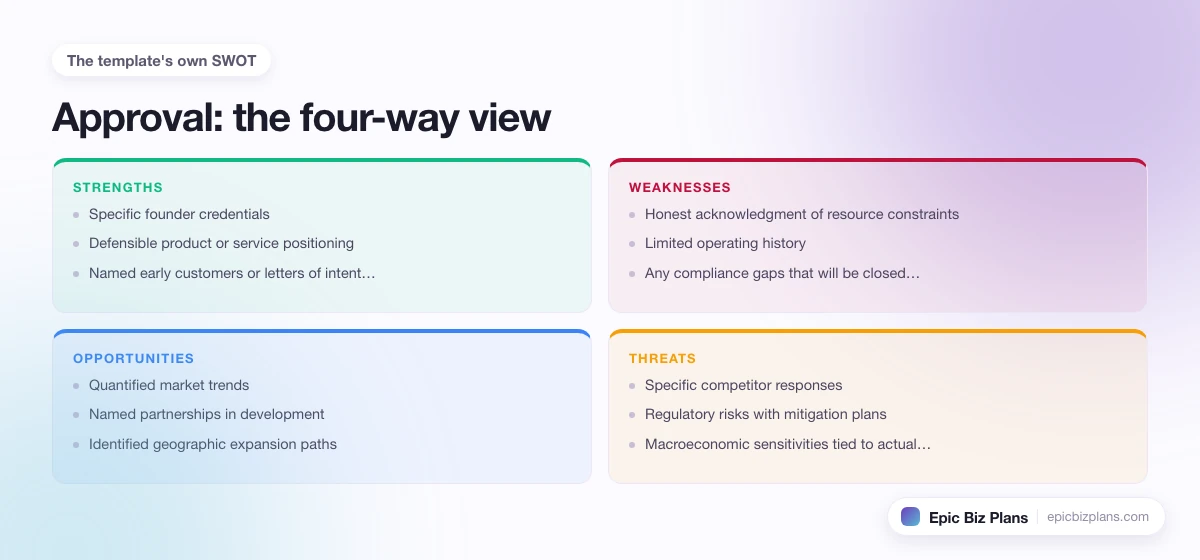
SWOT Analysis
- Strengths: Specific founder credentials, defensible product or service positioning, and named early customers or letters of intent where applicable.
- Weaknesses: Honest acknowledgment of resource constraints, limited operating history, and any compliance gaps that will be closed pre-launch.
- Opportunities: Quantified market trends, named partnerships in development, and identified geographic expansion paths.
- Threats: Specific competitor responses, regulatory risks with mitigation plans, and macroeconomic sensitivities tied to actual revenue assumptions.
Approval Business Name Ideas
Website
The website will run on Shopify or Squarespace, depending on whether the primary use case is ecommerce transactions or content and lead capture. Lenders and landlords sometimes review the website before approving applications, so launch with a finished home page, an about page that names the founder and team, and clear contact information. A polished but minimal site is more credible than an elaborate one that obviously runs ahead of the actual business.
Marketing Details
The marketing plan documents specific channels with budget allocation, expected customer acquisition cost, and benchmark conversion rates from comparable businesses. We use Semrush for keyword research and HubSpot for email marketing, but the plan focuses on the strategy rather than the tools. Underwriters look for marketing assumptions that produce a customer acquisition cost less than one third of customer lifetime value within 12 months.
Industry Trends
Industry analysis cites named sources (IBISWorld, Statista, government data) with publication dates from the last 24 months. We focus on trends that directly support the revenue model rather than broad statements about technology or sustainability. Outdated or unverifiable statistics damage credibility quickly with experienced reviewers.
Competitor Information
Direct competitors are named with publicly available information about size, pricing, and positioning. Indirect competitors and substitute products are also identified. We describe competitive advantage in terms of measurable differences (price, speed, quality, service) rather than subjective claims of superiority. The strongest plans acknowledge where competitors are stronger and explain how the business will compete around those strengths rather than against them.
Financial Information
Financial projections cover three years with monthly detail for year one and quarterly for years two and three. The model includes startup costs, working capital requirements, revenue ramp, gross margin, operating expenses, and a clear use-of-funds breakdown. Lenders compare every line against industry benchmarks; assumptions outside normal ranges need explicit justification rather than wishful thinking. Founders preparing for a specific lender conversation should also review our loan business plan template.
Legal and Compliance
The plan documents the legal structure (LLC, corporation, partnership), required licenses by jurisdiction, and any industry-specific compliance requirements. Insurance coverage is specified by policy type and coverage limits. Intellectual property protection (trademarks, trade secrets, contracts with key personnel) is described with current status and timeline for completion.
Operational Plan
Operations describe the core workflow from customer acquisition through delivery and post-sale service. Key suppliers and partners are named where contracts are in place, with backup options identified for single points of failure. Hiring plans show specific roles, timing, and salary ranges, since underwriters want to see that personnel costs are realistic.
Contingency Planning
Risk analysis covers the three to five most likely scenarios that could disrupt the business: revenue shortfall, key supplier failure, key person loss, regulatory change, and macroeconomic downturn. Each risk includes a quantified impact estimate and a specific mitigation strategy. Plans without honest risk acknowledgment are usually rejected by experienced reviewers, since a founder who claims no real risks is either inexperienced or hiding them.
Building Your Dream with Purpose
An approval-focused business plan is a different document than an internal operating plan, even when the underlying business is the same. The approval version answers an outside reviewer's questions in their preferred order, with their preferred level of detail. The internal version helps the team execute. Both matter, but mixing them produces a document that serves neither audience well.
-
 SemrushSemrush is a platform with literally any online tool you will need to promote your business. Spy on your competitors, get search traffic, keyword research, social info, ad copies and much more. Used by most of the top online companies in the world. Besides all its tools, Semrush also has many available integrations possible with many other tools that will make your work even better.
 -
 Surfer SEOSurfer SEO is an incredibly smart AI tool that will give you exact explanations what to do in order to make your website rank better. They use hundreds of parameters, check your competitors and decide on the best course of action. Whether it be inner links, bold text, paragraphs, headers, images and much more. Surfer is a must-have in 2026.
Embrace Growth and Evolution
The plan should evolve with each round of feedback. Track which sections lenders or investors ask the most questions about, and tighten those sections first. Most successful founders report that the third or fourth version of their plan was meaningfully stronger than the first, even when the underlying business did not change.
Practical Paths Forward
Use the plan as the document of record for any conversation that requires formal approval: SBA loan applications, investor pitches, commercial lease applications, supplier credit terms, and partnership agreements. Founders specifically focused on lender approval should also review our loan broker business plan template for the perspective of the people on the other side of the table.
Take Charge of Your Future
Your Approval business plan is 100% free, with unlimited edits, unlimited downloads, and unlimited chances to get it right. Use this template to shape the version that wins your next yes, and step into your next chapter with the credibility a strong plan provides.
