
Apartment Building Business Plan Template
-
 ShopifyPut your brand on Shopify. Launch your online store with tools designed for growth and success. Ready to turn your idea into profit? Start building your e-commerce business today.
 -
 SquarespaceShowcase your brand with Squarespace’s sleek designs. Build a professional online presence with ease. Start with a template that already looks finished.
 -
 WixBring your ideas to life with Wix. Customize every aspect of your site with unmatched flexibility. Start creating your unique online space and let your creativity shine.
 -
 ElementorCraft captivating websites effortlessly with Elementor. Enjoy complete creative control without coding. Make your site stand out to your audience. Start turning your vision into reality now.
- Executive Summary
- Business Info
- SWOT Analysis
- Apartment Building Business Name Ideas
- Website
- Marketing Details
- Industry Trends
- Competitor Information
- Development Finance and Startup Cost Breakdown
- Financial Information
- Legal and Compliance
- Operational Plan
- Contingency Planning
- Apartment Development Rewards Patient, Disciplined Execution
- Grow and Adapt Along the Way
- Practical Uses of Your Plan
Developing and operating an apartment building is one of the most capital-intensive business ventures in real estate. The economics of multifamily development require careful attention to land acquisition costs, construction budgets, financing structures, and stabilized operating income. A well-built apartment building business plan forces you to stress-test your assumptions across all of these dimensions before committing capital - which is exactly when you want to find the flaws, not after ground is broken.
This plan covers both the development phase (acquisition, entitlement, construction financing) and the operating phase (leasing, property management, maintenance, financial performance). Whether you're developing a new building from the ground up or acquiring and repositioning an existing multifamily asset, this framework applies.
Executive Summary
We will develop and operate high-quality apartment buildings that meet the housing needs of young professionals and families seeking well-maintained, amenity-rich rental housing at competitive prices. Our mission is to create thoughtfully designed residential communities that residents genuinely want to live in and stay in. Our vision is to build a multifamily portfolio recognized for below-market vacancy rates, above-average rent retention, and operational excellence. Financially, we target a 20% profit margin on stabilized operations within the first five years, with strong cash-on-cash returns for investors. Landlords managing a broader rental portfolio can also review our rental properties business plan template.
Business Info
Our primary product is rental apartments in strategically selected urban and suburban locations with strong demand fundamentals - growing employment base, limited competing supply, and population growth trends that support sustained rental demand. Our target tenants are professionals aged 25–35 and households seeking modern amenities, responsive management, and convenient locations near employment centers or transit corridors. We operate on a long-term lease model focused on high occupancy and tenant retention rather than maximum short-term rent extraction.
SWOT Analysis
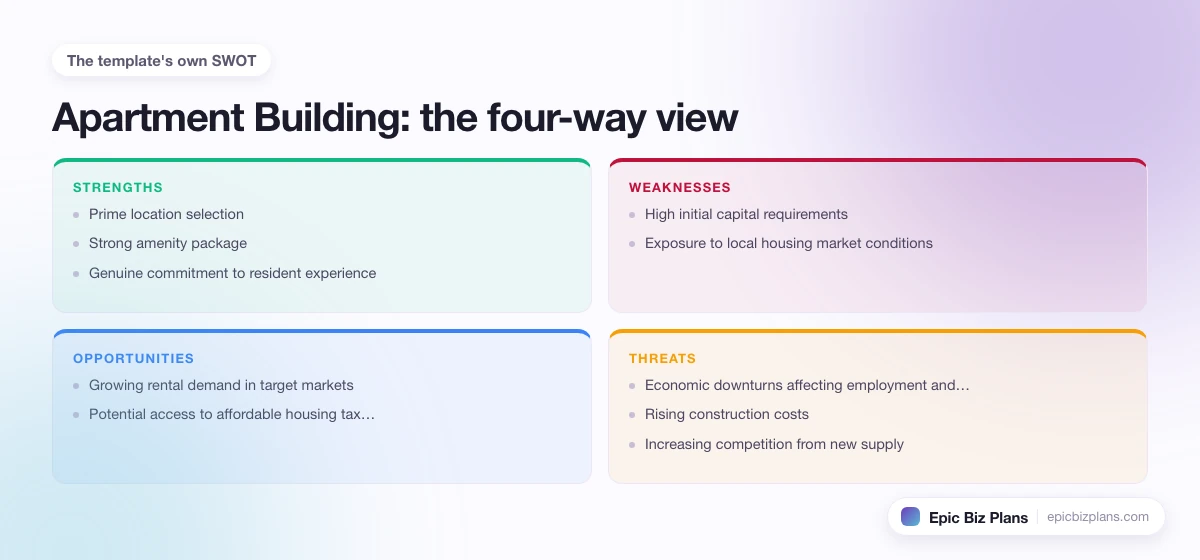
- Strengths: Prime location selection, strong amenity package, genuine commitment to resident experience.
- Weaknesses: High initial capital requirements, exposure to local housing market conditions.
- Opportunities: Growing rental demand in target markets, potential access to affordable housing tax credits or grants for qualifying projects.
- Threats: Economic downturns affecting employment and renter demand, rising construction costs, and increasing competition from new supply.
Apartment Building Business Name Ideas
Website
We will build our property website on WordPress with a professional property management theme that allows us to showcase individual unit listings with floor plans, high-quality photography, and virtual tour integration. The site will include an online inquiry and application flow so prospective tenants can move from interest to lease-signing with minimal friction. As we add properties to our portfolio, each building will have its own dedicated landing page with neighborhood information, nearby amenities, and current availability - all feeding into a unified brand presence.
Marketing Details
Apartment marketing runs on a combination of online listing platforms, search-driven organic traffic, and reputation management. We will list all available units on Apartments.com, Zillow Rental Manager, and Craigslist in our target markets. Semrush will guide our SEO work for property-specific pages optimized for neighborhood and unit-type search terms. HubSpot will manage our lead follow-up automation and prospective tenant email sequences, reducing response time to inquiries - which is directly correlated with conversion rates in competitive rental markets.
Resident retention is as important as new tenant acquisition. We will implement a systematic resident satisfaction program including annual lease renewal incentives, responsive maintenance management with clear communication timelines, and community events that build a sense of belonging. Happy residents renew leases and refer their peers, dramatically reducing vacancy and turnover costs. Operators in the property developers space and the vacation rental business face related but distinct marketing challenges worth reviewing for comparison.
Industry Trends
The multifamily market is being shaped by several structural trends. Millennial and Gen Z household formation rates remain strong, with homeownership out of reach for many first-time buyers in major metros - driving sustained rental demand. Smart home technology adoption is accelerating, with keyless entry, smart thermostats, and package locker systems becoming baseline expectations at newly constructed properties. Sustainability features - energy-efficient appliances, EV charging stations, and low-flow fixtures - are increasingly demanded by environmentally conscious tenants and provide long-term operating cost advantages. Remote work flexibility has also shifted some demand away from urban cores toward suburban markets with more space per unit, creating opportunities for well-located suburban apartment development.
Competitor Information
Direct competitors include other apartment developers and property managers operating in our target markets. Indirect competitors include single-family home rentals, condo conversions, and short-term rental operators who compete for the same tenant pool in some markets. Our differentiation strategy centers on management quality - responsive, professional property management that addresses maintenance requests quickly and treats residents with genuine respect is a meaningful differentiator in most markets. We track competing properties through regular market surveys, monitoring occupancy, rent trends, and amenity offerings to inform our own pricing and improvement decisions. Our plan references the rental housing business plan framework for the operational side of our ongoing management activities.
Development Finance and Startup Cost Breakdown
Apartment building development is fundamentally a capital structure exercise. A typical multifamily development project is financed with 60–70% debt (construction loan converting to permanent financing at stabilization) and 30–40% equity. Understanding your total development cost - land, hard construction costs, soft costs (design, permits, financing fees), and carry costs - is essential before approaching lenders or equity partners.
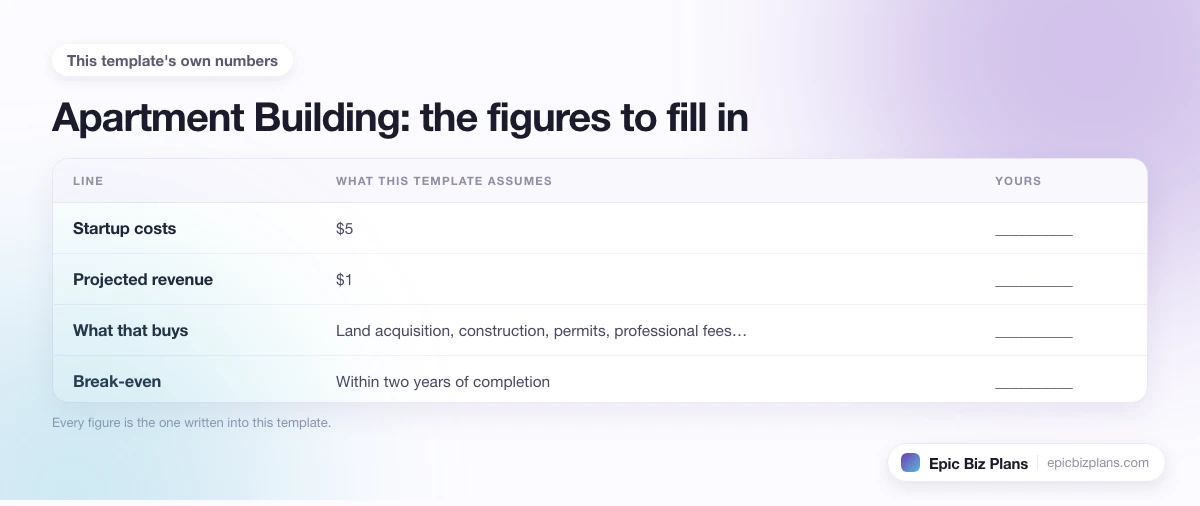
For a 50-unit urban apartment building, total development costs typically range from $7 million to $15 million depending on market, finishes, and construction type. A smaller 12–20 unit suburban project can be developed for $2 million to $5 million. Total project costs including our estimated startup of $5 million cover land ($1–1.5M), hard construction ($2.5–3.5M), soft costs ($400–600K), and pre-stabilization operating deficit reserve ($200–400K). Stabilized project values are underwritten using a capitalization rate applied to net operating income - understanding cap rates in your target market is essential for assessing whether development economics work before committing to a site.
Financial Information
Total project capitalization is estimated at $5 million, covering land acquisition, construction, permits, professional fees, and pre-stabilization reserves. We project annual revenue of $1 million by year three as the property stabilizes at target occupancy, with ongoing operating expenses including property management (8–10% of gross revenue), maintenance and repairs, insurance, property taxes, and utilities in common areas projected at $500,000 annually. Cash flow projections model a break-even stabilization within two years of completion, transitioning to 20% profit margins on a stabilized basis thereafter. Monthly financial reporting will track occupancy, revenue per available unit (RevPAU), and net operating income against underwriting assumptions.
Legal and Compliance
Apartment development and operation requires compliance across multiple regulatory domains: zoning and land use entitlement, building permits and construction code compliance, certificate of occupancy requirements, fair housing regulations (federal Fair Housing Act and state equivalents), landlord-tenant law governing lease terms and eviction procedures, and habitability standards enforced by local housing authorities. We will retain a real estate attorney experienced in multifamily development and landlord-tenant law from the project's outset. Trademark registration protects our brand and property names as our portfolio grows.
Operational Plan
Operations separate into two phases: development and property management. During development, a dedicated project management team oversees design, permitting, contractor bidding (the trades themselves often work from a contractor business plan), construction monitoring, and lease-up marketing beginning 60–90 days before project completion. Once the property is in operation, a property management team handles leasing, maintenance coordination, resident relations, financial reporting, and vendor management. We will use professional property management software (AppFolio or Buildium) to manage maintenance requests, collect rent, and generate financial reports. The real estate investor business plan provides useful context for the investment return analysis and portfolio management approach that guides our long-term development strategy.
Contingency Planning
Key risks include construction cost overruns, lease-up delays that extend the pre-stabilization cash burn period, and market softness that reduces achievable rents below underwriting assumptions. Construction cost risk is managed through a fixed-price contract with a qualified general contractor, a 10% contingency built into the construction budget, and monthly owner's representative oversight. Lease-up risk is mitigated through pre-construction market analysis confirming demand at projected rent levels, and a pre-leasing program beginning 90 days before delivery. Market rent risk is addressed by underwriting at conservative rents 5–10% below current market and stress-testing the financial model at 85% occupancy to ensure debt service coverage. An operating reserve covering 6 months of debt service and operating expenses is maintained throughout stabilization.
-
 SemrushSemrush is a platform with literally any online tool you will need to promote your business. Spy on your competitors, get search traffic, keyword research, social info, ad copies and much more. Used by most of the top online companies in the world. Besides all its tools, Semrush also has many available integrations possible with many other tools that will make your work even better.
 -
 Surfer SEOSurfer SEO is an incredibly smart AI tool that will give you exact explanations what to do in order to make your website rank better. They use hundreds of parameters, check your competitors and decide on the best course of action. Whether it be inner links, bold text, paragraphs, headers, images and much more. Surfer is a must-have in 2026.
Apartment Development Rewards Patient, Disciplined Execution
Multifamily development has a long cycle time - from site identification to stabilized operations can take 3–5 years. The developers who succeed over the long term are those who underwrite conservatively, manage construction carefully, and operate their properties with genuine attention to resident experience. The financial returns are real and significant, but they require both patience and operational discipline to realize.
Related real estate planning resources worth reviewing include the commercial real estate business plan and the room rental business plan, both of which cover income-producing real estate models with overlapping financial and operational structures.
Grow and Adapt Along the Way
Your apartment building business plan should be updated at each major project milestone: after site selection and entitlement, after construction financing closes, after lease-up is complete, and annually thereafter as part of portfolio review. Each update should incorporate actual performance data and adjust future projections accordingly.
Practical Uses of Your Plan
Use this plan to present to construction lenders, equity investors, and municipal planning departments as part of the entitlement process. A well-structured plan communicates credibility and demonstrates that you've done the work required to manage a complex development project responsibly.
Your apartment building business plan is 100% free - with unlimited edits, unlimited downloads, and unlimited chances to get it right.
