
Antenatal Business Plan Template
-
 ShopifyPut your brand on Shopify. Launch your online store with tools designed for growth and success. Ready to turn your idea into profit? Start building your e-commerce business today.
 -
 SquarespaceShowcase your brand with Squarespace’s sleek designs. Build a professional online presence with ease. Start with a template that already looks finished.
 -
 WixBring your ideas to life with Wix. Customize every aspect of your site with unmatched flexibility. Start creating your unique online space and let your creativity shine.
 -
 ElementorCraft captivating websites effortlessly with Elementor. Enjoy complete creative control without coding. Make your site stand out to your audience. Start turning your vision into reality now.
Creating an Antenatal business plan is the first real step toward launching in a field where families need steady, knowledgeable support. Pregnancy and the path into parenthood are deeply personal experiences, which means your services have to balance clinical credibility with genuine warmth. Your Antenatal business plan is the roadmap that defines your brand, your services, and exactly who you intend to serve.
A strong plan captures more than the operational basics. It should set out how you will reach expecting parents, what makes your support different, and how you will keep clients coming back through every stage of pregnancy. Treat the sections below as a working template you can adapt as your business grows and as you learn what your local families actually want.
Executive Summary
Our mission is to provide thorough antenatal care and education for expecting parents, so they feel supported and informed throughout pregnancy. We want to build a community where parents can reach quality resources, classes, and one-on-one guidance that helps them make confident decisions about their health and their baby's.
Our value proposition is personalized care that pairs expert knowledge with an empathetic approach, creating a calm environment for families. Financially, we aim to reach break-even within the first year of operations, then expand our services and outreach in the years that follow.
Business Info
We will offer a range of products and services built for expecting parents, including educational classes, prenatal yoga, and consultations with certified professionals. Our target market is pregnant individuals and their families, especially first-time parents aged 25 to 40 who want guidance and reassurance during pregnancy. Many of these same clients will later look for newborn care services, which gives us a natural path to extend the relationship after birth.
Business Model Overview
Our business will run on a mix of direct sales for classes and consultations, plus subscription services for ongoing support and resources. We will use both online and offline channels to reach our audience, which keeps us accessible to clients who prefer in-person classes and those who want virtual options.
SWOT Analysis
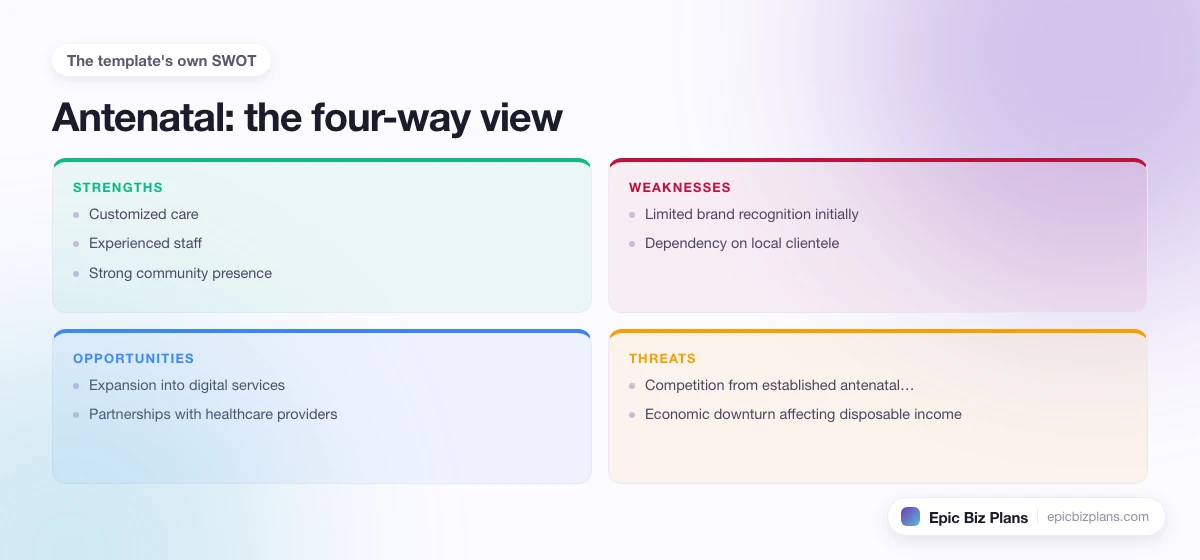
- Strengths: Customized care, experienced staff, strong community presence.
- Weaknesses: Limited brand recognition initially, dependency on local clientele.
- Opportunities: Expansion into digital services, partnerships with healthcare providers.
- Threats: Competition from established antenatal services, economic downturn affecting disposable income.
Antenatal Business Name Ideas
Website
We will build our website on Wix, since it gives non-technical owners an easy platform to work with. We will keep the site user-friendly and mobile-responsive, so potential clients can browse, compare classes, and book consultations without friction. If we decide to sell physical products, we will also look at Shopify for a dedicated online store.
Marketing Details
Our marketing will focus on digital and social media outreach. We will use Semrush for SEO to improve our search visibility, and email campaigns managed through HubSpot to keep our audience engaged between classes.
To reach younger parents, we will run targeted TikTok ads that show our services and educational content in a clear, friendly way. Partnering with a local midwifery practice for cross-referrals can also bring in clients who already trust a maternity provider.
Industry Trends
We are seeing steady growth in telehealth, which lets us run virtual consultations and classes for busy families. There is also a stronger focus on mental health during pregnancy, so we will fold wellness resources into our offerings. Pregnancy tracking apps and online communities are changing how expecting parents find information, and we plan to meet them in those channels rather than wait for them to come to us. Many parents also seek out lactation consultant support as their due date nears, which signals where demand is heading next.
Competitor Information
Our main competitors include local antenatal classes and online platforms offering similar resources. We will set ourselves apart with a highly personalized experience that blends physical and digital support. We will also build a real community through events and support networks, which is harder for large online platforms to replicate. A close look at prenatal and perinatal care providers shows where established players leave gaps we can fill.
Financial Information
Our startup costs will include leasing a facility, marketing, and initial product inventory. We project first-year revenue of $150,000, with ongoing expenses such as rent, salaries, and marketing totaling around $100,000. We aim for steady growth, with revenue potential reaching $300,000 by year three as our class schedule fills and subscriptions compound.
Legal and Compliance
We will meet local business registration requirements and obtain the permits needed to run antenatal classes. We will also protect our intellectual property through trademarks for our brand name and any original materials we create, such as course workbooks and class curricula.
Operational Plan
Key operations include scheduling classes, managing product inventory, and running a customer relationship management system. Our supply chain will rely on partnerships with local health professionals for guest lectures and workshops, which keeps the quality high and gives clients access to specialists we don't employ full time.
Contingency Planning
Potential risks include swings in demand, economic downturns, and competition. To manage these, we will keep a flexible service menu, add revenue streams such as online courses, and stay in close contact with our community so we can adjust our offerings as their needs change.
-
 SemrushSemrush is a platform with literally any online tool you will need to promote your business. Spy on your competitors, get search traffic, keyword research, social info, ad copies and much more. Used by most of the top online companies in the world. Besides all its tools, Semrush also has many available integrations possible with many other tools that will make your work even better.
 -
 Surfer SEOSurfer SEO is an incredibly smart AI tool that will give you exact explanations what to do in order to make your website rank better. They use hundreds of parameters, check your competitors and decide on the best course of action. Whether it be inner links, bold text, paragraphs, headers, images and much more. Surfer is a must-have in 2026.
Conclusion: Your Future Awaits
Starting an antenatal business is about more than numbers and forecasts. It is a chance to combine real expertise with the support new families are searching for. Whether you picture a cozy maternity boutique, an online resource hub, or a local class service, the options are wide, and each one connects expecting parents with help they genuinely need.
- Consider a prenatal yoga studio focused on wellness and calm.
- Launch an ecommerce store featuring well-made maternity wear.
- Host a local community center for new parents, similar to a broader parenting support business.
Your goals will shift over time, so keep your antenatal business plan flexible. Update it as you find new audiences, test pricing models, or add products built for your community. The plan should grow alongside the business, not sit untouched in a drawer.
Use your antenatal business plan as a working tool, whether you are presenting to partners, planning a launch, seeking funding, or sharpening your strategy. It is not just a document; it is your guide to building something that lasts.
Your antenatal business plan is 100% free, with unlimited edits, unlimited downloads, and unlimited chances to get it right. This is your moment to build the business you have always pictured.
