
Ant Business Plan Template
-
 ShopifyPut your brand on Shopify. Launch your online store with tools designed for growth and success. Ready to turn your idea into profit? Start building your e-commerce business today.
 -
 SquarespaceShowcase your brand with Squarespace’s sleek designs. Build a professional online presence with ease. Start with a template that already looks finished.
 -
 WixBring your ideas to life with Wix. Customize every aspect of your site with unmatched flexibility. Start creating your unique online space and let your creativity shine.
 -
 ElementorCraft captivating websites effortlessly with Elementor. Enjoy complete creative control without coding. Make your site stand out to your audience. Start turning your vision into reality now.
- Executive Summary
- Business Info
- SWOT Analysis
- Ant Business Name Ideas
- Website
- Marketing Details
- Industry Trends
- Competitor Information
- Financial Information
- Legal and Compliance
- Operational Plan
- Contingency Planning
- Build an Ant Business That Serves a Dedicated Community
- Adapt Your Plan as You Grow
- Practical Applications
- Take Action Today
An Ant business plan covers a genuinely distinctive niche - the growing market for ant-keeping products, educational kits, and insect conservation resources. Ant keeping has expanded from a fringe hobbyist activity into a recognized segment of the educational toy and nature science markets, with demand coming from schools, homeschool families, science educators, and adult hobbyists interested in entomology. The business model works well in e-commerce because the customer base is geographically dispersed and actively searches for specialized products that general pet stores do not carry.
Your Ant business plan should clearly define which customer segment you are targeting first - hobbyist retail, institutional education, or both - because the product mix, pricing, and marketing channels differ meaningfully between them. Getting that focus right from the outset will make your early marketing spend far more efficient.
Executive Summary
We will establish a business focused on producing and selling ant-related products, including educational kits, ant farm habitats, care guides, and branded merchandise for enthusiasts and researchers. Our mission is to build genuine appreciation for ants and their ecological role through well-designed, accessible products. Our vision is to become the leading online source for ant-keeping supplies and educational resources in our target market. Financial targets include reaching $100,000 in year-one revenue, with 25% year-over-year growth as we expand product range and institutional partnerships.
Business Info
Our primary offerings will include ant farm kits in multiple formats (formicaria, sand farms, gel farms), ant care guides in both print and digital formats, and merchandise including apparel and collectibles for the hobbyist community. The target market spans entomology students, science educators, hobbyists, and environmentally engaged individuals interested in insect ecology and conservation. Our business model will be e-commerce focused, with direct-to-consumer sales as the primary channel and potential wholesale supply to school districts and educational retailers as a secondary revenue stream. For businesses serving adjacent insect-focused niches, the insect repellent bracelet business plan offers a comparable e-commerce product launch framework.
SWOT Analysis
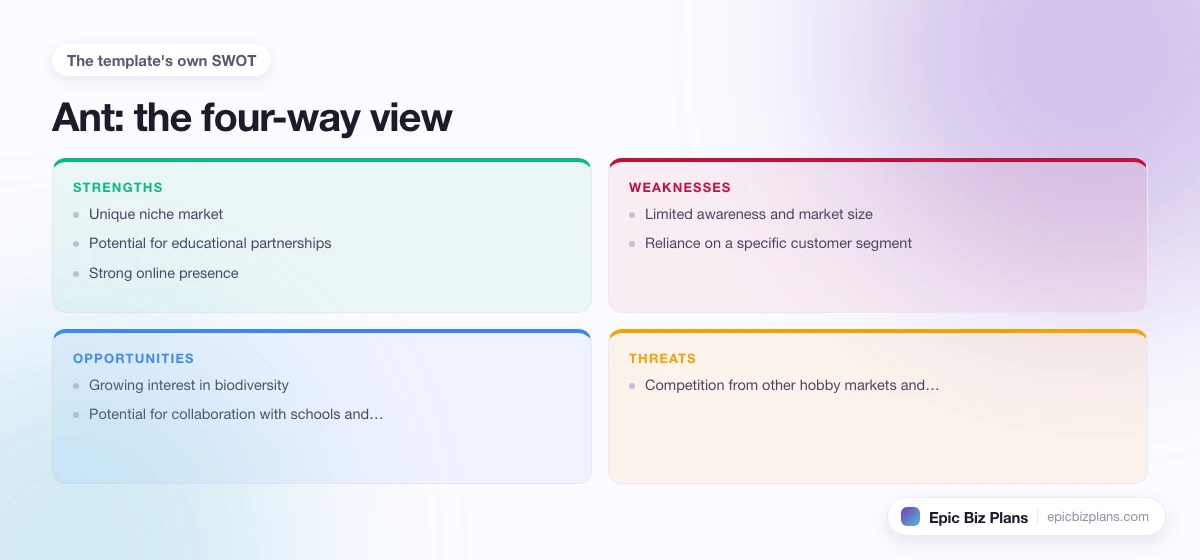
- Strengths: Unique niche market, potential for educational partnerships, and strong online presence.
- Weaknesses: Limited awareness and market size, reliance on a specific customer segment.
- Opportunities: Growing interest in biodiversity, potential for collaboration with schools and institutions.
- Threats: Competition from other hobby markets and potential regulatory changes around the sale of live insects.
Ant Business Name Ideas
Website
We will build our website on Shopify, which provides the inventory management, order processing, and marketing integration tools needed for a product-based e-commerce business. Shopify's platform also supports digital product sales, which is relevant for our downloadable care guides and educational content. Product photography will be a priority investment given that ant farm kits are visually distinctive products where image quality directly influences purchase decisions.
Marketing Details
Our digital marketing strategy will combine SEO, email, and social content to build audience across channels. Semrush will guide keyword research targeting terms used by hobbyists and educators searching for ant farm supplies and insect education resources. HubSpot will manage email campaigns, including new customer welcome sequences, product education content, and promotions tied to the academic calendar - a key purchase cycle for the educational segment.
TikTok and YouTube will be our primary social platforms, where ant-keeping content has an established and engaged community. Short-form videos showing ant colony behavior, habitat setup tutorials, and species identification content consistently attract organic engagement from exactly the audience we are targeting.
Industry Trends
Interest in biodiversity and insect ecology has grown substantially as environmental education has expanded in school curricula and popular media. The maker and DIY culture has also contributed to growth in the ant-keeping hobby, with communities on Reddit, YouTube, and dedicated forums creating shared knowledge bases that attract new participants. E-commerce has made it feasible for niche product businesses to reach customers globally, which is particularly valuable in a hobby where the total customer base is dispersed across many geographic markets. Schools and homeschool networks are increasingly purchasing live science products and educational kits as alternatives to traditional classroom materials. The pest control business plan provides useful context on insect-related regulatory compliance that may apply to certain ant product categories.
Competitor Information
Competitors range from specialized online ant-keeping retailers to general pet supply stores that carry basic ant farm products. General retailers compete on price but offer limited product depth, poor species-specific guidance, and no community engagement. Specialized competitors offer more relevant products but often have limited marketing reach. Our differentiation strategy focuses on product quality, comprehensive educational support materials, and community building - none of which commodity competitors can replicate at scale.
Financial Information
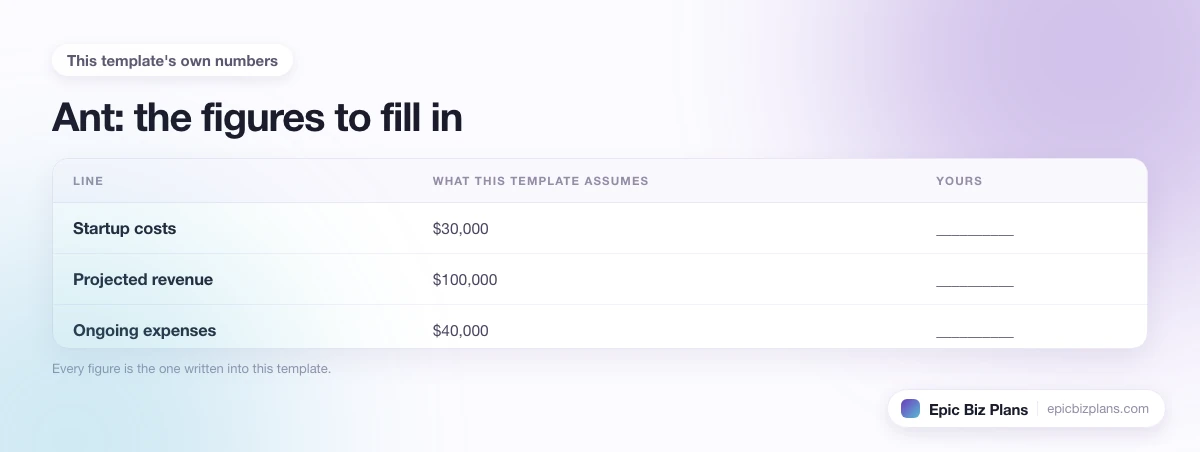
Startup costs are estimated at $30,000, covering initial product inventory, website development, brand design, and launch marketing. First-year revenue target is $100,000 with a gross margin of approximately 50%, based on product mix across physical kits and digital content. Ongoing expenses of approximately $40,000 annually will cover inventory replenishment, fulfillment, platform costs, and digital marketing. Cash flow will be monitored monthly, with P&L statements prepared quarterly to track margin performance and flag any cost variances early.
Legal and Compliance
Business registration and standard e-commerce operating requirements will be completed before launch. The sale of live insects is subject to state and federal regulations in the US and equivalent rules in other jurisdictions - species-specific import and transport restrictions apply and must be researched thoroughly before adding live products to the catalog. Intellectual property protections will be established for product designs, brand elements, and proprietary educational content to prevent unauthorized reproduction.
Operational Plan
We will establish qualified supplier relationships for habitat components, ant colony sourcing (where legally compliant), and merchandise manufacturing before launch. Logistics will be designed to handle both standard product orders and live insect shipments, which require appropriate packaging and expedited transit to protect colony viability. Inventory management systems will track stock levels across product categories, with reorder triggers set to prevent stockouts during peak demand periods such as the back-to-school season. Educational institution sales will require a separate B2B ordering workflow with net payment terms.
Contingency Planning
Key risks include regulatory changes affecting live insect sales, supply disruptions for habitat components, and seasonal demand fluctuations. Mitigation strategies include maintaining a substantial non-live product catalog that generates revenue independent of live insect availability, qualifying backup suppliers for key components, and building a 90-day cash reserve before launch. We will monitor regulatory developments in our key markets and engage proactively with any changes to live insect import or sale requirements.
Build an Ant Business That Serves a Dedicated Community
Niche businesses succeed when they serve their customer community with more depth and relevance than any general retailer can. The ant-keeping community is loyal, knowledgeable, and actively looking for better products and more reliable information than what commodity competitors provide. Building a brand that becomes genuinely useful to that community - through product quality, educational content, and responsive customer support - creates compounding value over time that is difficult for larger, less specialized competitors to replicate.
Adapt Your Plan as You Grow
Your Ant business plan should be updated regularly as you gather real data on product performance, customer acquisition costs, and institutional sales opportunities. Early product mix assumptions will shift as you learn which items drive the highest margins and repeat purchases. New product categories, school supply partnerships, or international shipping capabilities may all become viable growth levers as the business matures.
-
 SemrushSemrush is a platform with literally any online tool you will need to promote your business. Spy on your competitors, get search traffic, keyword research, social info, ad copies and much more. Used by most of the top online companies in the world. Besides all its tools, Semrush also has many available integrations possible with many other tools that will make your work even better.
 -
 Surfer SEOSurfer SEO is an incredibly smart AI tool that will give you exact explanations what to do in order to make your website rank better. They use hundreds of parameters, check your competitors and decide on the best course of action. Whether it be inner links, bold text, paragraphs, headers, images and much more. Surfer is a must-have in 2026.
Practical Applications
Use this business plan to present to potential wholesale partners, apply for small business funding, or structure an agreement with educational distributors. A clear operational and financial plan demonstrates the kind of preparation that gives partners and lenders confidence in your ability to execute.
Take Action Today
Your Ant business plan is 100% free - with unlimited edits, unlimited downloads, and unlimited chances to get it right. Start building the business your community is waiting for.
