
Animal Adoption Business Plan Template
-
 ShopifyPut your brand on Shopify. Launch your online store with tools designed for growth and success. Ready to turn your idea into profit? Start building your e-commerce business today.
 -
 SquarespaceShowcase your brand with Squarespace’s sleek designs. Build a professional online presence with ease. Start with a template that already looks finished.
 -
 WixBring your ideas to life with Wix. Customize every aspect of your site with unmatched flexibility. Start creating your unique online space and let your creativity shine.
 -
 ElementorCraft captivating websites effortlessly with Elementor. Enjoy complete creative control without coding. Make your site stand out to your audience. Start turning your vision into reality now.
- Executive Summary
- Business Info
- Business Model Overview
- SWOT Analysis
- Animal Adoption Business Name Ideas
- Website
- Marketing Details
- Industry Trends
- The Import Rule That Closed the Puppy Pipeline
- Competitor Information
- Financial Information
- Startup Cost Breakdown
- Legal and Compliance
- Operational Plan
- Key Success Metrics
- Contingency Planning
- Building an Animal Adoption Organization That Lasts
- Types of Businesses in the Animal Adoption Niche
- Adapt as You Grow
- Practical Uses for Your Plan
- Boldly Step Forward
An Animal Adoption business plan provides the structure to launch and operate a responsible, sustainable animal adoption organization, whether you're starting a small rescue focused on a specific breed, a general community shelter, or a fostering-based adoption network. The animal welfare sector is driven by mission, but successful organizations are run with the same financial and operational discipline as any other business.
Your Animal Adoption business plan needs to address the real challenges of this work: funding sustainability, animal care costs, compliance with local animal welfare regulations, community outreach, and the adoption process itself. Organizations that plan well are more effective, because they can care for more animals, achieve better adoption rates, and maintain the financial stability that allows them to operate long-term rather than struggling through funding crises every year. It also needs current numbers rather than pandemic-era ones, because the constraint on rescue capacity has changed, and a federal import rule has quietly closed off the pipeline many rescues were built around.
Executive Summary
Our mission is to provide compassionate, professional care to abandoned and stray animals and to facilitate successful adoptions that connect pets with appropriate, committed families. We will operate primarily as a nonprofit, funded through adoption fees, donations, grant funding, and community sponsorships. Organizations that take in unusual species face a different regulatory and husbandry picture, covered in the sloth business plan. Founders focused specifically on rehoming pets can also use our pet adoption business plan template.
Our vision is to become a recognized and trusted animal adoption resource in our community, known for thorough adoption screening, high-quality animal care, and post-adoption support that reduces return rates. Financial targets include reaching breakeven within the first year, with ongoing operations sustained through a diversified funding model that reduces dependence on any single revenue source, including partnerships with adoption-focused venues such as a cat cafe business plan. If you're considering adjacent ventures, check out our cat business plan.
Business Info
We will operate in the animal welfare sector, focusing on the adoption of dogs and cats, with capacity to expand to small animals as resources allow. Our target market consists of families with children, young professionals, and individuals who have actively researched pet adoption and are ready to commit to a pet long-term. Our business model follows a nonprofit structure in which adoption fees cover a portion of care costs, with donations, grants, and fundraising events covering the remainder. For organizations expanding into broader pet services, the pet products business plan covers the retail side of selling pet supplies and accessories alongside adoption services.
Business Model Overview
Revenue streams include adoption fees, typically $50 to $350 per animal depending on species, age, and vetting cost, individual donations, corporate sponsorships, grant funding from animal welfare foundations, and fundraising events. Each animal that comes into the organization generates care costs covering food, veterinary care, behavioral assessment, microchipping, vaccines, and spay or neuter surgery before it can be adopted. Managing the per-animal cost carefully is essential to financial sustainability, because organizations that don't track these costs accurately often find their adoption fees don't come close to covering expenses.
SWOT Analysis
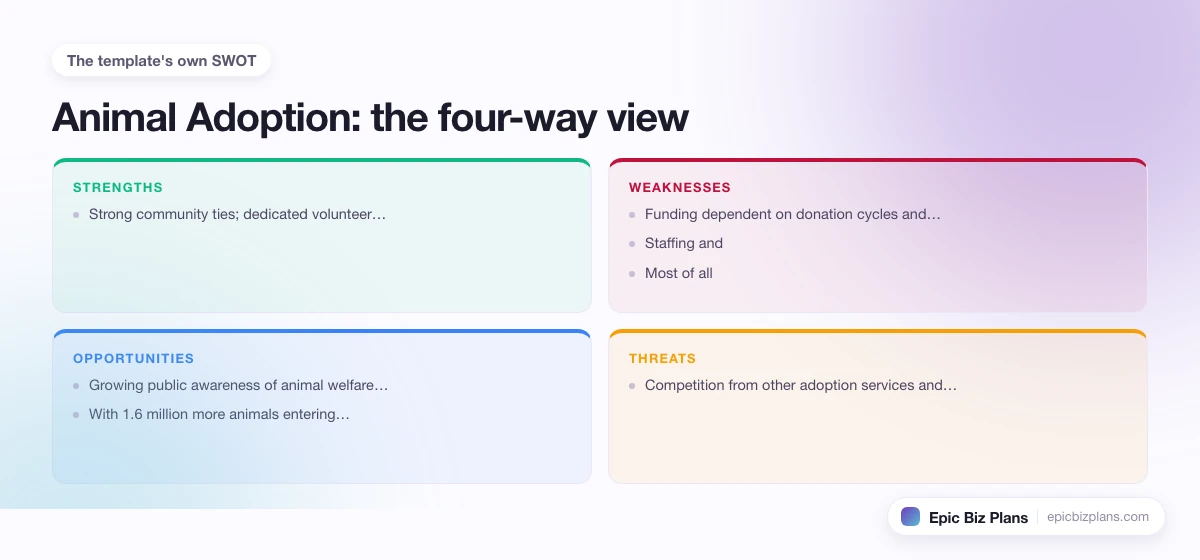
- Strengths: Strong community ties; dedicated volunteer base; experienced animal care staff; transparent adoption process that builds adopter trust.
- Weaknesses: Funding dependent on donation cycles and grants that can be unpredictable; limited capacity constrained by facility space, staffing and, most of all, by how long each animal stays.
- Opportunities: Growing public awareness of animal welfare; measurable unmet demand, with 1.6 million more animals entering shelters each year than are adopted out; potential partnerships with local businesses and veterinary practices for reduced-cost services.
- Threats: Competition from other adoption services and online platforms where breeders and private sellers operate; regulatory changes to animal care and shelter standards; lengthening stays for large dogs that tie up capacity.
Animal Adoption Business Name Ideas
Website
We will build the primary website on Wix for ease of content management, enabling the team to update animal profiles, success stories, and event listings without technical support. The site needs to accomplish three things clearly: show animals currently available for adoption with detailed profiles and photos, explain the adoption process step by step, and make it easy to donate or get involved. A prominent donation button and an automated email confirmation for donors are essential conversion elements. For organizations that also operate a pet supplies retail component, Shopify can be integrated for that functionality. Animal adoption organizations that want to expand into running a full residential shelter facility can find planning guidance in our existing pet shelter business plan template, which covers the operational requirements of a residential care operation.
Marketing Details
Social media is the single most effective marketing channel for animal adoption organizations, because photos and videos of adoptable animals generate organic reach and emotional engagement that paid advertising cannot replicate at the same cost. We will post consistently across platforms, prioritizing short-form video of animals in care, including enrichment, play, feeding and behavior assessments, which generates sharing and donor engagement. Semrush will be used to optimize the website for local search terms prospective adopters use, such as "adopt a dog [your city]" and "rescue cats near me", and the national volumes confirm how large this audience is: "animal shelters near me" draws roughly 673,000 US searches a month, "humane society" about 550,000, "dog shelters near me" about 246,000 and "adopt a pet" about 201,000. Almost all of it is local intent, so the Google Business Profile and accurate listings on the major adoption aggregators matter more than content volume.
Corporate sponsorship outreach will target local businesses that align with pet-friendly values, including pet supply stores, veterinary clinics, dog-friendly cafes, and outdoor recreation brands. These partnerships provide financial support and cross-marketing opportunities that reach new potential adopters.
Industry Trends
The pandemic-era framing of this sector is now out of date and planning against it leads to the wrong intake policy. The current picture, from national shelter data, is a persistent gap rather than a boom: in 2025 about 5.8 million dogs and cats entered United States shelters and rescues while about 4.2 million were adopted, leaving a shortfall of roughly 1.6 million animals. Intake is not the thing that is rising. Community intake in 2025 was down about 2% on 2024 and total intake has fallen roughly 11% since 2019, a decline of about 735,000 animals.
What has changed is how long animals stay. Length of stay has grown over the past five years, particularly for large dogs, and that is what produces the crowding that gets reported as a shelter crisis. The mechanism is simple and worth stating in the plan, because it drives every capacity decision: with intake roughly flat and stays getting longer, animals leave more slowly than new ones arrive, and every extra week an animal stays is a kennel unavailable to the next one.
The size breakdown is where this becomes actionable. In the first half of 2025, adoptions of small dogs and juvenile dogs each rose about 6%, while adoptions of large dogs fell about 9% and medium dogs about 3%. A rescue that takes in large dogs indiscriminately will fill its capacity with the hardest-to-place population and then be unable to respond to new need. The honest planning response is either to cap the proportion of large dogs against a realistic placement rate, or to build the foster network and marketing specifically for them before taking them in, rather than discovering the problem once the kennels are full.
Online adoption platforms and social media have made it much easier for rescue organizations to reach potential adopters beyond their immediate geography, enabling transport programs that move animals from high-intake areas to lower-intake markets with better adoption rates. Transparency in animal care practices is increasingly expected, since adopters want to know vaccination status, behavioral history, and how animals are housed before they commit. Organizations that publish this information openly and systematically build more trust than those that provide it only on request. For organizations also involved in animal breeding or pet sales, the pet breeding business plan covers the regulatory and operational considerations for that adjacent activity.
The Import Rule That Closed the Puppy Pipeline
Any plan that contemplates bringing dogs into the United States, whether from overseas rescue partners or across a land border, has to account for the CDC's dog importation requirements, which took effect on 1 August 2024 and apply regardless of how long the dog will stay or which country it comes from. They apply to rescue organisations and breeders exactly as they apply to a family travelling with a pet.
Every imported dog must meet all of the following: be healthy on arrival, be at least six months old at the time of entry, carry a microchip readable by a universal scanner, and have a CDC Dog Import Form receipt. There is an additional sequencing trap in the microchip requirement that catches people who have done everything else right. The microchip must have been implanted before the qualifying rabies vaccination. If the vaccination came first, it is treated as invalid and has to be repeated after chipping, which restarts the associated waiting periods.
-
 SemrushSemrush is a platform with literally any online tool you will need to promote your business. Spy on your competitors, get search traffic, keyword research, social info, ad copies and much more. Used by most of the top online companies in the world. Besides all its tools, Semrush also has many available integrations possible with many other tools that will make your work even better.
 -
 Surfer SEOSurfer SEO is an incredibly smart AI tool that will give you exact explanations what to do in order to make your website rank better. They use hundreds of parameters, check your competitors and decide on the best course of action. Whether it be inner links, bold text, paragraphs, headers, images and much more. Surfer is a must-have in 2026.
The six-month minimum age is the provision that changes the business model. Puppies are the most adoptable animals a rescue can offer and they place fastest, which is exactly why international puppy transport grew as a model. That route is now closed: a dog under six months cannot be imported at all. An organisation planning around international intake should therefore expect an older, slower-placing population, longer average stays, and the higher per-animal cost that follows. Combined with the length-of-stay trend above, a plan built on imported puppies needs rewriting rather than adjusting.
Domestic transport between states is not affected by this rule, which makes it the more dependable growth route for a new organisation, subject to each receiving state's own health certificate and interstate movement requirements.
Competitor Information
Primary competitors are other local rescue organizations and animal shelters. Indirect competitors include online pet marketplace sites such as Petfinder and Adopt-a-Pet, private breeders, and pet stores. It is worth noting that the large aggregators are better understood as distribution channels than as competitors, and listing on them is usually the cheapest source of qualified adopter traffic a small rescue has. Our differentiation focuses on the adoption experience: thorough pre-adoption counseling that matches the right animal to the right family, post-adoption support and check-ins that reduce returns, and transparent communication about each animal's history and behavior. Organizations that prioritize adopter education tend to have lower return rates, which matters both financially and for animal welfare outcomes.
Financial Information
Estimated startup costs are approximately $50,000, covering facility setup where applicable, initial equipment and supplies, animal intake costs, website development, and initial marketing. Annual operating expenses depend almost entirely on how many animals you take in, and this is where rescue budgets most often fail to add up, so the figure should be built from the animal count rather than guessed.
At the plan's target of 15 to 20 adoptions a month, the organization handles roughly 180 to 240 animals a year. At a per-animal care cost of $350 for dogs and $200 for cats, a mixed caseload averaging around $280 produces $50,000 to $67,000 of direct animal care cost alone. Adding administrative costs, insurance, facility expenses and fundraising costs, realistic total annual expenses for an operation at that scale are in the region of $75,000 to $95,000, not $30,000. A $30,000 annual budget corresponds to roughly 100 animals a year, so either the budget or the adoption target has to move. We plan on the higher figure.
Against that, adoption fees at an average of $150 across 200 placements contribute about $30,000, which is well under half of costs. That gap is normal and is precisely why diversified fundraising is a structural requirement rather than an enhancement. Quarterly profit and loss reviews and board financial reporting will maintain transparency and financial accountability.
Startup Cost Breakdown
- Facility setup and kennel equipment: $15,000 to $25,000, if not using a foster-only model
- Initial animal care supplies including food, bedding, crates and medical supplies: $3,000 to $5,000
- Nonprofit registration and legal: $1,500 to $3,000
- Website and social media setup: $2,000 to $4,000
- Initial marketing and community outreach: $2,000 to $4,000
- Working capital reserve: $10,000 to $15,000, covering 3 months before donation revenue stabilizes
A foster-based model removes the largest line in that list and is the reason many new rescues start without a facility. It trades fixed cost for recruitment effort, since capacity then equals the number of active foster homes, and foster retention becomes the operational priority that kennel maintenance would otherwise be.
Legal and Compliance
The organization will be registered as a nonprofit, 501(c)(3) in the United States or the equivalent in the operating jurisdiction, to enable tax-deductible donations and access to grant funding. Local animal welfare regulations vary significantly, including requirements for shelter standards, animal holding periods, intake documentation, and euthanasia policies where applicable. These regulations must be researched and documented before operations begin. A growing number of states also require rescue organizations to register separately from their nonprofit incorporation, and some impose source and record-keeping requirements on animals obtained from out of state, so check both before accepting a transport. Contracts with veterinary partners, foster families, and volunteers will be in place from launch. All adoptions will be accompanied by a signed adoption agreement that specifies adopter obligations and the return policy.
Operational Plan
Operations follow a defined intake, care, assessment, and placement workflow. Incoming animals go through an intake assessment covering health check, behavioral observation and history documentation, followed by a defined care period during which they receive necessary veterinary treatment and enrichment. Once cleared, animals are listed for adoption with complete profiles. The adoption process includes an application, a compatibility assessment, an interview, and for dogs a meet-and-greet with existing pets in the household. Post-adoption check-ins at 7, 30, and 90 days reduce return rates and provide adopters with support during the adjustment period. For organizations partnering with dog-focused care services, the dog sitting business plan covers how fostering-adjacent care operations can be structured as complementary businesses.
Key Success Metrics
- Monthly adoption placements: Target 15 to 20 adoptions a month by end of year one
- Adoption return rate: Under 5%, since strong screening reduces this significantly
- Per-animal care cost: Track and report monthly; target under $350 per animal for dogs and under $200 for cats
- Donor retention rate: 55% or more of prior-year donors giving again in year two
- Average time to adoption from intake: Under 30 days for dogs and under 21 days for cats
- Large dog share of population: Capped against placement rate, reviewed monthly, since this is the metric that most often turns into a capacity failure
Contingency Planning
Primary risks are funding shortfalls and unexpected increases in animal care costs, including veterinary emergencies and disease outbreaks in the facility. We will diversify funding across donations, grants, adoption fees, and fundraising events so no single source represents more than 40% of revenue. A financial reserve covering three months of operating expenses will be maintained to handle periods between grant cycles or during donation shortfalls. A disease response protocol will be developed and staff-trained before the first animals are admitted, to prevent outbreak scenarios that could affect multiple animals simultaneously and create significant unexpected costs. We will also hold a written intake pause policy, agreed by the board in advance, defining the occupancy and average-stay thresholds at which intake stops. Deciding that under pressure, with animals waiting, is how organizations exceed their capacity to provide care.
-
ShopifyPut your brand on Shopify. Launch your online store with tools designed for growth and success. Ready to turn your idea into profit? Start building your e-commerce business today.
-
SquarespaceShowcase your brand with Squarespace’s sleek designs. Build a professional online presence with ease. Start with a template that already looks finished.
-
WixBring your ideas to life with Wix. Customize every aspect of your site with unmatched flexibility. Start creating your unique online space and let your creativity shine.
-
ElementorCraft captivating websites effortlessly with Elementor. Enjoy complete creative control without coding. Make your site stand out to your audience. Start turning your vision into reality now.
Building an Animal Adoption Organization That Lasts
Animal adoption organizations succeed when they combine genuine mission with sound operations. The most passionate rescue organizations often struggle financially because they take in more animals than their funding supports, fail to track per-animal costs, and rely too heavily on a single donation source. The ones that sustain long-term success are disciplined about intake capacity, proactive about funding diversification, and transparent with their community about operations and outcomes. Your business plan is where that discipline starts.
Types of Businesses in the Animal Adoption Niche
Animal adoption operations range from small breed-specific rescue networks that use volunteer foster homes, with minimal fixed costs and maximum flexibility, to full residential shelter facilities that house animals on-site, with higher capacity and higher fixed costs. Transport programs that move animals between high-intake and low-intake regions are another growing model, and domestic transport is now the more practical version of that model for the import reasons set out above. Each approach has different startup costs, operational requirements, and regulatory considerations, and the plan you build should reflect the specific model you intend to operate.
Adapt as You Grow
Update your Animal Adoption business plan annually and whenever you make significant operational changes, such as adding a new species focus, launching a transport program, opening a physical facility, or hiring your first paid staff member. Each change has financial and regulatory implications that should be planned before you commit resources.
Practical Uses for Your Plan
Use your business plan to present to grant-making foundations, most of which require a detailed operational plan, attract board members and major donors, or structure conversations with veterinary partners about reduced-cost service agreements. A plan with clear financial projections and outcome metrics is far more persuasive to funders than a general mission statement.
Boldly Step Forward
Your Animal Adoption business plan is 100% free, with unlimited edits, unlimited downloads, and unlimited chances to get it right. Build it around your specific model, community, and financial reality, because the specificity is what makes it useful when you need to make decisions and secure support.
