
Amazon Business Plan Template
-
 ShopifyPut your brand on Shopify. Launch your online store with tools designed for growth and success. Ready to turn your idea into profit? Start building your e-commerce business today.
 -
 SquarespaceShowcase your brand with Squarespace’s sleek designs. Build a professional online presence with ease. Start with a template that already looks finished.
 -
 WixBring your ideas to life with Wix. Customize every aspect of your site with unmatched flexibility. Start creating your unique online space and let your creativity shine.
 -
 ElementorCraft captivating websites effortlessly with Elementor. Enjoy complete creative control without coding. Make your site stand out to your audience. Start turning your vision into reality now.
- Executive Summary
- Business Info
- Business Model Overview
- SWOT Analysis
- Amazon Business Name Ideas
- Website
- Marketing Details
- Industry Trends
- Competitor Information
- Financial Information
- Startup Cost Breakdown
- Legal and Compliance
- Operational Plan
- Contingency Planning
- Building an Amazon Business Worth Owning
- Exploring Opportunities
- Growth and Adaptation
- Embrace Your Future
Selling on Amazon is one of the most accessible paths to building a product-based business at scale. The platform's 200+ million Prime members, built-in logistics infrastructure, and trusted checkout experience remove many of the barriers that make direct-to-consumer e-commerce difficult in the early stages. But Amazon is also one of the most competitive retail environments in the world - and a well-structured Amazon business plan is what separates sellers who build durable, profitable brands from those who chase trends, overspend on PPC, and burn through inventory capital without a clear return.
An Amazon business is not a passive income stream. It requires ongoing investment in listing optimization, advertising management, customer review acquisition, and product development to stay competitive. Your business plan should reflect the real operational demands of the platform alongside the financial opportunity it represents.
Executive Summary
We will build a private-label product brand selling through Amazon's marketplace, supplemented by a direct-to-consumer Shopify store to reduce platform dependency over time. Our mission is to create a focused product portfolio in a specific category - home organization and storage - where we can develop genuine brand recognition and customer loyalty, not just transactions. Our vision is to become a top-10 ranked seller in our chosen subcategory within 24 months of launching our first product.
Financial goals include $100,000 in first-year sales and a 20% net profit margin after Amazon fees, COGS, and advertising costs. We will achieve positive cash flow by month six through disciplined inventory management and staged product launch cadence.
Business Info
We will sell a curated range of home organization products - drawer organizers, shelf dividers, cable management systems, and storage containers - sourced from certified manufacturers in Vietnam and Taiwan. Our target buyers are adults aged 25-45 actively furnishing or reorganizing homes, including first-time homeowners, apartment renters, and remote workers improving their home office environment. This segment makes repeat purchases as they complete different rooms and is responsive to bundle offers that increase average order value.
Business Model Overview
We will use Amazon FBA (Fulfillment by Amazon) for logistics - Amazon handles warehousing, picking, packing, and shipping, which allows us to focus on product development, listing quality, and marketing. A supplementary Shopify store will allow us to build an email list, offer bundles not available on Amazon, and reduce our overall fee exposure as revenue grows. For the Amazon FBA model in detail, see our Amazon FBA business plan.
SWOT Analysis
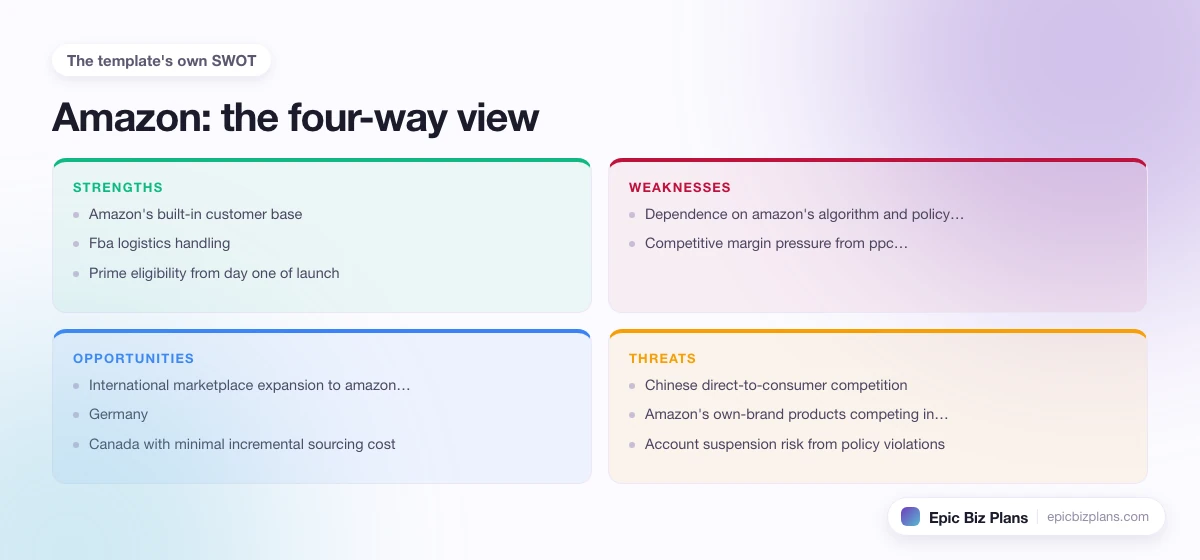
- Strengths: Amazon's built-in customer base, FBA logistics handling, and Prime eligibility from day one of launch.
- Weaknesses: Dependence on Amazon's algorithm and policy changes, and competitive margin pressure from PPC advertising costs that have risen substantially since 2020.
- Opportunities: International marketplace expansion to Amazon UK, Germany, and Canada with minimal incremental sourcing cost.
- Threats: Chinese direct-to-consumer competition, Amazon's own-brand products competing in popular categories, and account suspension risk from policy violations.
Amazon Business Name Ideas
Website
Our Amazon storefront will be our primary channel, supported by an Amazon Brand Registry enrollment that gives us access to A+ Content, Brand Analytics, and Sponsored Brand ad formats. Our supplementary Shopify store will house our full product catalog, bundle offers, and our subscription program for consumable items. Shopify's Amazon channel integration will sync inventory across both platforms automatically. For broader ecommerce retail strategy, see our ecommerce retail business plan.
Marketing Details
Amazon PPC (Pay-Per-Click) advertising is the primary customer acquisition tool on the platform. We will use Helium 10 or Jungle Scout for keyword research and Semrush for competitive analysis outside Amazon's walled garden. Our advertising strategy starts with Sponsored Products for core keywords, expanding to Sponsored Brands once we have Brand Registry approval and sufficient review volume. HubSpot will manage our off-Amazon email list, with post-purchase insert cards driving subscribers to our loyalty program and Shopify store.
TikTok and Instagram Reels featuring product setup videos, before-and-after organization content, and comparison videos against competitive products drive organic awareness and can generate significant sales velocity spikes. External traffic from social channels also qualifies for Amazon's Brand Referral Bonus program, which provides a 10% credit on sales generated from external sources - a meaningful incentive to invest in off-platform marketing. For supplementary planning, see our dropshipping business plan and fulfillment business plan.
Industry Trends
Amazon's algorithm increasingly rewards brand consistency, review velocity, and listing quality over pure price competition. Sellers who invest in professional photography, detailed A+ Content, and genuine customer review programs consistently outperform those who rely on low prices alone. Augmented reality (AR) product visualization is becoming an important differentiator for home goods - buyers who can virtually place a storage unit in their space before purchasing convert at significantly higher rates and return less frequently.
Competitor Information
In the home organization category, mDesign, Lifewit, and SimpleHouseware are established mid-market brands with thousands of reviews. IKEA and The Container Store are indirect offline competitors. We differentiate by focusing on a specific niche within organization - remote work desk and cable management - where existing listings are lower quality and keyword competition is less saturated than the broader home organization category. Precise niche focus is more profitable in year one than broad category competition.
Financial Information
Initial capital requirements are approximately $25,000: $12,000-$15,000 for first inventory order (500 units per SKU × 3 SKUs), $5,000 for professional photography and listing creation, $3,000-$5,000 for initial PPC budget, and $2,000-$3,000 for Amazon seller fees, branding, and working capital. First-year revenue target is $100,000, with net income after all costs estimated at $18,000-$22,000 (18-22% margin). Year two targets scale to $250,000 as brand review base grows and PPC efficiency improves.
Startup Cost Breakdown
- Initial inventory (3 SKUs × 500 units): $12,000–$18,000
- Professional photography and A+ content: $3,000–$5,000
- Initial PPC advertising budget (3 months): $4,500–$6,000
- Brand registration, trademark, and legal: $2,000–$3,500
- Working capital reserve: $5,000–$8,000
Legal and Compliance
We will register our business as an LLC and apply for a USPTO trademark on our brand name - Brand Registry enrollment requires a pending or registered trademark, which takes 8-12 months to process. We will ensure all products meet applicable safety standards for our category and carry proper UPC barcodes registered through GS1 USA, not third-party resellers, which is required for long-term brand integrity on Amazon. All suppliers will provide product liability insurance certificates naming our LLC as an additional insured.
Operational Plan
Product sourcing will be managed through verified manufacturer relationships established via Alibaba with physical factory audits for our top two suppliers. Shipment schedules will be built around Amazon's quarterly inventory limits for new sellers. We will use Helium 10's Inventory Management module to forecast reorder quantities based on sales velocity and lead times. Customer service will be responded to within 24 hours - Amazon's order defect rate metrics heavily penalize slow or unresolved customer contacts.
Contingency Planning
Account suspension is the most serious business risk for an Amazon seller - suspensions can freeze inventory and stop revenue without warning. We will maintain strict compliance with Amazon's Terms of Service, avoid review manipulation, and keep our ODR (Order Defect Rate) below 1%, Pre-Fulfillment Cancel Rate below 2.5%, and Late Shipment Rate below 4%. We will also build a DTC Shopify channel capable of handling 30% of our order volume independently, so a temporary Amazon account issue does not end the business. For additional income diversification, our online income business plan covers multi-channel revenue models.
-
 SemrushSemrush is a platform with literally any online tool you will need to promote your business. Spy on your competitors, get search traffic, keyword research, social info, ad copies and much more. Used by most of the top online companies in the world. Besides all its tools, Semrush also has many available integrations possible with many other tools that will make your work even better.
 -
 Surfer SEOSurfer SEO is an incredibly smart AI tool that will give you exact explanations what to do in order to make your website rank better. They use hundreds of parameters, check your competitors and decide on the best course of action. Whether it be inner links, bold text, paragraphs, headers, images and much more. Surfer is a must-have in 2026.
Building an Amazon Business Worth Owning
The best Amazon sellers think like brand operators, not marketplace arbitrageurs. They build products customers genuinely prefer, maintain review scores that reflect real satisfaction, and develop the off-Amazon brand equity that protects their business from platform risk. An Amazon business built on this foundation can eventually be sold - Amazon FBA businesses consistently attract acquisition interest from aggregators and strategic buyers willing to pay 3-5x annual profit for well-run brands with strong review history.
Exploring Opportunities
Amazon's marketplace supports businesses across every product category - consumables, electronics, apparel, baby products, sports equipment, and more. The best category to enter is one where your sourcing relationships, product expertise, or customer knowledge gives you a genuine advantage over generic competition. Generic products in crowded categories generate race-to-the-bottom pricing dynamics that make profitability very difficult to maintain.
Growth and Adaptation
Revisit your Amazon business plan quarterly. Track which products generate repeat purchases through Amazon's Subscribe & Save program, which ad campaigns produce your lowest ACOS (Advertising Cost of Sales), and which product categories your existing customer base is likely to buy from you next. These data points should directly drive your product development roadmap.
Embrace Your Future
Your Amazon business plan is 100% free - with unlimited edits, unlimited downloads, and unlimited chances to get it right. Use it to build a product business on one of the world's most powerful distribution platforms - with the operational rigor needed to turn marketplace access into long-term brand value.
