
Aluminum Business Plan Template
-
 ShopifyPut your brand on Shopify. Launch your online store with tools designed for growth and success. Ready to turn your idea into profit? Start building your e-commerce business today.
 -
 SquarespaceShowcase your brand with Squarespace’s sleek designs. Build a professional online presence with ease. Start with a template that already looks finished.
 -
 WixBring your ideas to life with Wix. Customize every aspect of your site with unmatched flexibility. Start creating your unique online space and let your creativity shine.
 -
 ElementorCraft captivating websites effortlessly with Elementor. Enjoy complete creative control without coding. Make your site stand out to your audience. Start turning your vision into reality now.
- Executive Summary
- Business Info
- SWOT Analysis
- Aluminum Business Name Ideas
- Website
- Marketing Details
- Industry Trends
- Competitor Information
- Financial Information
- Legal and Compliance
- Operational Plan
- Contingency Planning
- Putting Your Aluminum Business Plan to Work
- Adapting Your Strategy
- Practical Uses for Your Plan
An aluminum business plan lays out the operating model, capital needs, and supplier strategy required to compete in a metal market driven by construction, automotive, and packaging demand. The category includes everything from extrusion shops to fabrication outfits to recyclers, so your plan should make your specific position clear. Pricing in aluminum tracks the LME, which means margins shift with global supply, and your plan should explain how you absorb that volatility.
In a world where aluminum applications are on the rise, from lightweight vehicles to green architecture, your Aluminum business plan needs to stand out. Don’t just follow trends; set them. This is your chance to carve out a unique identity in a bustling marketplace. The process may be challenging, but with the right plan in hand, you can confidently aim high and reach your goals.
Executive Summary
We aim to establish an aluminum business that provides high-quality aluminum products for various industries. Our mission is to offer premium aluminum goods that cater to the construction, automotive, and consumer goods markets, ensuring sustainability and reliability. Our vision is to become a market leader in the aluminum industry by focusing on innovation, quality, and exceptional customer service. We will achieve financial goals by developing a strong sales strategy and maintaining strong supplier relationships, targeting a revenue growth of 20% annually.
Business Info
We will specialize in the production and distribution of aluminum sheets, extrusions, and finished products. Our target market will primarily consist of construction companies, manufacturing firms, and DIY consumers. We will operate on a B2B and B2C business model, offering our products directly to other businesses as well as to individual customers through online and physical stores.
SWOT Analysis
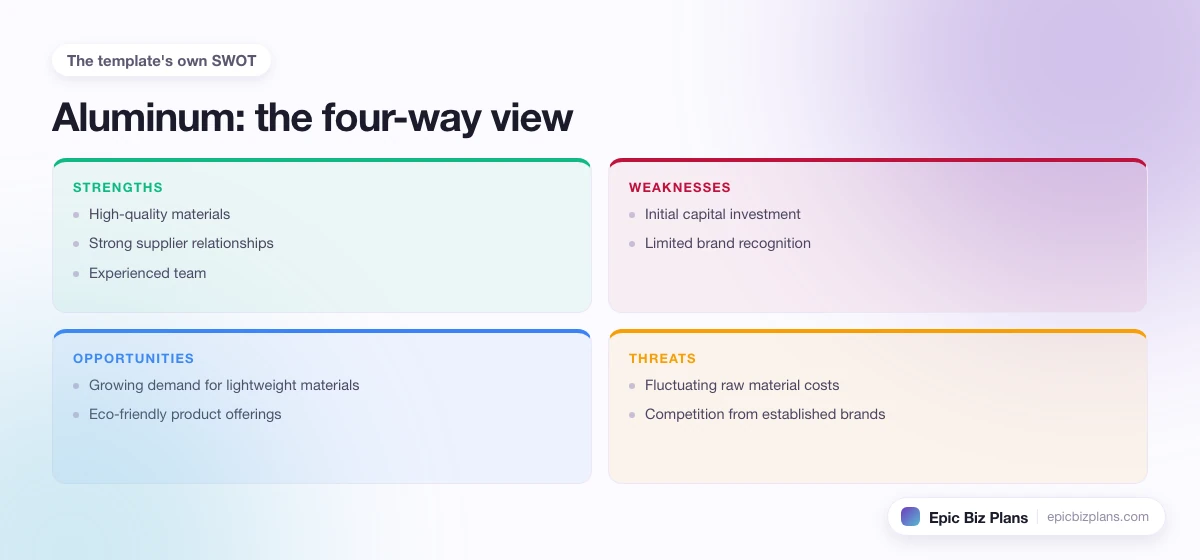
- Strengths: High-quality materials, strong supplier relationships, experienced team.
- Weaknesses: Initial capital investment, limited brand recognition.
- Opportunities: Growing demand for lightweight materials, eco-friendly product offerings.
- Threats: Fluctuating raw material costs, competition from established brands.
Aluminum Business Name Ideas
Website
We will build our website using Shopify to help our e-commerce capabilities. This platform is optimal for selling aluminum products online efficiently, allowing for user-friendly navigation and scalability. We will also consider using Squarespace if we expand into portfolio presentations or custom projects, as it provides excellent design templates.
Marketing Details
Our marketing strategy will encompass both digital and traditional channels. We will implement SEO strategies using Semrush to enhance our online visibility. For customer engagement, we will use HubSpot for email campaigns to nurture leads and maintain customer relationships.
To attract a younger demographic, we will use TikTok ads which are effective in reaching new audiences through creative and engaging content.
Industry Trends
The aluminum industry is seeing substantial technological advancements, with an emphasis on lightweight materials and sustainability practices. Innovations such as aluminum recycling are gaining traction, which not only reduces waste but also cuts down production costs. We will stay updated on these trends to incorporate them into our business model for competitive advantage.
Competitor Information
We will analyze both direct and indirect competitors within the aluminum market. Key competitors include established aluminum manufacturers and local suppliers. We will differentiate our business by offering superior customer service and customizable solutions that cater specifically to individual client needs. By fostering strong relationships with our customers, we will also capitalize on brand loyalty.
Financial Information
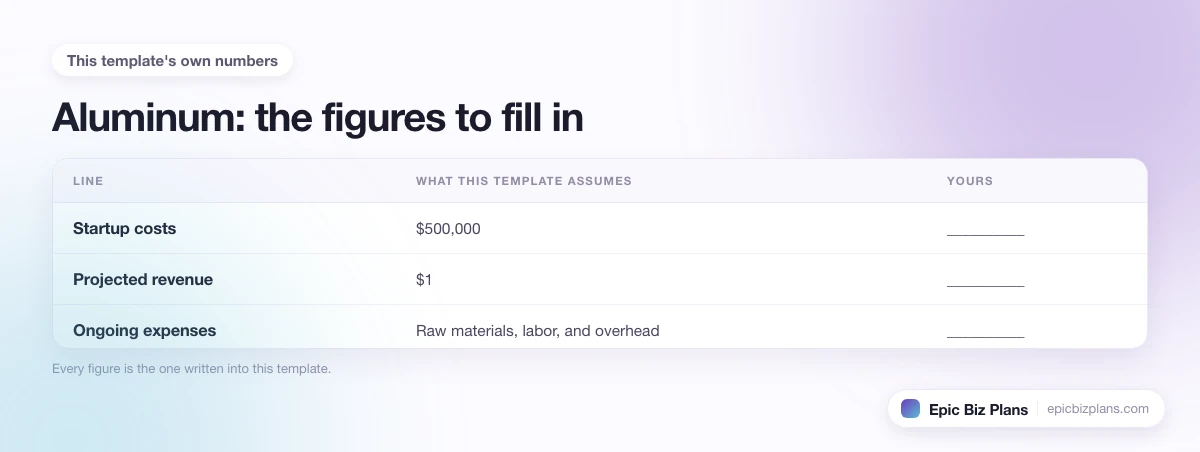
Startup costs will include equipment purchase, initial inventory, and marketing expenses, estimated at around $500,000. We project our revenue could reach $1 million in the first year with a targeted growth rate of 20% annually. Ongoing expenses will include raw materials, labor, and overhead, which will be closely monitored to maintain profitability.
We will maintain cash flow through regular monitoring and financial planning, ensuring we have sufficient liquidity to meet our operational costs. A detailed P&L statement will be prepared to track profitability and guide our financial decisions.
Legal and Compliance
We will ensure compliance with all legal requirements, including business registration, safety regulations, and environmental standards regarding aluminum production. Additionally, we will consider protecting our intellectual property through trademarks and patents as needed.
Operational Plan
Key operations will include sourcing raw materials from reliable suppliers, manufacturing through efficient processes, and distributing products via an established logistics network. We will implement quality control measures at every stage to ensure our products meet industry standards.
Contingency Planning
Potential risks include supply chain disruptions and economic downturns impacting demand. To mitigate these risks, we will develop strong relationships with multiple suppliers and maintain a diversified product line to adapt to market changes. Regular reviews of our operational practices will also be conducted to ensure sustainability and adaptability in uncertain conditions.
Putting Your Aluminum Business Plan to Work
Starting an aluminum business covers a wide range of operations: extrusion, fabrication, custom furniture, architectural components, or eCommerce distribution of finished products. Each path has different capital requirements and customer profiles. Document which segment you're targeting and why your operating model fits that segment. Operators expanding their product range often pair their work with a metalworking business plan or a scrap metal business plan for adjacent revenue streams.
-
 SemrushSemrush is a platform with literally any online tool you will need to promote your business. Spy on your competitors, get search traffic, keyword research, social info, ad copies and much more. Used by most of the top online companies in the world. Besides all its tools, Semrush also has many available integrations possible with many other tools that will make your work even better.
 -
 Surfer SEOSurfer SEO is an incredibly smart AI tool that will give you exact explanations what to do in order to make your website rank better. They use hundreds of parameters, check your competitors and decide on the best course of action. Whether it be inner links, bold text, paragraphs, headers, images and much more. Surfer is a must-have in 2026.
Adapting Your Strategy
Your aluminum business plan is a working document, not a one-time deliverable. As your customer mix and cost structure change, update pricing, expand into new regions, or add sales channels. Operators serving the construction sector also benefit from reviewing an iron and steel business plan to compare margin structures across metals, or a recycling business plan for a circular sourcing model.
Practical Uses for Your Plan
Treat your aluminum business plan as the foundation when you meet partners, lock in supplier contracts, plan your launch, or apply for financing. Lenders especially want to see clear unit economics and a realistic ramp schedule.
Your aluminum business plan is 100% free, with unlimited edits, unlimited downloads, and unlimited chances to get it right. This is your opportunity to succeed; seize it with boldness.
