
Album Business Plan Template
-
 ShopifyPut your brand on Shopify. Launch your online store with tools designed for growth and success. Ready to turn your idea into profit? Start building your e-commerce business today.
 -
 SquarespaceShowcase your brand with Squarespace’s sleek designs. Build a professional online presence with ease. Start with a template that already looks finished.
 -
 WixBring your ideas to life with Wix. Customize every aspect of your site with unmatched flexibility. Start creating your unique online space and let your creativity shine.
 -
 ElementorCraft captivating websites effortlessly with Elementor. Enjoy complete creative control without coding. Make your site stand out to your audience. Start turning your vision into reality now.
- Executive Summary
- Business Info
- Business Model Overview
- SWOT Analysis
- Album Business Name Ideas
- Website
- Marketing Details
- Industry Trends
- Competitor Information
- Financial Information
- Artist Onboarding and Catalog Management
- Legal and Compliance
- Operational Plan
- Contingency Planning
- Building Your Album Business
- Types of Businesses in the Album Niche
- Adapt and Evolve
- Practical Uses for Your Plan
An album business plan provides the strategic framework for launching a music-focused venture, whether that is a digital distribution platform, a record label, or a direct-to-fan sales operation. The recorded music industry has returned to sustained growth driven by streaming revenue and a resurgence in vinyl and physical media sales, creating opportunities for entrepreneurs who understand both the creative and commercial sides of the business.
Your plan should define your revenue model, target audience, artist acquisition strategy, and the technology stack that powers your platform. In an industry where discovery algorithms and social media virality can make or break a release, having a documented go-to-market approach gives you a clear advantage over competitors who operate without one.
Executive Summary
Our mission is to connect independent musicians with engaged listeners through a platform that prioritizes fair artist compensation and personalized music discovery. We envision a marketplace where artists retain control of their catalog while reaching fans who value supporting independent creators. Our value proposition centers on a subscription model that ensures artists receive a higher per-stream payout than major platforms. We aim for 30% annual revenue growth over the next three years.
Business Info
We will provide a digital album marketplace that allows artists to sell their music directly to consumers, including digital downloads, limited-edition physical releases, and exclusive content bundles. Our target market includes music enthusiasts aged 18 to 34 in urban areas who actively seek out independent and genre-specific music. We will operate on a freemium model, offering free access with premium features available through subscription. Artists looking to pair their releases with professional production facilities should review a recording and rehearsal studio business plan for complementary infrastructure planning.
Business Model Overview
- Subscription-based access to exclusive music content and early releases.
- Revenue from artist sales commissions, typically 10 to 15 percent of each transaction.
- Merchandising integrations and advertising placements on the platform.
SWOT Analysis
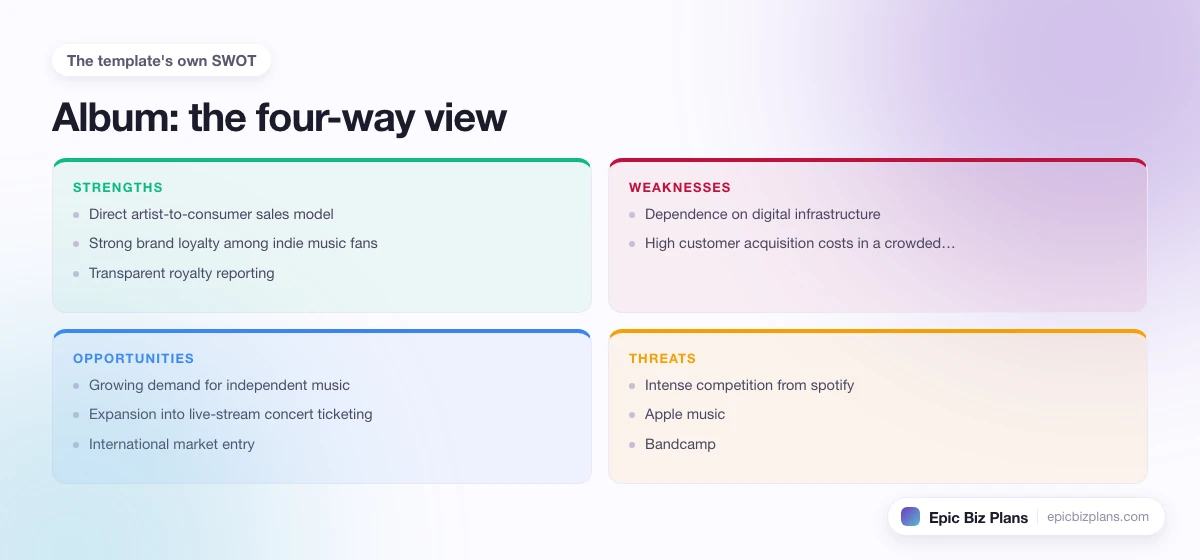
- Strengths: Direct artist-to-consumer sales model, strong brand loyalty among indie music fans, and transparent royalty reporting.
- Weaknesses: Dependence on digital infrastructure, high customer acquisition costs in a crowded market.
- Opportunities: Growing demand for independent music, expansion into live-stream concert ticketing, and international market entry.
- Threats: Intense competition from Spotify, Apple Music, and Bandcamp, plus shifting technology standards.
Album Business Name Ideas
Website
We will build our storefront on Shopify, leveraging its e-commerce features to manage artist profiles, digital downloads, and physical merchandise sales. Shopify's app ecosystem includes integrations for digital delivery and subscription billing that align with our business model. A secondary content hub on Squarespace may host editorial features, artist interviews, and playlist curation.
Marketing Details
Our marketing strategy will combine search engine optimization, email marketing, and social media community building. Semrush will guide our keyword strategy around terms like "buy independent music" and "support indie artists." HubSpot will power segmented email campaigns for new release announcements, artist spotlights, and subscriber-only offers.
TikTok and Instagram Reels are essential channels, as short-form video drives music discovery more effectively than any other format today. Partnering with music bloggers, playlist curators, and genre-specific influencers will amplify launch campaigns. Entrepreneurs interested in audio content beyond music should also explore a podcast business plan for adjacent revenue models.
Industry Trends
The digital music industry continues to grow, with streaming accounting for the majority of global recorded music revenue. AI-powered recommendation engines are reshaping how consumers discover new artists, while blockchain-based royalty tracking is gaining interest as a transparency tool. The vinyl revival has created a parallel market where limited-edition physical releases command premium pricing and serve as collector items. Understanding the broader music business landscape, as outlined in a music business plan, provides valuable context for positioning within the industry.
Competitor Information
Key competitors include Bandcamp, DistroKid, and SoundCloud, each offering different value propositions for independent artists. Bandcamp focuses on direct sales with a strong community ethos. DistroKid provides low-cost distribution to major platforms. We will differentiate by combining the best elements: fair artist payouts, strong discovery features, and a community-driven fan experience that encourages direct engagement between artists and listeners.
Financial Information
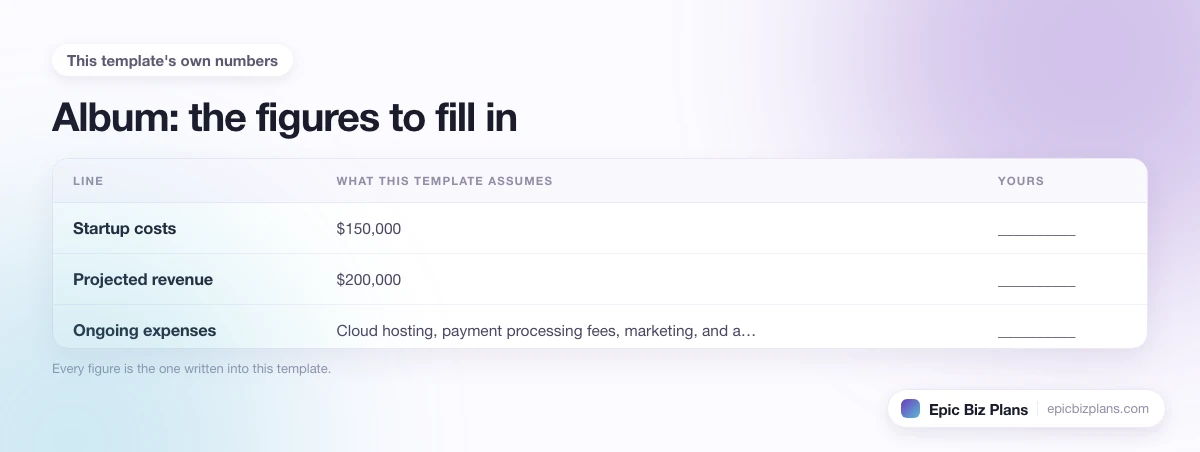
Estimated startup costs are approximately $150,000, covering platform development, initial marketing campaigns, and operational expenses for the first year. We project first-year revenue of $200,000, scaling to $500,000 by year three as the artist catalog and subscriber base grow. Ongoing expenses will include cloud hosting, payment processing fees, marketing, and a small engineering team. Gross margins on digital sales typically range from 40 to 60 percent after artist payouts.
Artist Onboarding and Catalog Management
A streamlined artist onboarding process is critical to building catalog depth quickly. We will provide a self-service upload portal where artists can submit tracks, album artwork, metadata, and pricing in under 15 minutes. Automated quality checks for audio format, metadata completeness, and content guidelines will reduce manual review time. Entrepreneurs exploring physical media should also consider a vinyl business plan for pressing and distribution logistics.
Catalog management tools will allow artists to schedule releases, set pre-order windows, and bundle digital content with physical merchandise. Providing artists with a real-time analytics dashboard showing plays, sales, and fan demographics builds trust and encourages long-term platform loyalty.
Legal and Compliance
We will ensure compliance with digital content regulations, including copyright law, DMCA takedown procedures, and data protection requirements under GDPR and CCPA. Mechanical and performance royalty obligations must be handled through licensing agreements with publishing rights organizations like Harry Fox Agency and ASCAP/BMI. A clear terms-of-service agreement will define the platform's rights and responsibilities regarding hosted content. For a related approach, see our Kpop albums business plan template.
Operational Plan
Key operations will include platform development and maintenance, artist onboarding, customer support, and content curation. A dedicated editorial team will manage featured playlists and artist spotlights that drive discovery on the platform. Partnerships with merch-on-demand services will allow artists to offer branded merchandise without holding inventory, adding a revenue stream with minimal operational overhead.
Contingency Planning
Potential risks include platform outages during major release events, copyright disputes, data breaches, and shifts in consumer behavior toward new formats. Mitigation strategies include investing in redundant cloud infrastructure, maintaining comprehensive content insurance, implementing strong cybersecurity protocols, and keeping the platform adaptable to emerging formats like spatial audio and AI-generated music curation.
-
 SemrushSemrush is a platform with literally any online tool you will need to promote your business. Spy on your competitors, get search traffic, keyword research, social info, ad copies and much more. Used by most of the top online companies in the world. Besides all its tools, Semrush also has many available integrations possible with many other tools that will make your work even better.
 -
 Surfer SEOSurfer SEO is an incredibly smart AI tool that will give you exact explanations what to do in order to make your website rank better. They use hundreds of parameters, check your competitors and decide on the best course of action. Whether it be inner links, bold text, paragraphs, headers, images and much more. Surfer is a must-have in 2026.
Building Your Album Business
The music industry rewards entrepreneurs who combine genuine passion for artists with sound business fundamentals. Whether you are launching a boutique label, building an indie music marketplace, curating vinyl subscription boxes, or creating a platform for emerging artists to reach fans directly, the album business niche offers multiple paths to profitability.
Types of Businesses in the Album Niche
The album space supports diverse business models. You might build a digital distribution platform, operate a recording studio with label services, launch a direct-to-fan merch and music e-commerce store, or create a curation service that connects listeners with independent artists. Each model serves a different segment of the music ecosystem.
Adapt and Evolve
Your album business plan should evolve as the industry changes. Update it regularly to reflect new revenue streams, platform features, geographic expansion, and shifts in how fans consume music. A plan that adapts with you remains useful far beyond launch day.
Practical Uses for Your Plan
Use your album business plan to pitch to investors, negotiate artist partnerships, plan your launch timeline, or secure a startup loan. A well-structured plan demonstrates that you understand both the creative and financial dimensions of the music business.
Your album business plan is 100% free - with unlimited edits, unlimited downloads, and unlimited chances to get it right. Start building the platform your artists and fans deserve.
