
Air Compressor Business Plan Template
-
 ShopifyPut your brand on Shopify. Launch your online store with tools designed for growth and success. Ready to turn your idea into profit? Start building your e-commerce business today.
 -
 SquarespaceShowcase your brand with Squarespace’s sleek designs. Build a professional online presence with ease. Start with a template that already looks finished.
 -
 WixBring your ideas to life with Wix. Customize every aspect of your site with unmatched flexibility. Start creating your unique online space and let your creativity shine.
 -
 ElementorCraft captivating websites effortlessly with Elementor. Enjoy complete creative control without coding. Make your site stand out to your audience. Start turning your vision into reality now.
- Executive Summary
- Business Info
- SWOT Analysis
- Business Name Ideas
- Website
- Marketing Details
- Product Selection and Sourcing
- Industry Trends
- Competitor Information
- Service and Warranty Offering
- Financial Information
- Legal and Compliance
- Operational Plan
- Contingency Planning
- Build Your Future with Your Air Compressor Business Plan
- Plan for Growth Through Adaptation
- Practical Uses for Your Plan
An air compressor business plan gives you a clear path into one of the steadiest industrial supply categories on the market. Demand for compressed air systems comes from construction crews, auto shops, paint contractors, and home garages, and that demand is consistent year over year rather than tied to a single trend. Your plan needs to spell out which segments you are chasing, what product mix you stock, and how you reach buyers cost-effectively. Done right, the document doubles as a roadmap and a pitch tool for suppliers, lenders, and partners.
The plan should pair operational details with concrete financial projections. Cover sourcing relationships with manufacturers, your service and warranty offering, and the marketing channels you will use to reach contractors versus DIY buyers. Margins differ widely between portable consumer units and industrial reciprocating systems, so price each line carefully. If your business will also stock related gear, the hand tools business plan template covers an adjacent product category that often shares the same customer base.
Executive Summary
We will establish a business focused on supplying high-quality air compressors to commercial and residential customers. Our mission is to deliver reliable, energy-efficient products backed by responsive service and clear technical guidance. Our vision is to become a trusted regional supplier known for matching customers with the right compressor for the job rather than upselling. Financially, we target $500,000 in first-year revenue with a 15% annual growth rate after that.
Business Info
Our company will offer a range of air compressors, including portable units, stationary models, and specialized air tools. The target market includes contractors, automotive repair shops, body and paint shops, and DIY enthusiasts working in home garages. We will follow a direct sales model complemented by an online store and a small showroom for in-person demonstrations.
SWOT Analysis
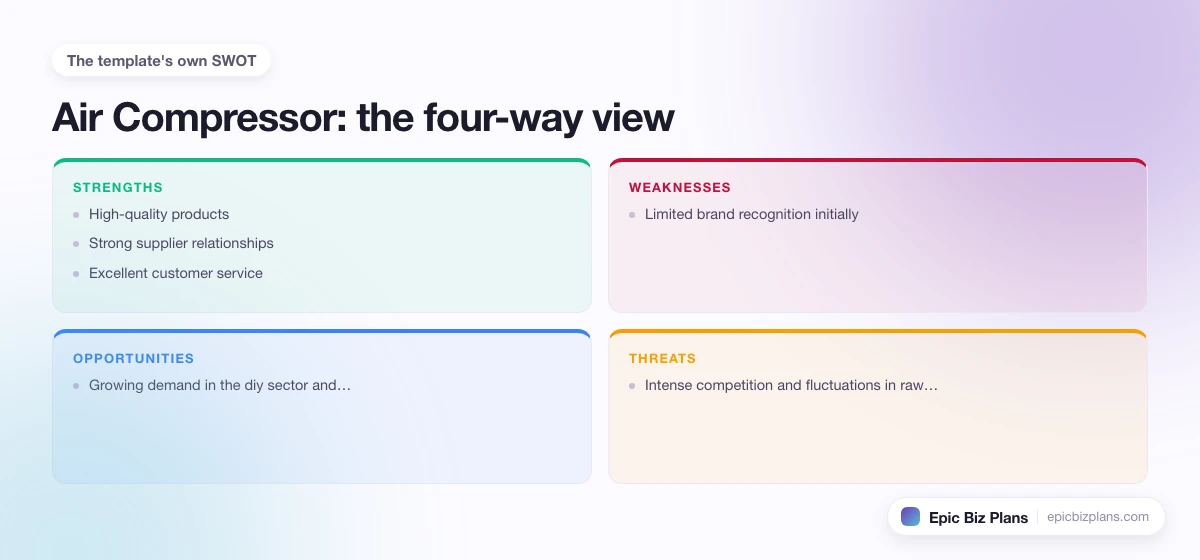
- Strengths: High-quality products, strong supplier relationships, and excellent customer service.
- Weaknesses: Limited brand recognition initially.
- Opportunities: Growing demand in the DIY sector and opportunities for product diversification.
- Threats: Intense competition and fluctuations in raw material costs.
Business Name Ideas
Website
We will build our website on Shopify because it handles ecommerce out of the box and integrates cleanly with shipping carriers and payment processors. Shopify also gives us flexibility for product specs, downloadable manuals, and clear filtering by CFM, tank size, and horsepower. A clean catalog and a secure checkout reduce friction for buyers comparing models across multiple sites.
Marketing Details
Our marketing strategy combines paid digital, organic content, and trade outreach. We use SEMrush for keyword and competitor research and run targeted SEO around buying-intent terms like "5 HP air compressor" and "best compressor for body shop." HubSpot manages email sequences for repeat customers and warranty follow-ups.
For the DIY segment, we will run TikTok and YouTube ads featuring short demo clips of compressors handling real tasks. Trade-focused outreach targets local contractor associations and supply houses where bulk and account customers gather.
Product Selection and Sourcing
We will carry three tiers of compressors: entry-level portable units for hobbyists, mid-range single-stage models for small shops, and two-stage industrial compressors for commercial customers. Each tier targets a different price point and use case, which broadens our addressable market without overcomplicating inventory. Sourcing is split between two manufacturers to avoid single-supplier risk during shipping or production delays.
Accessories such as hoses, fittings, regulators, and filters carry stronger margins than the compressors themselves, so we treat them as a key revenue driver. Bundling accessories with each compressor sale lifts average order value and reduces the friction of customers shopping elsewhere for parts. Our equipment offering complements adjacent categories covered in the equipment sales business plan template.
Industry Trends
The compressor industry is moving toward energy-efficient variable-speed drives and smart monitoring features that flag service intervals automatically. Rising energy costs are pushing commercial buyers toward higher-efficiency models even at a price premium. Automation and the growth of small-shop manufacturing also drive sustained demand for reliable pneumatic systems. On the consumer side, portable air products like those in the mini fan business plan template follow the same shift toward efficient, battery-friendly designs.
Competitor Information
Our main competitors include established brands with strong market presence and big-box retailers that compete on price. We differentiate with technical guidance, faster local service turnaround, and a curated product range rather than the overwhelming catalogs of larger sellers. Customers who need a compressor for a specific application benefit from our ability to recommend the right unit on the first try.
Service and Warranty Offering
Service revenue is one of the most defensible parts of an air compressor business. We will offer paid maintenance plans, on-site repairs for commercial customers, and standard warranty support for every unit sold. Recurring service contracts produce predictable revenue and keep us in front of customers when they are ready to upgrade.
For shops that need ongoing support, our service plans align well with the broader approach in our equipment repair business plan template.
Financial Information
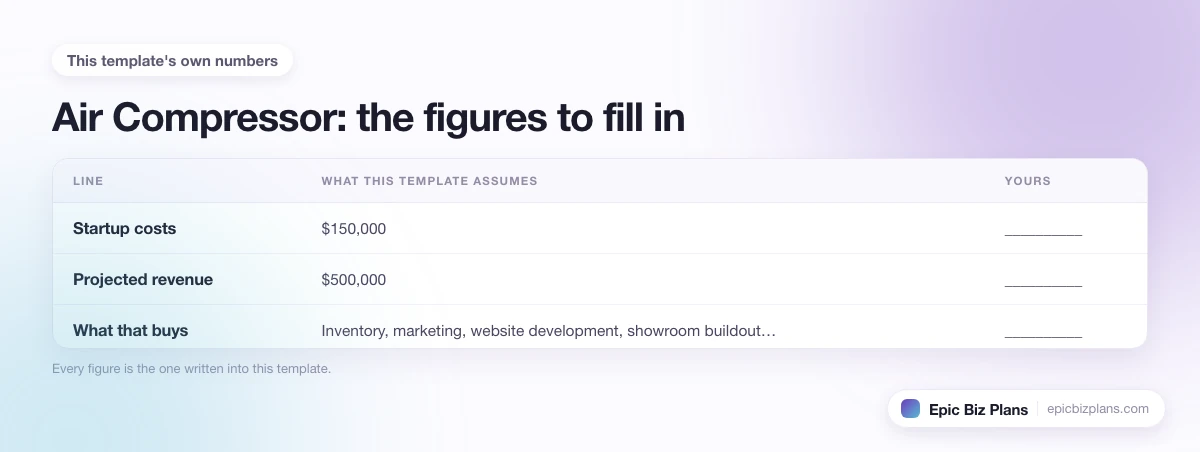
Startup costs are estimated at $150,000, covering inventory, marketing, website development, showroom buildout, and operational expenses. First-year revenue is set at $500,000 with ongoing expenses around 30% of revenue. We track inventory turns monthly to keep capital from sitting on the shelf and adjust purchase orders based on actual sell-through.
Legal and Compliance
We register the business locally, secure a resale certificate, and verify that our products meet all relevant ASME and OSHA standards for pressure vessels. Warranty terms and clear return policies protect both the customer and the company. Legal review of supplier contracts is done before signing to avoid surprises around minimum order commitments.
-
 SemrushSemrush is a platform with literally any online tool you will need to promote your business. Spy on your competitors, get search traffic, keyword research, social info, ad copies and much more. Used by most of the top online companies in the world. Besides all its tools, Semrush also has many available integrations possible with many other tools that will make your work even better.
 -
 Surfer SEOSurfer SEO is an incredibly smart AI tool that will give you exact explanations what to do in order to make your website rank better. They use hundreds of parameters, check your competitors and decide on the best course of action. Whether it be inner links, bold text, paragraphs, headers, images and much more. Surfer is a must-have in 2026.
Operational Plan
Operations focus on efficient receiving, accurate inventory counts, and quick shipping turnaround. We partner with regional freight carriers for larger units and a parcel carrier for accessories. A barcode-based inventory system keeps stock levels accurate and triggers reorders before items go out of stock.
Contingency Planning
Supply chain disruptions and demand swings are the two clearest risks. We mitigate supply risk by sourcing from two manufacturers and keeping a 60-day buffer of top sellers. Demand risk is handled by tracking sales weekly and shifting marketing spend toward whichever segment, contractor or DIY, is responding best in the current quarter.
Build Your Future with Your Air Compressor Business Plan
The moment you commit to your Air Compressor business plan is the moment the project gets real. Whether you envision a local repair-and-supply shop, an ecommerce store specializing in industrial-grade units, or a hybrid model that pairs sales with service contracts, the path is in your hands. The category supports both small specialized startups and larger operations serving construction, automotive, and manufacturing clients. Some operators also expand into related categories like the spray painting business plan template, which depends on quality compressed air.
Plan for Growth Through Adaptation
Your Air Compressor business plan should never sit untouched. As volumes grow and customer mix shifts, revisit pricing, the product range, and your service offering. Adjust for new regions, evaluate adding rental options, or refine your sales channels each quarter. Each edit keeps the plan honest with what is actually happening in the business.
Practical Uses for Your Plan
Treat the plan as your working roadmap. Use it to pitch suppliers for credit terms, brief a new hire, secure financing, or organize your own thinking before a launch. Each section should answer a real question someone might ask before doing business with you.
Your Air Compressor business plan is 100% free, with unlimited edits, unlimited downloads, and unlimited chances to refine it. Start now and you can be selling your first unit within weeks rather than months.
