
Agri Tech Business Plan Template
-
 ShopifyPut your brand on Shopify. Launch your online store with tools designed for growth and success. Ready to turn your idea into profit? Start building your e-commerce business today.
 -
 SquarespaceShowcase your brand with Squarespace’s sleek designs. Build a professional online presence with ease. Start with a template that already looks finished.
 -
 WixBring your ideas to life with Wix. Customize every aspect of your site with unmatched flexibility. Start creating your unique online space and let your creativity shine.
 -
 ElementorCraft captivating websites effortlessly with Elementor. Enjoy complete creative control without coding. Make your site stand out to your audience. Start turning your vision into reality now.
- Executive Summary
- Business Info
- Products and Services
- Target Market
- Business Model Overview
- SWOT Analysis
- Agri-Tech Business Name Ideas
- Website
- Marketing Details
- Industry Trends
- Competitor Information
- Financial Information
- Legal and Compliance
- Operational Plan
- Contingency Planning
- Build for the Farmer First
- Agri-Tech Business Models Worth Considering
- Adaptability is Essential
- Practical Uses for Your Plan
An agri-tech business plan requires you to think simultaneously about two distinct sets of customers: the technology side and the farming side. Your product may be technically excellent, but adoption depends entirely on whether farmers find it practical, affordable, and worth the time investment of learning something new. Building that understanding into your plan from the start separates agri-tech businesses that achieve real market penetration from those that stall after early adopters.
The agri-tech sector has attracted significant investment, but the path from promising technology to commercial scale involves more friction than most general tech business frameworks acknowledge. Crop cycles, seasonal cash flow constraints, connectivity limitations in rural areas, and the conservative risk tolerance of farming operations all shape how you need to design, price, and sell your product. Your plan should address these realities directly.
Executive Summary
Our mission is to transform agricultural operations by providing technology solutions that measurably improve productivity, reduce operational costs, and support sustainable farming practices, including hardware for indoor growers like the systems in our vertical farming business plan. Our vision is to become a trusted agri-tech partner for small and medium-sized farm operators who currently lack access to the data and automation tools available to large commercial operations. If you're considering adjacent ventures, check out our hi tech business plan.
Our value proposition is built on solutions that deliver quantifiable returns - higher yields, lower input costs, or reduced labor hours - with an implementation process designed for operators who are running farms, not technology departments. Financially, we aim to capture a meaningful share of our target segment within five years through sustainable, referral-driven growth.
Business Info
Products and Services
We offer precision agriculture tools, IoT devices for farm monitoring, mobile applications for farm management, and data analytics services. Each product is designed to be operational within a single growing season and compatible with existing farm equipment where possible. For operators looking to understand how technology purchasing fits within broader farm investment planning, the organic farming business plan provides useful context on how farms evaluate and budget for operational improvements.
Target Market
Our primary target market includes small to medium-sized farmers, agribusinesses, and agricultural cooperatives. We focus specifically on operations where labor costs, water management, or yield variability represent significant financial pressure - the segments where our solutions generate the clearest return on investment. Secondary markets include agricultural input suppliers and cooperatives who can bundle our tools as part of their member service offerings.
Business Model Overview
Our business model combines direct product sales with subscription-based services for software and ongoing data analytics. Hardware sales generate upfront revenue; subscriptions provide recurring income that improves financial predictability. Partnerships with agricultural organizations and cooperatives give us access to large networks of potential customers with lower per-customer acquisition costs than direct-to-farmer marketing. The vertical farming business plan covers technology integration approaches within controlled-environment agriculture - a complementary market segment for agri-tech tools.
SWOT Analysis
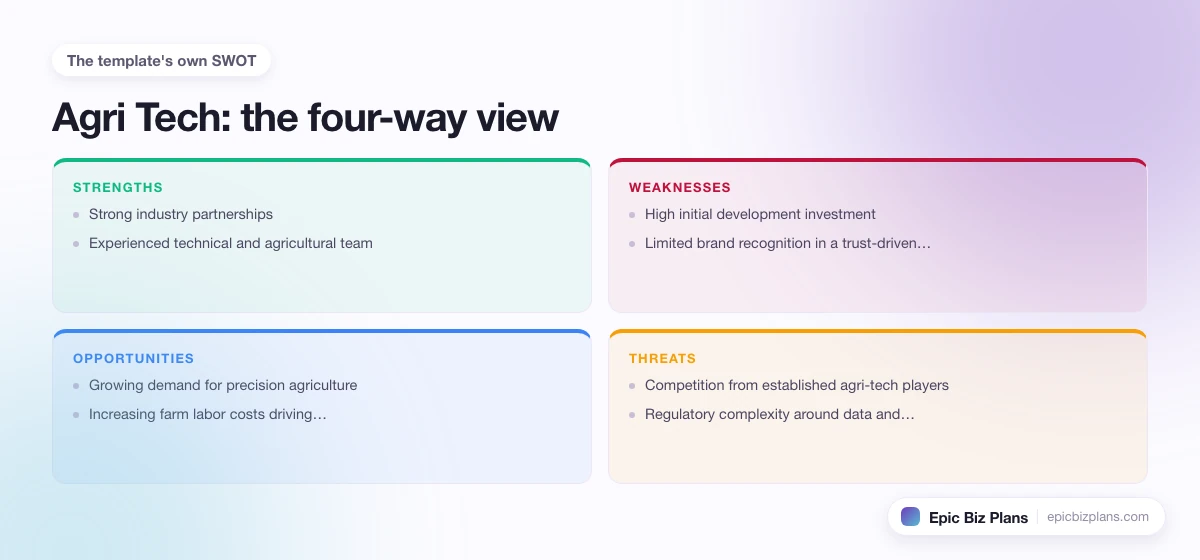
- Strengths: Innovative and practical solutions, strong industry partnerships, experienced technical and agricultural team.
- Weaknesses: High initial development investment, limited brand recognition in a trust-driven market.
- Opportunities: Growing demand for precision agriculture, increasing farm labor costs driving automation interest.
- Threats: Competition from established agri-tech players, regulatory complexity around data and connectivity.
Agri-Tech Business Name Ideas
Website
We will build our website on a platform suited to B2B software and hardware marketing - likely WordPress or HubSpot CMS, rather than a pure e-commerce platform. Our site will focus on demonstrating product outcomes through case studies, ROI calculators, and video documentation of field deployments. Trust-building content - farmer testimonials, pilot results, and agronomist endorsements - will be central to converting research-stage visitors into qualified leads.
Marketing Details
Our marketing strategy will combine digital outreach with direct-channel engagement through agricultural trade shows, cooperative networks, and agronomist partnerships. Semrush will support SEO targeting for high-intent search queries from farm operators researching specific problems. HubSpot will manage lead nurturing sequences calibrated to farming seasonal cycles - campaigns timed to pre-planting planning periods consistently outperform year-round generic outreach. For understanding how farmers make equipment and technology purchasing decisions, the farm equipment business plan offers relevant insight into farm operator purchasing behavior.
Industry Trends
Precision agriculture adoption is accelerating as hardware costs fall and connectivity in rural areas improves. IoT sensor networks for soil, water, and crop monitoring are moving from early-adopter niches into mainstream consideration among commercial farm operators. Data analytics services that convert sensor data into actionable recommendations are becoming a significant competitive differentiator. Sustainability pressure from supply chain buyers and government programs is also pushing farm operators toward technology adoption as a measurable compliance tool. For a related angle, look at our Revolution Business Plan Template.
Competitor Information
Our main competitors include established agri-tech companies with existing distributor networks and recognized brands. We will differentiate through superior responsiveness to customer needs, customization flexibility, and a focus on ROI clarity that larger competitors with complex product portfolios often fail to communicate. Our sustainability positioning also aligns with growing buyer-driven requirements at the supply chain level, which gives us a marketing angle beyond pure productivity gains. Agri-tech businesses targeting farm operators should also understand how their customers make equipment purchasing decisions - our tractor business plan provides useful context on the agricultural machinery buying process, customer relationships, and financing models that shape how farmers evaluate new technology investments.
Financial Information
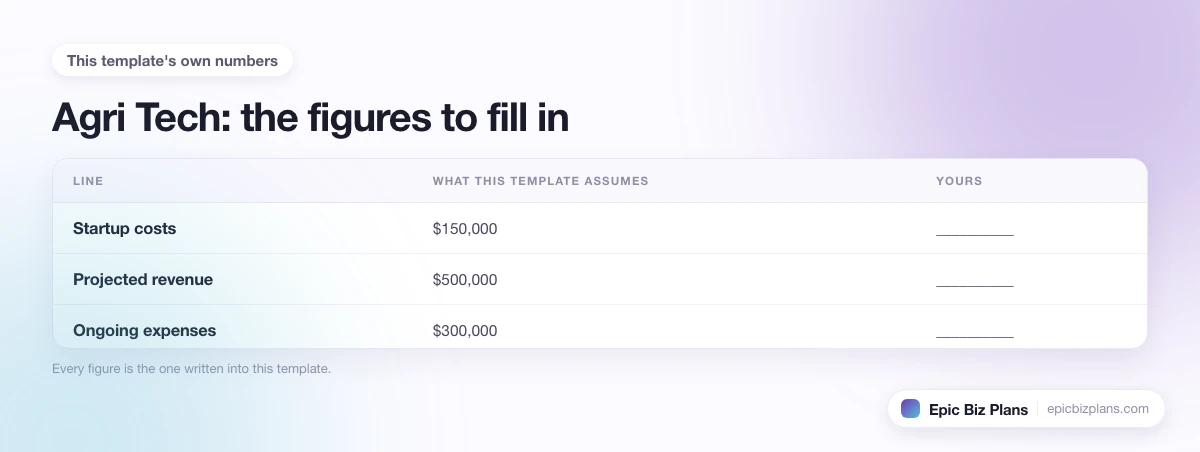
Startup costs are estimated at $150,000, covering product development, marketing, and initial operations. We project first-year revenue of $500,000, with ongoing expenses of approximately $300,000. Cash flow management is particularly important in agri-tech given that farm customers often pay on seasonal cycles rather than on standard net-30 terms. Building receivables management and payment plan options into your financial model from the start reflects how agri-tech businesses actually operate in the field.
Legal and Compliance
We will register the business and obtain all necessary permits for operating in the agri-tech space. Intellectual property protection for our core technologies, algorithms, and proprietary datasets is essential for maintaining competitive advantage. Data privacy compliance is also increasingly relevant as our products collect farm-level operational data - clear data ownership terms in customer agreements protect both parties.
Operational Plan
Key operations include product development cycles, supply chain management for hardware components, field installation support, and customer service. We will build supplier relationships for efficient hardware sourcing and implement remote monitoring capabilities to provide proactive support before farmers experience service disruptions. The crop business plan covers the customer side of our market - understanding how farm operators plan, finance, and manage their growing operations helps us design products and support services that fit their actual workflow.
Contingency Planning
Key risks include component supply disruptions, slower-than-projected adoption rates, and evolving agricultural subsidy and regulatory frameworks. Mitigation strategies include maintaining multiple hardware supplier options, designing modular products that can be reconfigured as regulations change, and maintaining a 6-month operating reserve to weather slow-adoption periods. Regular engagement with agricultural policy developments ensures we can anticipate regulatory changes rather than react to them after they affect our customers. If you are weighing related options, the Philadelphia Business Plan Template is worth a read.
-
 SemrushSemrush is a platform with literally any online tool you will need to promote your business. Spy on your competitors, get search traffic, keyword research, social info, ad copies and much more. Used by most of the top online companies in the world. Besides all its tools, Semrush also has many available integrations possible with many other tools that will make your work even better.
 -
 Surfer SEOSurfer SEO is an incredibly smart AI tool that will give you exact explanations what to do in order to make your website rank better. They use hundreds of parameters, check your competitors and decide on the best course of action. Whether it be inner links, bold text, paragraphs, headers, images and much more. Surfer is a must-have in 2026.
Build for the Farmer First
The agri-tech businesses that achieve durable commercial success are those that remained grounded in real farm operator needs throughout their development process. Products built in isolation from working farmers - however technically impressive - consistently fail the adoption test. Build regular farmer feedback into your product development cycle and treat deployment challenges as product design information rather than implementation inconveniences.
Agri-Tech Business Models Worth Considering
Your business model options range from hardware-centric product companies to pure SaaS analytics platforms, with hybrid approaches in between. Each carries different capital requirements, gross margin profiles, and customer acquisition dynamics. Choose the model that aligns with your team's strengths and your customers' willingness to pay for recurring versus one-time purchases.
Adaptability is Essential
Agriculture operates on multi-year cycles, and your agri-tech business plan should reflect long-term thinking while remaining adaptable to near-term market feedback. Update your plan annually with actual data on customer adoption rates, support costs per customer, and sales cycle length - these metrics often diverge significantly from initial projections in agri-tech businesses during the first three years.
Practical Uses for Your Plan
Your agri-tech business plan is a credibility document for investors, a strategic reference for your team, and a communication tool for partnership discussions with cooperatives and distributors. Investors in the agri-tech space are familiar with the adoption curve challenges of the sector and will want to see that your plan accounts for them realistically.
Your Agri-Tech business plan is 100% free - with unlimited edits, unlimited downloads, and unlimited chances to get it right. Build it on genuine market knowledge and a commitment to solving problems that farmers actually have.
