
Aftershave Business Plan Template
-
 ShopifyPut your brand on Shopify. Launch your online store with tools designed for growth and success. Ready to turn your idea into profit? Start building your e-commerce business today.
 -
 SquarespaceShowcase your brand with Squarespace’s sleek designs. Build a professional online presence with ease. Start with a template that already looks finished.
 -
 WixBring your ideas to life with Wix. Customize every aspect of your site with unmatched flexibility. Start creating your unique online space and let your creativity shine.
 -
 ElementorCraft captivating websites effortlessly with Elementor. Enjoy complete creative control without coding. Make your site stand out to your audience. Start turning your vision into reality now.
- Executive Summary
- Business Info
- SWOT Analysis
- Aftershave Business Name Ideas
- Startup Cost Breakdown
- Licensing and Compliance
- Website
- Marketing Details
- Industry Trends
- Competitor Information
- Financial Information
- Legal and Compliance
- Operational Plan
- Contingency Planning
- Building Your Aftershave Business Plan
- Types of Aftershave Businesses
- Iterations to Match Growth
- Practical Applications of Your Plan
An aftershave business plan helps you build a grooming product brand with a clear strategy for product development, regulatory compliance, and market positioning. The men's grooming market has grown significantly, with premium and natural products driving a large share of the expansion. But this is also a crowded space - building a brand that earns shelf space or a loyal DTC customer base requires more than a good formula.
Your aftershave business plan should make specific decisions visible before you spend money on formulation and packaging: who your target customer is, how you'll price against established brands, which channels you'll sell through, and what your margin structure needs to look like to reach profitability. The sections below provide a practical framework for each of those decisions.
Executive Summary
Our mission is to create a premium aftershave line that delivers real skin benefits alongside a distinctive, refreshing scent. We aim to become a recognized brand in the men's grooming segment, built on quality ingredients and transparent formulation. Our value proposition centers on natural, skin-compatible ingredients that soothe and hydrate without irritation. We target a 20% profit margin within the first year, with meaningful market expansion by year three.
Business Info
Our product line will include aftershave balms, lotions, and splashes formulated for different skin types. We will target men aged 18–45 who take their grooming seriously and are willing to pay a premium for quality ingredients and effective formulas. Our primary sales model is direct-to-consumer through e-commerce, supplemented by targeted wholesale partnerships with barbershops and specialty retailers.
SWOT Analysis
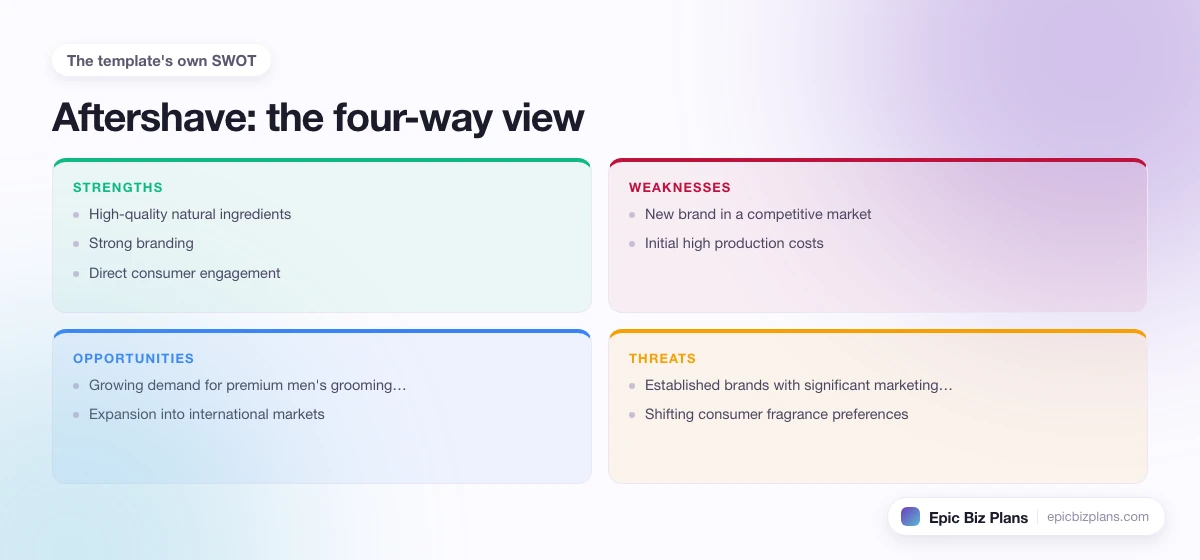
- Strengths: High-quality natural ingredients, strong branding, direct consumer engagement.
- Weaknesses: New brand in a competitive market, initial high production costs.
- Opportunities: Growing demand for premium men's grooming products, expansion into international markets.
- Threats: Established brands with significant marketing budgets, shifting consumer fragrance preferences.
Aftershave Business Name Ideas
Startup Cost Breakdown
Launching an aftershave brand involves product development, compliance, and marketing costs that add up quickly. Here is a realistic estimate:
- Product formulation and lab testing: $5,000–$15,000
- Minimum order quantity for initial production run: $10,000–$25,000
- Packaging design and initial packaging inventory: $5,000–$12,000
- FDA cosmetic compliance and safety testing: $3,000–$8,000
- Brand identity and website: $3,000–$7,000
- Digital marketing (first 3 months): $8,000–$15,000
- Photography and content creation: $2,000–$5,000
Total estimated startup budget: $36,000–$87,000. Brands launching with a single hero SKU can start at the lower end; multi-SKU launches with custom packaging will fall at the higher end.
Licensing and Compliance
Aftershave products are regulated as cosmetics in the US under the FDA. While cosmetics don't require pre-market approval, they must be safe and properly labeled, and any drug claims (such as "prevents razor burn from infection") would classify the product as an OTC drug - a significantly higher compliance burden. You'll need to register your formulation and ensure all ingredients comply with FDA cosmetic ingredient guidelines. In the EU, cosmetic products must be registered in the EU Cosmetic Products Notification Portal (CPNP) before sale. Working with a cosmetic chemist and regulatory consultant from the start is a cost-effective way to avoid reformulation later.
Website
We will build our e-commerce site on Shopify, which handles payment processing, inventory tracking, and subscription product sales efficiently. Our site will feature high-quality product photography, ingredient transparency pages, and customer reviews prominently displayed. Brands selling in adjacent grooming categories - such as those building a men's grooming business plan - face similar channel and positioning decisions and often benefit from shared marketing infrastructure.
Marketing Details
Our marketing strategy centers on SEO, social proof, and targeted paid acquisition. We will use Semrush to identify high-intent keywords in men's skincare and aftershave categories and build content around those terms. HubSpot will manage email campaigns promoting new products and grooming education content. TikTok and Instagram will be our primary paid social platforms, where authentic grooming content performs well with younger male demographics.
Product seeding with men's grooming influencers and barber channels builds credibility faster than paid advertising alone. We will allocate 15–20% of our marketing budget to creator partnerships in the first six months to build genuine reviews and social proof before scaling paid acquisition.
Industry Trends
The men's grooming market has moved toward premium, natural formulations as consumers become more ingredient-conscious. Clean formulations with minimal synthetic fragrances and identifiable botanical ingredients are gaining market share from traditional grooming brands that relied on heavy fragrance to mask functional shortcomings. Sustainability in packaging - refillable glass bottles, recycled cardboard inserts, reduced plastic - is increasingly a purchase driver among the 25–40 demographic. Businesses in adjacent categories like fragrance and perfume businesses are seeing similar shifts toward naturals and transparency.
Competitor Information
Our main competitors include established grooming brands with strong retail distribution and loyal customer bases. Direct DTC competitors have proliferated in recent years, many competing on ingredient quality and brand storytelling. We will differentiate through formulation transparency, specific skin-type targeting, and barbershop channel partnerships that give our brand professional credibility. Our packaging will reflect a premium but accessible positioning - avoiding the clinical aesthetic of medical-grade products while clearly communicating natural ingredient quality.
Financial Information
Startup costs will include formulation, packaging, marketing, and website development. We project meaningful revenue growth as we expand our product range and distribution. Target unit economics: manufacturing cost under $6 per unit on products retailing at $24–$38, which supports the margin structure needed to fund paid acquisition at scale. We will maintain monthly cash flow and P&L statements to track performance and inform decisions about production scaling and channel expansion.
Legal and Compliance
We will register our business and trademark our brand name and logo early to protect the brand before significant marketing investment. All aftershave formulations will be tested by a certified lab for safety and stability before launch. We will adhere strictly to FDA cosmetic labeling requirements, including full ingredient disclosure in INCI format. Import/export documentation will be managed proactively for any international distribution we pursue.
Operational Plan
Operations will focus on sourcing quality botanical ingredients from certified suppliers, maintaining quality control at a contract manufacturing facility, and managing order fulfillment through a third-party logistics partner. We will build a secondary supplier relationship for key ingredients to reduce supply concentration risk. Barbershop partnerships will be managed through a dedicated account relationship process, including product samples, sell sheets, and quarterly check-ins. Businesses launching adjacent personal care product lines should also review a shave business plan for insight into how complementary grooming products are positioned and distributed together.
-
 SemrushSemrush is a platform with literally any online tool you will need to promote your business. Spy on your competitors, get search traffic, keyword research, social info, ad copies and much more. Used by most of the top online companies in the world. Besides all its tools, Semrush also has many available integrations possible with many other tools that will make your work even better.
 -
 Surfer SEOSurfer SEO is an incredibly smart AI tool that will give you exact explanations what to do in order to make your website rank better. They use hundreds of parameters, check your competitors and decide on the best course of action. Whether it be inner links, bold text, paragraphs, headers, images and much more. Surfer is a must-have in 2026.
Contingency Planning
We will address risks including ingredient sourcing disruptions, market competition from larger brands entering the premium natural segment, and potential regulatory changes to cosmetic ingredient standards. We will maintain a three-month inventory buffer for our top-selling SKUs and keep approved alternative formulations on file with our contract manufacturer in case ingredient availability changes. Flexible marketing plans will allow us to shift spend across channels based on performance data.
Building Your Aftershave Business Plan
A successful aftershave brand is built on the intersection of formulation quality, brand positioning, and disciplined customer acquisition. Your aftershave business plan gives you a framework to make those decisions deliberately rather than reactively. The brands that have carved out durable positions in the premium men's grooming space - Baxter of California, Jack Black, American Crew - all started with clear positioning and consistent execution before expanding their product lines.
Types of Aftershave Businesses
The aftershave market supports several distinct business models. Artisanal makers can sell handcrafted, small-batch products at premium prices through direct channels. Mid-market DTC brands scale through paid social and email retention. Wholesale-focused brands target barbershops, specialty retail, and subscription box services. Subscription boxes offer a recurring revenue model that pairs well with a small but high-quality SKU set. Each model has different capital requirements and margin structures - your plan should specify which model you're pursuing.
Iterations to Match Growth
Revisit your aftershave business plan quarterly to reflect what you've learned from customer feedback, sales data, and competitive developments. Product extensions - beard oils, shaving creams, facial moisturizers - should be evaluated against your margin targets and existing customer purchase behavior before launching.
Practical Applications of Your Plan
Use this plan to brief potential retail buyers, present to investors, structure conversations with contract manufacturers, and align your team on priorities. Every section reflects a real decision that affects how your brand operates and grows.
Your aftershave business plan is 100% free - with unlimited edits, unlimited downloads, and unlimited chances to get it right. The discipline of planning before launching is the first signal to the market that you're serious about building something that lasts.
