
Advise Business Plan Template
-
 ShopifyPut your brand on Shopify. Launch your online store with tools designed for growth and success. Ready to turn your idea into profit? Start building your e-commerce business today.
 -
 SquarespaceShowcase your brand with Squarespace’s sleek designs. Build a professional online presence with ease. Start with a template that already looks finished.
 -
 WixBring your ideas to life with Wix. Customize every aspect of your site with unmatched flexibility. Start creating your unique online space and let your creativity shine.
 -
 ElementorCraft captivating websites effortlessly with Elementor. Enjoy complete creative control without coding. Make your site stand out to your audience. Start turning your vision into reality now.
- Executive Summary
- Business Info
- Business Model Overview
- SWOT Analysis
- Advise Business Name Ideas
- The Green Claims Rules Just Changed, and Your Copy Has to Change With Them
- What to Write Instead
- Website
- Marketing Details
- Industry Trends
- A Claims Audit as a Productised Advisory Offer
- Competitor Information
- Financial Information
- Startup Cost Breakdown
- Legal and Compliance
- Operational Plan
- Contingency Planning
- Embrace Your Vision
- Adapt and Evolve
- Strategic Applications
- Your Path Forward
An Advise business plan gives you a structured foundation for launching a sustainability-focused advisory or eco-product business. Whether you are building a brand that sells eco-friendly consumer goods, advising other companies on sustainable practices, or combining both into a consultancy-plus-product model, the plan needs to be specific about how you generate revenue, who your customers are, and what it will cost to reach them. Generic plans produce generic results, so the goal here is a document grounded in real numbers and clear positioning.
This template is built for a direct-to-consumer eco-products business, but the frameworks around market analysis, financial projections, and operational planning apply equally well to advisory and consulting models in the sustainability space. Adapt the sections to fit your model as you work through it, and pay particular attention to the claims section, because the rules governing what you are allowed to say about a green product changed materially in 2026.
Executive Summary
Our mission is to offer high-quality, genuinely sustainable products that meet the purchasing standards of environmentally conscious consumers. We envision a brand recognized for product quality, supply chain transparency, and consistent environmental values, not just marketing language. Our value proposition is delivering eco-friendly alternatives comparable in quality to conventional products at a price that reflects, but does not exploit, the premium buyers in this segment are willing to pay.
Financial targets: break-even within 14 months, with year-two revenue of $500,000 built on a growing repeat-customer base and an expanding product range. We will reach this through a direct-to-consumer e-commerce model supplemented by eco-retail partnerships in year two.
Business Info
We will offer a curated range of eco-friendly consumer products targeting millennials and Gen Z buyers who prioritize sustainability in their purchasing decisions. Our direct-to-consumer model, selling through our own online platform, gives us control over pricing, brand messaging, and customer data. Distribution partnerships with eco-focused retailers will provide a secondary channel as the brand matures.
Business Model Overview
Revenue comes primarily from online product sales at premium pricing justified by verified sustainable sourcing. Margins on eco-friendly consumer goods typically run 50% to 65% on materials cost, but packaging, fulfillment, and customer acquisition costs must be tracked carefully. In year two, a wholesale tier for eco-retail partners will add volume at a lower per-unit margin but meaningful incremental revenue.
SWOT Analysis
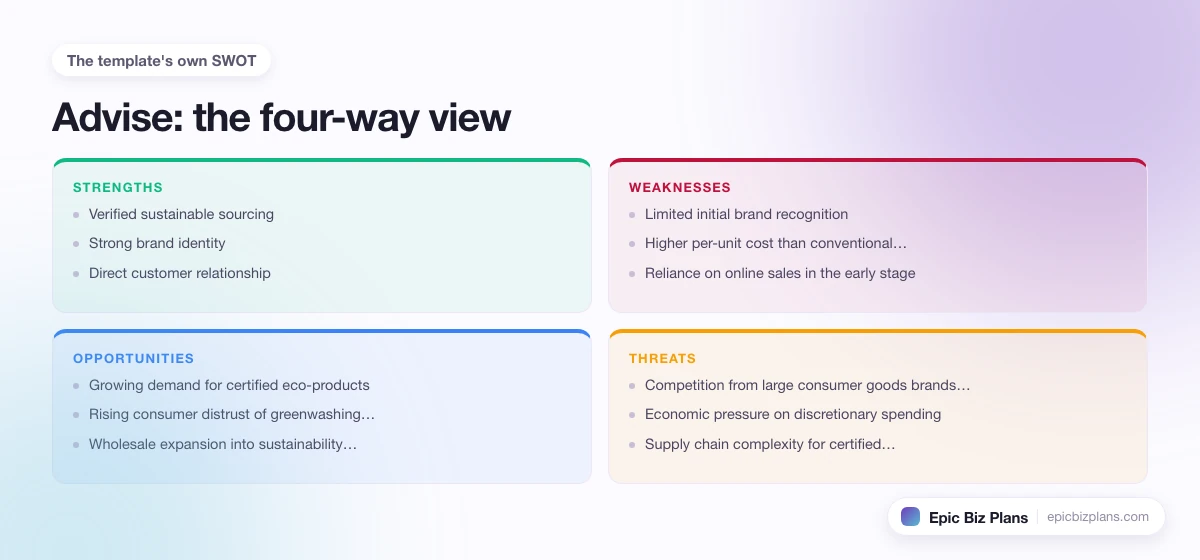
- Strengths: Verified sustainable sourcing, strong brand identity, direct customer relationship, lower overhead than physical retail.
- Weaknesses: Limited initial brand recognition, higher per-unit cost than conventional competitors, reliance on online sales in the early stage.
- Opportunities: Growing demand for certified eco-products, rising consumer distrust of greenwashing creating space for genuinely transparent brands, wholesale expansion into sustainability retail chains.
- Threats: Competition from large consumer goods brands launching sustainable sub-lines, economic pressure on discretionary spending, supply chain complexity for certified materials.
Advise Business Name Ideas
The Green Claims Rules Just Changed, and Your Copy Has to Change With Them
If you sell into the European Union, the Empowering Consumers for the Green Transition Directive (EU 2024/825) applies from 27 September 2026, with member states having transposed it by 27 March 2026. It amends the Unfair Commercial Practices Directive, and three of its prohibitions rewrite the standard eco-brand product page:
- Generic environmental claims are banned unless substantiated. Words like eco-friendly, green, and climate neutral cannot stand alone; they are permitted only where recognised excellent environmental performance can be demonstrated. That rules out most of the vocabulary this category has used for a decade.
- Carbon neutrality claims based on offsetting are prohibited outright. Claiming a product is carbon neutral because emissions were offset elsewhere is no longer permissible, regardless of the quality of the offsets.
- Future commitments must be backed by a plan. A pledge such as "net zero by 2030" needs clear, objective, publicly available and verifiable commitments, an implementation plan with measurable, time-bound targets, and regular independent third-party verification.
In the US, the FTC Green Guides govern the same territory, and the underlying principle is identical: a claim must be substantiated and qualified so that a reasonable consumer is not misled. The practical result for a brand selling in both markets is one compliant copy standard rather than two, and it is stricter than most eco brands are currently writing to.
What to Write Instead
Replace the adjective with the measurement. "Eco-friendly packaging" becomes "carton is 90% post-consumer recycled fibre, FSC certified, recyclable in kerbside collection". "Sustainably sourced" becomes the name of the standard and the certificate number. "Plastic free" becomes a statement of exactly which components are free of plastic, including the seal, the liner, and the shipping material, because a single polyethylene window is enough to make the claim false.
This is a commercial advantage rather than a burden. Buyers in this category read labels and are already sceptical of vague claims, so specific, verifiable copy converts better than the language the rules now prohibit. It also survives a retail buyer's due diligence, which matters when the wholesale channel opens in year two.
Website
Shopify is the preferred platform, since its e-commerce infrastructure handles inventory, payment processing, subscription apps, and analytics without custom development. Product pages need to do more than list features, because buyers in the eco-products space research their purchases carefully and are sceptical of unsupported claims. Each product page should include specific sourcing details, certifications with issuing body and scope, and packaging composition. That level of transparency converts better than generic sustainability messaging, builds long-term trust with repeat buyers, and is now the compliant way to write the page.
Marketing Details
Our marketing approach combines organic search, email, and social. Keyword research will guide us toward high-intent search terms where people are actively comparing eco-friendly options in our categories, and the volumes in this space are substantial: eco-friendly laundry detergent and its close variants run around 60,500 US searches a month, non-toxic cleaning products around 27,100, and eco-friendly cleaning products around 18,100, with advertiser bids mostly between $0.75 and $7. That combination of high volume and modest bids is unusual and makes organic content an efficient channel here.
Email automation manages welcome sequences for new subscribers, abandoned cart recovery, and post-purchase flows that reinforce the brand story and encourage second purchases. Short-form video focused on production transparency and honest product comparisons performs consistently well with sustainability-conscious buyers aged 18 to 35. Every claim in an influencer brief is checked against the same substantiation standard as the label, because a regulator does not distinguish between a claim you made and a claim you paid someone else to make.
Businesses advising other companies on sustainability strategy alongside their product offering should review the management consulting business plan template for client acquisition and service pricing frameworks. For brands building a green advisory practice specifically, the strategy consulting business plan template covers retainer structure and proposal development relevant to sustainability consulting engagements.
Industry Trends
Three trends are reshaping the eco-product and sustainability advisory market: demand for third-party verified certifications over self-reported claims, growth in refill and zero-waste product formats, and rising corporate demand for sustainability advisory services as disclosure requirements expand. The tightening of green claims rules is itself the largest of these, because it converts a marketing function into a compliance function and creates a paid advisory need where there was previously only an in-house marketing decision. Businesses that combine a credible product offering with advisory capability are well-positioned to serve both consumer and business markets from a single brand.
-
 SemrushSemrush is a platform with literally any online tool you will need to promote your business. Spy on your competitors, get search traffic, keyword research, social info, ad copies and much more. Used by most of the top online companies in the world. Besides all its tools, Semrush also has many available integrations possible with many other tools that will make your work even better.
 -
 Surfer SEOSurfer SEO is an incredibly smart AI tool that will give you exact explanations what to do in order to make your website rank better. They use hundreds of parameters, check your competitors and decide on the best course of action. Whether it be inner links, bold text, paragraphs, headers, images and much more. Surfer is a must-have in 2026.
A Claims Audit as a Productised Advisory Offer
The regulatory change above creates a specific, sellable service for the advisory side of this business, and it has a deadline attached, which is what makes it sell. Package it rather than quoting it bespoke.
A claims audit runs in four stages: inventory every environmental claim the client makes across packaging, website, marketing, and sales decks; classify each as substantiated, qualifiable, or prohibited under the applicable regime; rewrite the qualifiable ones with the specific evidence attached; and hand over a substantiation file that maps each surviving claim to its source document. Price it as a fixed-fee engagement scaled by SKU count, and offer an annual re-audit as the retainer that follows. Clients who sell into both the EU and the US need one standard covering both, which is the argument for doing it once, properly, rather than market by market.
Competitor Information
Direct competitors are established eco-product brands and boutique sustainability consultancies. Indirect competition comes from large consumer goods companies launching sustainable product lines and from general management consultants adding sustainability to their service menu. Differentiation comes from depth of commitment: specific certifications, transparent supply chains, and measurable environmental impact metrics that marketing-led competitors cannot quickly replicate. For adjacent eco-product categories, the green and eco business plan template covers supplier vetting and certification strategy in useful detail.
Financial Information
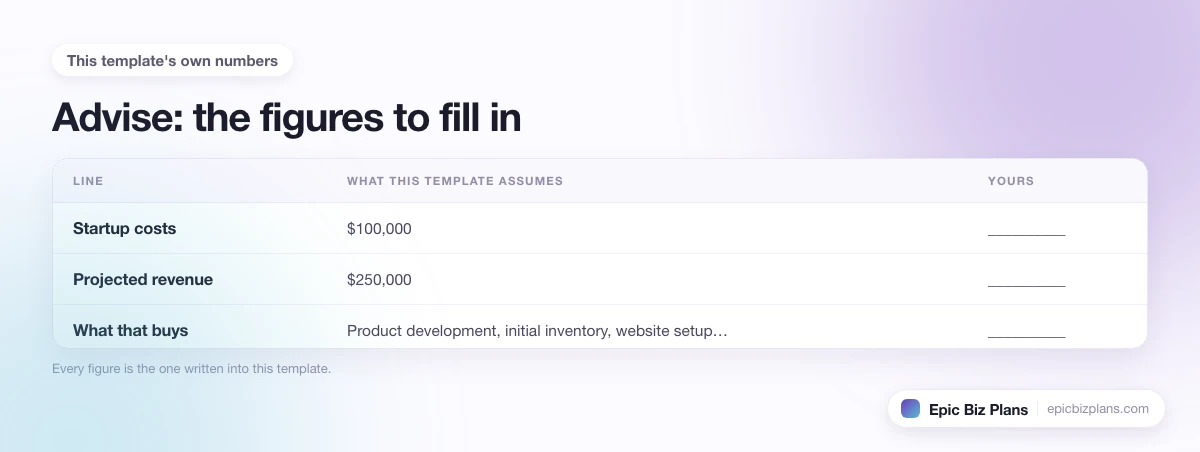
Estimated startup costs are approximately $100,000, covering product development, initial inventory, website setup, branding, and first-quarter marketing. Year-one revenue is projected at $250,000, scaling to $500,000 in year two as organic search traffic compounds and repeat purchase rates improve.
Startup Cost Breakdown
- Initial product inventory: $35,000 to $50,000
- Website development and e-commerce setup: $5,000 to $10,000
- Brand identity and packaging design: $8,000 to $15,000
- Marketing and launch campaign: $15,000 to $25,000
- Certification, testing, and claims substantiation: $5,000 to $15,000, depending on how many standards you pursue and how many SKUs carry the claim
- Business registration, insurance, legal: $3,000 to $5,000
- Working capital reserve (3 months): $10,000 to $20,000
Certification is the line most first-time eco brands leave out, and it is the one that decides whether the premium price is defensible. Treat it as a cost of entry rather than a marketing upgrade, and sequence it: one standard that genuinely fits the product range, applied properly, beats three logos applied loosely.
Legal and Compliance
Business registration, product liability insurance, and compliance with consumer goods labeling regulations are baseline requirements. Environmental marketing claims must be substantiated under the FTC Green Guides in the US and, for EU sales, under the rules described above from 27 September 2026. Vague claims without evidence attract scrutiny in both markets. Certifications such as B Corp, Fair Trade, or material-specific standards should be pursued early, since they function as both legal protection and marketing assets. Keep a written substantiation file for every claim you make, organised by SKU, and review it whenever a formulation, supplier, or packaging component changes.
Operational Plan
Core operations cover supplier sourcing and qualification, inventory management, order fulfillment, and customer service. We will maintain at least two qualified suppliers for each core product category to avoid single-source dependency. Supplier qualification includes collecting the certificates behind any claim we intend to repeat, since a claim inherited from a supplier is still our claim at the point of sale. Inventory will be managed against a 90-day rolling forecast, with safety stock on the highest-velocity SKUs. Logistics will be planned for consolidated shipping and minimal packaging waste, both because it reduces cost and because it aligns with the brand values our customers expect to see carried through to delivery.
Contingency Planning
Key risks: certified material supply disruption, slower-than-projected online sales growth, and input cost increases for sustainably sourced materials. Mitigation: a diversified supplier base with backup options qualified before they are needed, a 90-day cash reserve, and secondary channel options such as farmers' markets, local eco-retailers, and business advisory services that can be activated without significant additional investment if direct-to-consumer growth lags. Add one more: if a supplier loses a certification we rely on, we need a pre-agreed process to pull the affected claim from the site and packaging within days rather than months.
Embrace Your Vision
Building a sustainable consumer products or advisory business means committing to a set of values that inform every operational decision. The market rewards that consistency, because customers who trust a brand's environmental commitments become loyal, repeat buyers and active advocates. Start with a specific, well-researched plan, execute it consistently, and revise it as you accumulate real sales data.
Adapt and Evolve
Your Advise business plan should be reviewed at the end of each quarter in year one. Revenue per channel, customer acquisition cost, repeat purchase rate, and gross margin are the four numbers that tell you whether the model is working. If any of them diverge significantly from the plan, address the cause early rather than waiting for the gap to compound. Brands whose range leans toward apparel rather than household goods can compare sourcing and certification requirements in the sustainable fashion business plan template.
-
ShopifyPut your brand on Shopify. Launch your online store with tools designed for growth and success. Ready to turn your idea into profit? Start building your e-commerce business today.
-
SquarespaceShowcase your brand with Squarespace’s sleek designs. Build a professional online presence with ease. Start with a template that already looks finished.
-
WixBring your ideas to life with Wix. Customize every aspect of your site with unmatched flexibility. Start creating your unique online space and let your creativity shine.
-
ElementorCraft captivating websites effortlessly with Elementor. Enjoy complete creative control without coding. Make your site stand out to your audience. Start turning your vision into reality now.
Strategic Applications
Use this plan to present to potential wholesale buyers, apply for sustainability grants, approach eco-retail partners, or secure early-stage funding. Each section of a specific, numbers-backed plan answers the questions those audiences will ask before they commit.
Your Path Forward
Your Advise business plan is 100% free, with unlimited edits, unlimited downloads, and unlimited chances to get it right.
