
Adult Education Business Plan Template
-
 ShopifyPut your brand on Shopify. Launch your online store with tools designed for growth and success. Ready to turn your idea into profit? Start building your e-commerce business today.
 -
 SquarespaceShowcase your brand with Squarespace’s sleek designs. Build a professional online presence with ease. Start with a template that already looks finished.
 -
 WixBring your ideas to life with Wix. Customize every aspect of your site with unmatched flexibility. Start creating your unique online space and let your creativity shine.
 -
 ElementorCraft captivating websites effortlessly with Elementor. Enjoy complete creative control without coding. Make your site stand out to your audience. Start turning your vision into reality now.
- Executive Summary
- Business Info
- Products and Services
- Target Market
- Business Model Overview
- SWOT Analysis
- Adult Education Business Name Ideas
- Website
- Marketing Details
- Industry Trends
- Competitor Information
- Financial Information
- Legal and Compliance
- Operational Plan
- Contingency Planning
- Build Yourself Through Adult Education
- Exploring Your Business Options
- Adapt and Evolve
- Strategize and Succeed
- Take the Leap
Writing your Adult Education business plan is the first real step toward building a teaching business that pays. Adult learners want training that fits around work and family, so your plan has to show how you will deliver it and how you will get paid for it. This document forces you to define your courses, your students, and your pricing before you spend a dollar. Treat it as a working blueprint, not a pitch.
Your Adult Education business plan should map who you teach, what you charge, and how you reach people. The market for skills training keeps growing as workers retrain and change careers, which is good news for new providers. Providers teaching lab or science subjects can pair this with our chemistry business plan template for course and kit ideas. The sections below walk through each decision, from curriculum to compliance, so nothing important gets left out. Educators selling self-paced lessons online can also see our online course business plan template.
Executive Summary
We are committed to providing high-quality adult education programs that support individuals at various stages of their lives. Organizations running these programs as a registered nonprofit can also follow our NPO business plan template. Our mission is to build the skills, knowledge, and competencies of our learners, supporting personal and professional growth. Our vision is a supportive learning environment that is accessible and tailored to the needs of adult learners. We deliver value through a personalized curriculum, experienced instructors, and a flexible learning model. For a related approach, see the Programme business plan template.
Financially, we aim for steady growth, with a goal of reaching break-even within the first two years of operation while building a loyal client base.
Business Info
Products and Services
We will offer a range of adult education courses, including vocational training, personal development, language courses such as those offered by a learning English business, and online classes tailored to professional certifications. Our programs will fit various learning styles and schedules, so we can meet the needs of a diverse audience. Short evening seminars also work well for working adults, and a seminar business plan shows how to price and fill one-off sessions.
Target Market
Our target market consists of adults aged 25 to 54, including working professionals seeking new skills, people changing careers, and lifelong learners pursuing personal interests. We will focus on urban areas to keep our programs accessible to as many learners as possible.
Business Model Overview
We will run a hybrid model that combines in-person classes with online offerings, letting us reach a wider audience. Course portfolios that include practical-skill programs benefit from referencing a structured driving lessons business plan for that specific service line. Revenue will come mainly from course fees, with extra income from workshops and corporate training partnerships.
SWOT Analysis
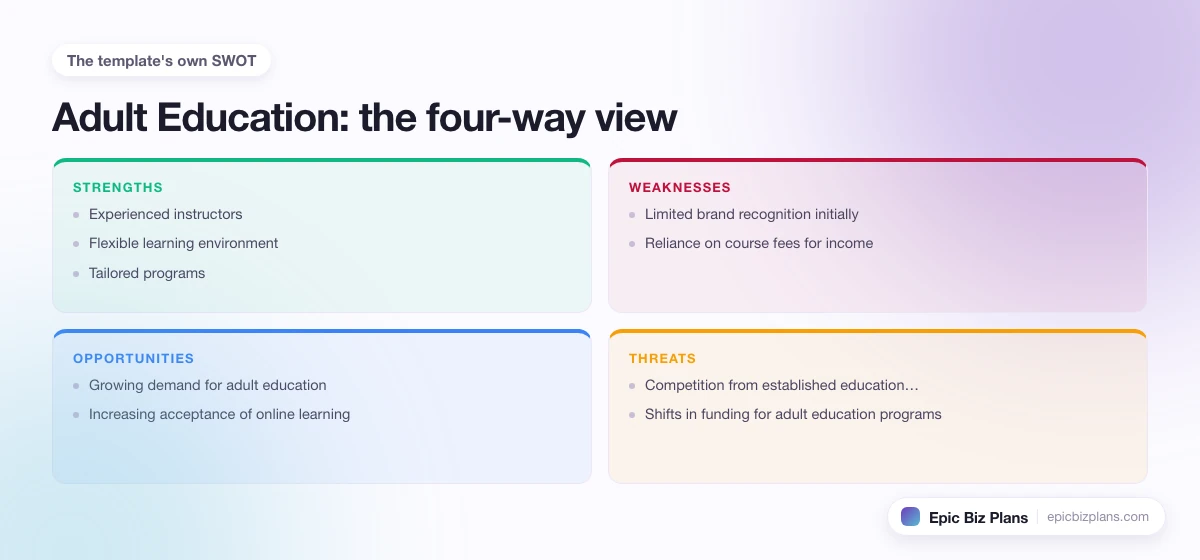
- Strengths: Experienced instructors, flexible learning environment, tailored programs.
- Weaknesses: Limited brand recognition initially, reliance on course fees for income.
- Opportunities: Growing demand for adult education, increasing acceptance of online learning.
- Threats: Competition from established education providers, shifts in funding for adult education programs.
Adult Education Business Name Ideas
Website
We will build our website using Wix, which gives non-developers an easy platform and a friendly interface to manage. We will also consider Shopify or Squarespace for e-commerce if we decide to sell educational materials online. Our website will show our courses and instructors and provide resources that help learners through their studies.
Marketing Details
Our marketing strategy combines digital channels so we reach our target audience effectively. We will use Semrush for search engine optimization to improve our visibility and HubSpot for targeted email campaigns to engage potential learners. We will also use TikTok ads to reach younger people interested in building new skills.
Industry Trends
The adult education sector is changing fast, driven largely by technology. Digital resource marketplaces, like those built around a Teachers Pay Teachers model, serve a parallel market of professional educators who need curriculum materials to support adult learners in workplace and community settings. Online learning keeps gaining ground, making flexible, accessible education easier to deliver. Adult education businesses looking to add a technology layer to their delivery model should reference the edtech business plan for how to structure a digital platform alongside traditional instruction.
There is also a growing emphasis on skill-specific training that lines up with job market demand, giving learners practical knowledge that improves their employability. Entrepreneurs developing educational products for students across all age groups, not just adult learners, should also explore our scholar business plan, which covers online course platforms, tutoring models, and regulatory requirements for educational product businesses. Organizations serving justice-impacted communities can also review the prison business plan template when planning programs.
Competitor Information
We will assess both direct and indirect competitors in the adult education space, looking at their offerings, pricing, and market positioning. Operators serving a broader all-ages audience can also model that mix with a learning center business plan. Operators building multi-subject digital lesson libraries alongside adult programs should also review a lessons business plan template for complementary online delivery models. Our way to stand out will center on personalized instruction, high-quality course materials, and responsive support that meets learners' individual needs.
Tutors and instructors structuring one-on-one programs alongside adult courses can also reference our teaching business plan template. Subject-specific tuition services, including those following a tuition business plan, often act as feeder programs for adult learners who want to build foundational knowledge before enrolling in broader education programs. Providers offering music instruction to adult learners can also use our music education business plan template. Coaches who help adults set goals and stay accountable can pair their courses with the model in a life coach business plan.
Financial Information
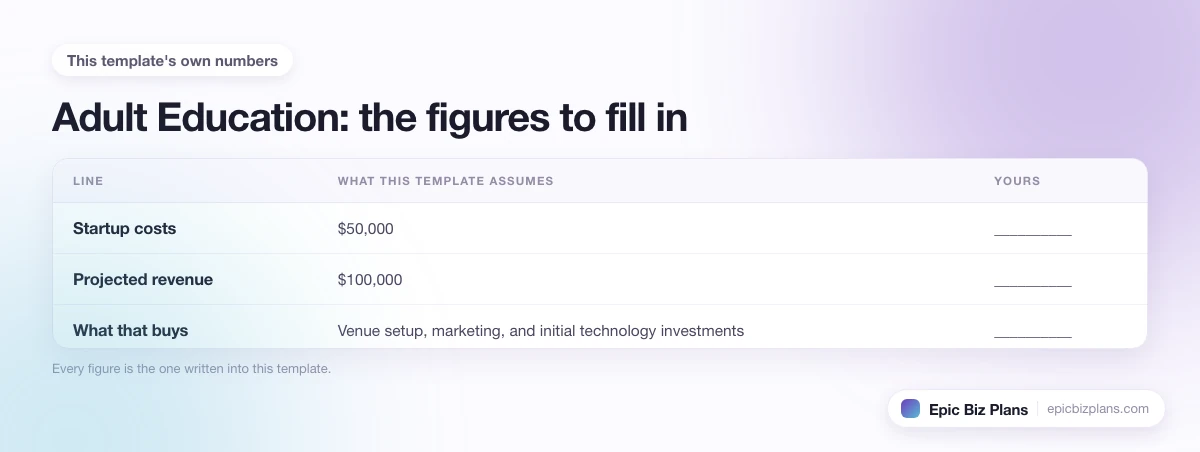
To get started, we expect startup costs covering venue setup, marketing, and initial technology investments, totaling around $50,000. We project revenue to grow steadily, aiming for $100,000 in our first year, with increases in the years after. We will watch ongoing expenses such as instructor salaries, utility bills, and marketing to keep a healthy cash flow. We will produce regular P&L statements to track performance and make informed operational decisions.
Legal and Compliance
We will meet local education regulations, including the licenses and permits required to operate an educational institution. We will also protect the intellectual property in our course materials and brand identity, consulting legal professionals to handle this correctly.
-
 SemrushSemrush is a platform with literally any online tool you will need to promote your business. Spy on your competitors, get search traffic, keyword research, social info, ad copies and much more. Used by most of the top online companies in the world. Besides all its tools, Semrush also has many available integrations possible with many other tools that will make your work even better.
 -
 Surfer SEOSurfer SEO is an incredibly smart AI tool that will give you exact explanations what to do in order to make your website rank better. They use hundreds of parameters, check your competitors and decide on the best course of action. Whether it be inner links, bold text, paragraphs, headers, images and much more. Surfer is a must-have in 2026.
Operational Plan
Key operations include course development, instructor recruitment, and student registration. We will set up a reliable supply chain for educational materials, using local suppliers where possible to support the community. Logistics will cover class scheduling, online course management, and a smooth experience for every participant. Programs that grow into a permanent campus can also follow our institute business plan template.
Contingency Planning
Potential risks include swings in enrollment, competition, and changes in regulatory requirements. We will reduce these risks by diversifying our course offerings, watching market trends, and keeping open communication with learners so we can adapt quickly to their needs. We will also build an emergency fund to keep operations stable during difficult stretches.
Build Yourself Through Adult Education
There is a reason so many people start the process of creating an Adult Education business plan. It is not only about profit; it is about shaping skills, building community, and helping others learn. The chance to teach and inspire can change your life and the lives of the learners you serve.
Exploring Your Business Options
In adult education you have plenty of options. You can run small, community-based workshops, larger online courses, or e-commerce platforms that sell educational materials. You might launch a local skills-training center, start a blog that shares useful insights, or build an online tutoring service for specific adult learners. People who enjoy one-on-one guidance can also look at a career counseling business plan as a related path.
Adapt and Evolve
Your Adult Education business plan is not a static document. As you grow, so will your audience, pricing models, product offerings, and sales channels. Keep it flexible so you can adjust as your vision and the market shift. That flexibility keeps you aligned with your goals while serving your learners well.
Strategize and Succeed
Make the most of your business plan. Use it to present to potential partners, plan your launch, secure funding, or clarify your overall vision. Each section sets up the next, giving you clarity and confidence as you take the next steps.
Take the Leap
Creating your Adult Education business plan is just the start. Your Adult Education business plan is 100% free, with unlimited edits, unlimited downloads, and unlimited chances to get it right. You have laid the groundwork for something that matters, so step forward and build the future you envision.
