
Addiction Medicine Business Plan Template
-
 ShopifyPut your brand on Shopify. Launch your online store with tools designed for growth and success. Ready to turn your idea into profit? Start building your e-commerce business today.
 -
 SquarespaceShowcase your brand with Squarespace’s sleek designs. Build a professional online presence with ease. Start with a template that already looks finished.
 -
 WixBring your ideas to life with Wix. Customize every aspect of your site with unmatched flexibility. Start creating your unique online space and let your creativity shine.
 -
 ElementorCraft captivating websites effortlessly with Elementor. Enjoy complete creative control without coding. Make your site stand out to your audience. Start turning your vision into reality now.
- Executive Summary
- Business Info
- SWOT Analysis
- Addiction Medicine Business Name Ideas
- Website
- Marketing Details
- Industry Trends
- Startup Cost Breakdown
- Competitor Information
- Financial Information
- Legal and Compliance
- Operational Plan
- Contingency Planning
- Creating a Practice Built on Purpose
- Adapt and Evolve
- Strategic Uses for Your Plan
- Boldly Go Forward
An addiction medicine business plan is a specialized document that requires more precision than most - the regulatory environment is complex, startup costs are substantial, and patient outcomes depend heavily on staffing quality and evidence-based treatment protocols. This template walks through the key planning components for launching an addiction treatment center, from facility requirements and licensing to financial projections and insurance reimbursement modeling. Use it as a starting framework and work with healthcare legal counsel to validate compliance requirements before launch.
Addiction treatment is a field where there is genuine unmet demand - the gap between people who need help and those who can access it remains wide in most markets. A well-run addiction medicine practice can be financially sustainable while delivering real community benefit. But the planning requirements are non-trivial: HIPAA compliance, state healthcare licensing, DEA certification for medication-assisted treatment, and insurance credentialing all require lead time and upfront investment before the first patient is seen.
Executive Summary
We are establishing a comprehensive addiction medicine clinic offering evidence-based treatment for substance use disorders and behavioral addictions. Services span assessment, medically supervised detoxification, outpatient therapy, medication-assisted treatment (MAT), and structured aftercare programs like those outlined in our recovery services business plan. Our clinical model integrates addiction medicine with mental health support, reflecting the high rate of co-occurring disorders among our patient population. We project profitability within 18 months of operation, with first-year revenue of $500,000 growing to $600,000 in year two as insurance credentialing is completed and patient volume scales.For a related angle on rebuilding lives, see our recover business plan template.
Business Info
We will serve adults aged 18–65 seeking treatment for substance use disorders (alcohol, opioids, stimulants, and benzodiazepines), with a separate intake pathway for family members seeking guidance and support. Services are delivered through a combination of in-person sessions at our outpatient clinic and telehealth options for patients who have stabilized and can safely engage remotely. Revenue will come from three primary sources: direct private-pay fees, insurance reimbursements from major carriers, and Medicaid/Medicare billing once credentialing is completed. Telehealth expansion will be pursued in year two to extend geographic reach without proportional facility cost increases.
SWOT Analysis
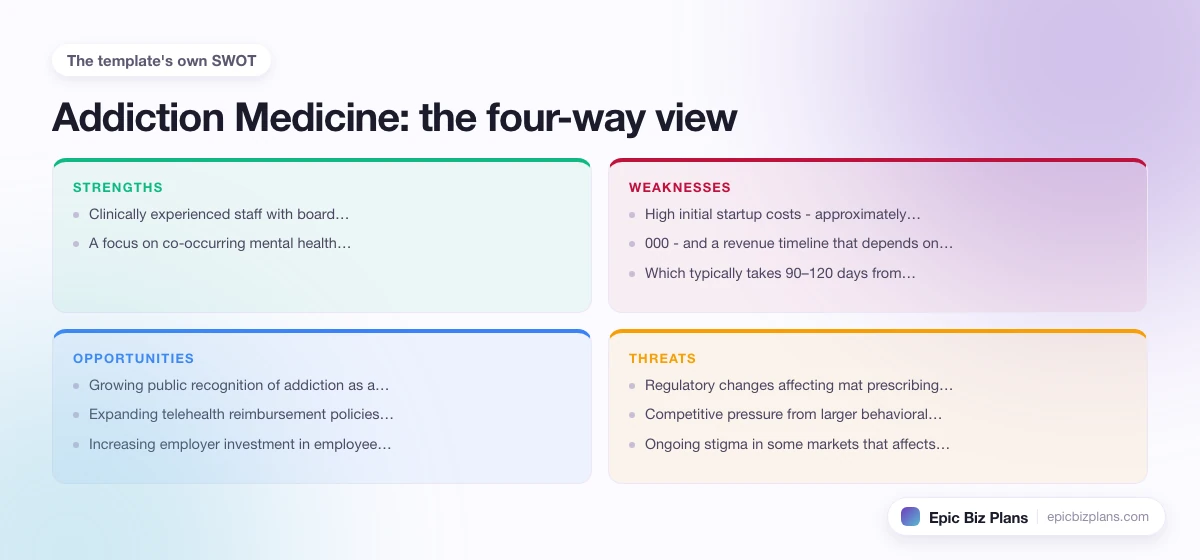
- Strengths: Clinically experienced staff with board certification in addiction medicine, a comprehensive service range that reduces the need for patient referrals to outside providers, and a focus on co-occurring mental health conditions that improves treatment retention rates.
- Weaknesses: High initial startup costs - approximately $250,000 - and a revenue timeline that depends on insurance credentialing completing on schedule, which typically takes 90–120 days from application.
- Opportunities: Growing public recognition of addiction as a medical condition, expanding telehealth reimbursement policies that improve access for rural and underserved patients, and increasing employer investment in employee assistance programs (EAPs) that cover addiction treatment.
- Threats: Regulatory changes affecting MAT prescribing (particularly buprenorphine), competitive pressure from larger behavioral health networks with established insurance relationships, and ongoing stigma in some markets that affects patient willingness to seek formal treatment.
Addiction Medicine Business Name Ideas
Website
Our website will be built on WordPress, which offers the flexibility to integrate appointment booking, patient intake forms, HIPAA-compliant contact forms, and educational content in one platform. The site's primary purpose is trust-building: prospective patients and families are making high-stakes decisions, and the website must communicate clinical credibility, team qualifications, and a clear picture of what treatment with us looks like. We will maintain a resource library covering addiction education, treatment options, and recovery support tools that drives organic traffic and serves as a first step for patients who are not yet ready to call. All forms and data handling will comply with HIPAA requirements.
Marketing Details
Healthcare marketing for addiction medicine requires a careful balance: reaching people in need without exploiting vulnerability. Semrush will guide SEO, targeting search terms used by people seeking treatment options and families researching addiction resources. HubSpot will manage email communication with former patients and community referral partners, including primary care physicians, employee assistance programs, and social service agencies. TikTok and Instagram will be used for public health awareness content rather than direct sales messaging - this builds brand trust and generates referrals from people sharing content with those they know need help. For related healthcare service models, see this telehealth business plan template and this rehabilitation center business plan template.
Industry Trends
Telehealth has permanently expanded the delivery options for outpatient addiction treatment, with several states now permitting buprenorphine induction via telehealth for established patients - a significant access improvement. The integration of mental health treatment with addiction medicine has become the clinical standard rather than an optional add-on, driven by research showing that co-occurring disorders, when left untreated, dramatically increase relapse rates. Value-based care models are gaining ground in behavioral health, with payers increasingly tying reimbursement to patient outcomes rather than visit volume. Any new addiction medicine practice should be designed to capture outcome data from the start to support these reimbursement models as they expand.
Startup Cost Breakdown
Total startup costs are projected at $250,000, broken down as follows: $80,000 for facility lease, buildout, and furnishing to meet healthcare regulatory standards; $60,000 for medical equipment, electronic health record (EHR) system setup, and telehealth infrastructure; $50,000 for staffing costs during the pre-revenue credentialing period; $30,000 for licensing, legal fees, and compliance consulting; and $30,000 for marketing, website development, and initial community outreach. A $20,000 operating reserve is maintained separately from these projected costs. Revenue will not begin at full rate until insurance credentialing is complete, typically 90–120 days after application submission.
Competitor Information
Direct competitors include local rehabilitation centers, outpatient behavioral health clinics, private addiction medicine practices, and recovery residences run from a sober living business plan template. Indirect competition comes from primary care physicians offering brief addiction interventions and online MAT providers who have expanded access through telehealth. Our differentiation is in the comprehensiveness of our model: rather than offering a single service line, we integrate medical treatment, therapy, MAT, and aftercare in a coordinated program that reduces patient attrition between service components. Businesses planning adjacent healthcare services may find this mental health counseling business plan template or this mental health therapy business plan template useful for comparison.
Financial Information
First-year revenue is projected at $500,000, assuming 40 active patients per month at an average monthly revenue per patient of approximately $1,000 (a mix of private-pay, insurance, and Medicaid billing). Year-two revenue is targeted at $600,000 as insurance credentialing is complete and patient volume grows. Gross margin on clinical services runs 45–55% after staffing costs. Ongoing annual expenses - facility, staff, supplies, software, and marketing - are estimated at $280,000, leaving net profit of approximately $70,000 in year one, growing in year two as fixed costs are spread across higher revenue. A formal P&L will be reviewed monthly with the clinical and administrative leadership team. Practices working with adults experiencing mood disorders can reference our depression business plan.
Legal and Compliance
The business will be registered as a professional corporation or LLC, depending on state requirements for healthcare entity structure. Compliance requirements include state healthcare facility licensing, DEA registration for controlled substance prescribing, HIPAA compliance for all patient data systems, and billing compliance with insurance anti-fraud requirements. We will retain a healthcare attorney and a compliance consultant before opening to ensure all requirements are addressed proactively rather than reactively. Staff credentialing will be verified and documented prior to providing any patient care.
Operational Plan
Patient flow will begin with a structured intake assessment, followed by individualized treatment planning that determines service level - detoxification, intensive outpatient, standard outpatient, or telehealth maintenance. The EHR system will manage clinical documentation, scheduling, and billing in an integrated platform to reduce administrative burden on clinical staff. Monthly case conferences will review patient progress across all active cases, ensuring the treatment team maintains coordinated care. Aftercare - including relapse prevention planning and alumni check-ins - is a defined component of every treatment episode, not an optional add-on. For a complementary framework on running a healthcare service business, see this rehab business plan template.
Contingency Planning
Insurance reimbursement delays or denials are the primary financial risk in the first year - we will maintain the operating reserve specifically to absorb a 90-day delay in insurance payments without disrupting operations. Regulatory risk (particularly around MAT prescribing rules) will be managed through active monitoring of federal and state policy changes and a standing relationship with a healthcare compliance attorney. Staff turnover in clinical roles is a recurring operational risk; we will address this through competitive compensation, clear advancement pathways, and a workplace culture that takes clinician wellbeing seriously alongside patient outcomes.
Creating a Practice Built on Purpose
Addiction medicine is one of the most clinically and personally demanding fields in healthcare, but it is also one of the most impactful. Building a financially sustainable practice requires careful attention to regulatory compliance, billing strategy, and staffing quality - all of which this template prompts you to think through before you open your doors. Replace the projected figures above with your own market research, and work with healthcare legal and financial advisors to pressure-test your assumptions before committing capital.
Adapt and Evolve
Treatment modalities, reimbursement models, and telehealth regulations all continue to evolve. Your business plan should be updated at least annually to reflect these changes and to incorporate what you've learned from actual patient outcomes and operational experience. The practices that thrive in behavioral health over the long term are those that stay clinically current and operationally flexible.
-
 SemrushSemrush is a platform with literally any online tool you will need to promote your business. Spy on your competitors, get search traffic, keyword research, social info, ad copies and much more. Used by most of the top online companies in the world. Besides all its tools, Semrush also has many available integrations possible with many other tools that will make your work even better.
 -
 Surfer SEOSurfer SEO is an incredibly smart AI tool that will give you exact explanations what to do in order to make your website rank better. They use hundreds of parameters, check your competitors and decide on the best course of action. Whether it be inner links, bold text, paragraphs, headers, images and much more. Surfer is a must-have in 2026.
Strategic Uses for Your Plan
A well-documented addiction medicine business plan supports conversations with facility lenders, grant agencies, healthcare investors, and potential clinical partners. The specificity of your financial projections, compliance framework, and clinical model will determine how credible those conversations are. Treat this document as a working tool that earns its keep through regular use, not a one-time exercise.
Boldly Go Forward
Your Addiction Medicine business plan is 100% free - with unlimited edits, unlimited downloads, and unlimited chances to get it right. The foundation you build in planning will shape the quality of care you can deliver once you're operating See our sure business plan for related planning.
