
A To Z Business Plan Template
-
 ShopifyPut your brand on Shopify. Launch your online store with tools designed for growth and success. Ready to turn your idea into profit? Start building your e-commerce business today.
 -
 SquarespaceShowcase your brand with Squarespace’s sleek designs. Build a professional online presence with ease. Start with a template that already looks finished.
 -
 WixBring your ideas to life with Wix. Customize every aspect of your site with unmatched flexibility. Start creating your unique online space and let your creativity shine.
 -
 ElementorCraft captivating websites effortlessly with Elementor. Enjoy complete creative control without coding. Make your site stand out to your audience. Start turning your vision into reality now.
- Executive Summary
- Business Info
- SWOT Analysis
- A To Z Business Name Ideas
- Website
- Marketing Details
- Industry Trends
- Competitor Information
- Financial Information
- Legal and Compliance
- Operational Plan
- Contingency Planning
- Startup Cost Breakdown
- Building Your First Customer Base
- Embrace Your Vision
- Adapt and Evolve
- Put Your Plan to Work
- Forge Ahead
An A To Z business plan gives you a complete framework for launching and running your business from the ground up. Whether you are starting a retail store, a service company, or an online brand, covering every aspect of your business in one plan keeps your strategy organized and actionable.
Your A To Z business plan should reflect your specific business goals, target market, and competitive landscape. A strong plan is not just a formality. It is the document you will refer back to when making hiring decisions, setting prices, choosing marketing channels, and planning your next phase of growth.
Executive Summary
Our mission is to provide high-quality products that cater to our customers' diverse needs. We aim to become a recognized leader in our industry with a value proposition built on excellence and customer satisfaction. Our financial goals for the next five years include achieving consistent revenue growth of 20% annually and reaching profitability within the first two years of operations.
Business Info
We will offer a comprehensive range of products that target a broad audience, including individuals and businesses. Our business model revolves around a direct-to-consumer approach, using both e-commerce and physical retail channels. For more ideas on structuring an online business, see our online income business plan template.
SWOT Analysis
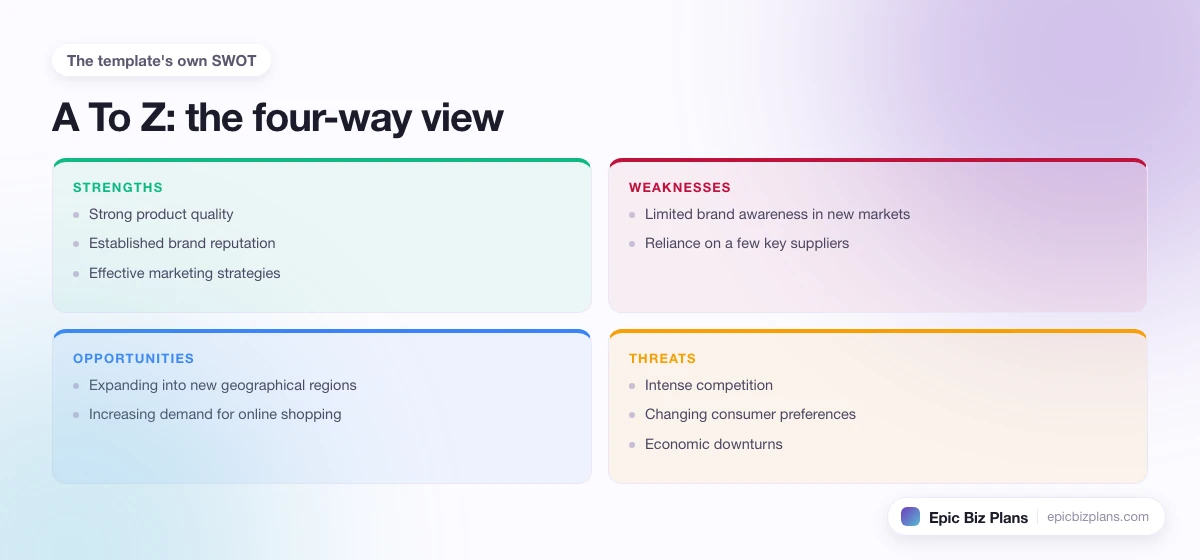
- Strengths: Strong product quality, established brand reputation, effective marketing strategies.
- Weaknesses: Limited brand awareness in new markets, reliance on a few key suppliers.
- Opportunities: Expanding into new geographical regions, increasing demand for online shopping.
- Threats: Intense competition, changing consumer preferences, economic downturns.
A To Z Business Name Ideas
Website
We will build our website on Shopify or Squarespace, as these platforms work well for e-commerce. They offer user-friendly interfaces and a range of templates suited to our product offerings. For general business needs, Wix is another option worth considering for its simpler maintenance and straightforward design tools.
Marketing Details
Our marketing strategy will include digital initiatives such as SEO optimization using Semrush and email campaigns through HubSpot. We will also target younger demographics through TikTok ads, building our brand presence on social media platforms where our audience spends time.
Content marketing will support our SEO efforts. Publishing blog posts, how-to guides, and product comparisons builds organic traffic over time and positions our brand as a trusted resource in our category.
Industry Trends
We are seeing a clear shift toward sustainable and eco-friendly products as consumers become more environmentally conscious. Technological advances are also streamlining online shopping experiences, from faster checkout to personalized product recommendations. Staying current with these trends is necessary for maintaining our competitive position.
Competitor Information
Our main competitors include established brands in our industry that share similar product offerings. We will stand out by emphasizing superior customer service and unique product features that are not available through other local or online retailers. Monitoring competitor pricing, product launches, and customer reviews will inform our ongoing strategy.
Financial Information
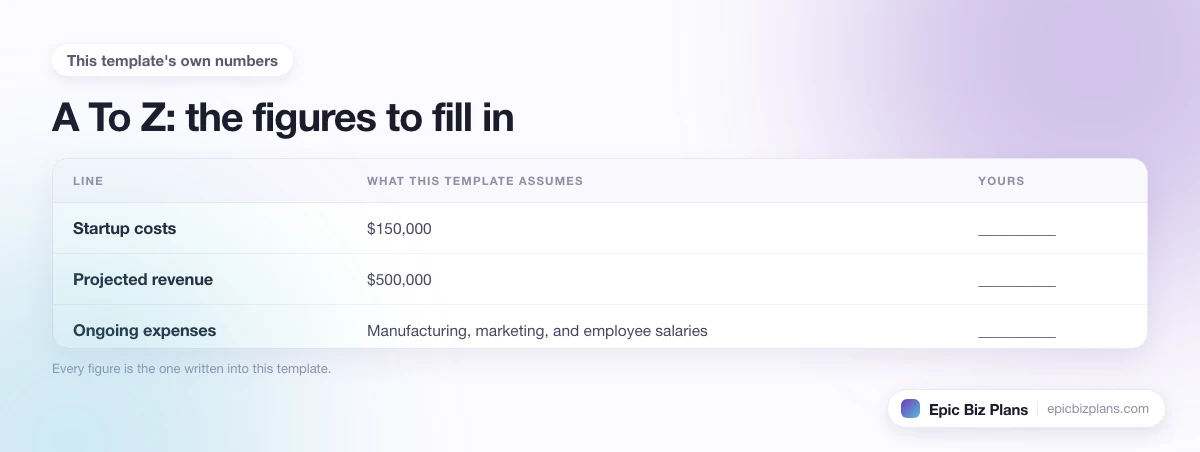
Our startup costs are estimated at $150,000, covering inventory, marketing, and operational expenses. We project revenue of $500,000 in our first year with gradual increases based on market penetration. Ongoing expenses will include manufacturing, marketing, and employee salaries.
We will focus on maintaining positive cash flow to sustain operations. Monthly financial reviews and quarterly P&L statements will help us catch issues early and make data-driven decisions about where to invest next.
Legal and Compliance
We will ensure compliance with local laws by registering our business and acquiring necessary licenses. Intellectual property protection will safeguard our product designs and brand identity. Consulting with a business attorney during the setup phase is a worthwhile investment that can prevent costly legal issues later.
Operational Plan
Our key operations will include sourcing products from reliable suppliers, managing inventory effectively, and ensuring smooth logistics for timely delivery. We aim to establish a strong supply chain system that minimizes delays and keeps customer satisfaction high. Automated inventory tracking will help us avoid stockouts during peak demand periods.
Contingency Planning
To address potential risks such as supply chain disruptions or market fluctuations, we will develop a risk management plan. This will include diversifying suppliers, maintaining a cash reserve, and having a responsive marketing strategy ready to deploy if conditions change. Quarterly risk assessments will keep our contingency plans current.
Startup Cost Breakdown
Breaking down your $150,000 startup budget into clear categories helps you allocate funds where they matter most. Inventory should represent your largest expense at roughly 40% to 50% of total startup costs, or $60,000 to $75,000. Marketing and advertising for the first six months should be budgeted at $20,000 to $30,000.
-
 SemrushSemrush is a platform with literally any online tool you will need to promote your business. Spy on your competitors, get search traffic, keyword research, social info, ad copies and much more. Used by most of the top online companies in the world. Besides all its tools, Semrush also has many available integrations possible with many other tools that will make your work even better.
 -
 Surfer SEOSurfer SEO is an incredibly smart AI tool that will give you exact explanations what to do in order to make your website rank better. They use hundreds of parameters, check your competitors and decide on the best course of action. Whether it be inner links, bold text, paragraphs, headers, images and much more. Surfer is a must-have in 2026.
Website development and e-commerce platform setup will require $3,000 to $8,000 depending on customization needs. Legal fees, business registration, and insurance should account for $5,000 to $10,000. The remaining funds serve as working capital to cover rent, utilities, payroll, and unexpected expenses during the critical first months. Businesses like those in our wholesaling business plan follow similar budgeting structures.
Building Your First Customer Base
Your initial customers are the hardest to win and the most important to keep. Focus on building relationships rather than chasing volume in the early months. Offer exceptional service, follow up after purchases, and ask for reviews. Word-of-mouth referrals from satisfied early customers often outperform paid advertising in the startup phase.
Email list building should start before your official launch. Collect signups through a landing page that previews your products and offers an early-bird discount. Brands in our pet products business plan category have used this approach effectively to build launch-day momentum.
Embrace Your Vision
Starting a business goes beyond transactions. It is about building something that reflects your values, engages your creativity, and gives you the freedom to work on your own terms. With a well-crafted A To Z business plan, you can turn your ideas into a working business. Whether you are eyeing a boutique clothing shop, a tech startup, or an eCommerce store selling artisan goods, the range of possibilities is wide. For another comprehensive approach, explore our general business plan template.
Adapt and Evolve
As you begin building, remember that your A To Z business plan is a living document. Update and refine it as your business grows. Tailor it for different audiences, explore new pricing models, branch into fresh product lines, or expand into new regions. The market changes, and your strategy should change with it.
Put Your Plan to Work
This business plan is a practical tool for presenting to partners, planning your launch, securing funding, or clarifying your business strategy. Use it to organize your thinking and guide your execution through each stage of growth.
Forge Ahead
Your A To Z business plan is 100% free with unlimited edits, unlimited downloads, and unlimited chances to get it right. Start building the future you have been working toward.
