
A Little Bit Of Everything Business Plan Template
-
 ShopifyPut your brand on Shopify. Launch your online store with tools designed for growth and success. Ready to turn your idea into profit? Start building your e-commerce business today.
 -
 SquarespaceShowcase your brand with Squarespace’s sleek designs. Build a professional online presence with ease. Start with a template that already looks finished.
 -
 WixBring your ideas to life with Wix. Customize every aspect of your site with unmatched flexibility. Start creating your unique online space and let your creativity shine.
 -
 ElementorCraft captivating websites effortlessly with Elementor. Enjoy complete creative control without coding. Make your site stand out to your audience. Start turning your vision into reality now.
- Executive Summary
- Business Info
- SWOT Analysis
- A Little Bit Of Everything Business Name Ideas
- Website
- Marketing Details
- Industry Trends
- Competitor Information
- Financial Information
- Startup Cost Breakdown
- Legal and Compliance
- Operational Plan
- Contingency Planning
- Why Start an A Little Bit Of Everything Business?
- Types of Businesses in the Niche
- Grow and Evolve Your Plan
- Practical Uses for Your Plan
The "a little bit of everything" retail model - a curated general merchandise store or multi-category e-commerce brand - has real market potential when it is built around a clear customer identity rather than a random product assortment. The key is understanding what connects your product categories in the mind of your specific buyer. A lifestyle brand for young professionals, a discovery-focused gift store, a home and tech marketplace - each of these is a "little bit of everything" concept, but each has a coherent angle that makes curation meaningful rather than arbitrary.
This business plan gives you the framework to build that kind of multi-category retail business with clarity and structure. It addresses product sourcing, inventory management, marketing channels, and financial planning for a business model where the challenge is not lack of options, but making the right choices about which options to focus on first.
Executive Summary
Our mission is to offer a curated selection of products across home decor, lifestyle items, and everyday essentials that serve a specific customer well rather than everyone broadly. We will build a brand around discovery - the pleasure of finding something useful, interesting, or beautifully made that you wouldn't have found on your own. Our financial goal is 20% revenue growth in the first year, building toward $200,000 in Year 1 revenue and a loyal customer base that returns for new additions to the range.
Business Info
Our product range will include home decor items, lifestyle accessories, tech gadgets, and curated gift sets - categories that share a common thread of quality and discovery-worthiness. Our target customer is a young professional or family buyer aged 25–45 who values well-designed products, shops online, and appreciates a merchant that does the curation work for them. We will sell primarily through our own e-commerce store, with a secondary channel through local markets and pop-up events to build brand awareness and test new product categories.
SWOT Analysis
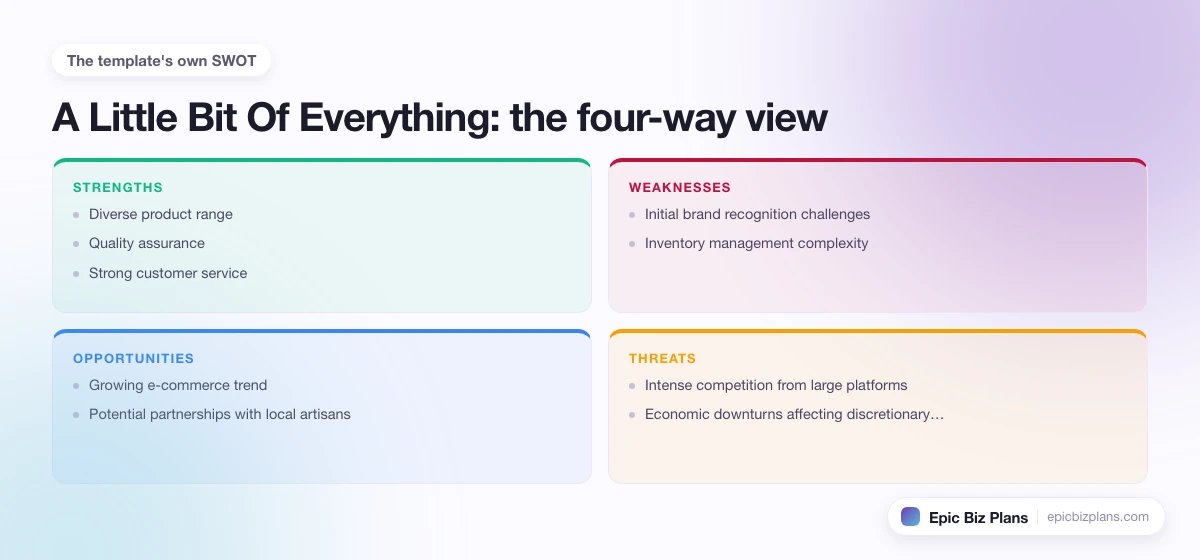
- Strengths: Diverse product range, quality assurance, strong customer service.
- Weaknesses: Initial brand recognition challenges, inventory management complexity.
- Opportunities: Growing e-commerce trend, potential partnerships with local artisans.
- Threats: Intense competition from large platforms, economic downturns affecting discretionary spending.
A Little Bit Of Everything Business Name Ideas
Website
We will build our store on Shopify, which is well-suited to multi-category product catalogs with its flexible collection management and variant handling. We will organize our store around clear lifestyle-based categories rather than product type categories - "For the Home," "For the Desk," "For the Kitchen" - to guide customers toward products relevant to how they live. Email capture with a first-purchase incentive will be a priority from day one, as email is our highest-margin retention channel for a general merchandise model.
Marketing Details
Our marketing strategy prioritizes discovery - the core experience our brand is built around. We will use Semrush to identify specific product-level search queries and build individual product pages optimized for those terms, rather than relying on broad category pages to rank. HubSpot will manage our email marketing, including a welcome series, new product drop announcements, and curated "what's new this month" newsletters.
Pinterest and Instagram are strong platforms for discovery-oriented retail, and we will invest in visual content that shows products in real home and lifestyle settings. TikTok will be used for product reveal and unboxing content targeted at younger demographics. For entrepreneurs interested in a lower-inventory entry into this type of business, the general dropshipping business plan covers the dropship model in detail.
Industry Trends
Consumer preference is shifting toward smaller, curated brands over large platform shopping experiences. The experience of discovering something unexpected from a brand with a clear point of view is increasingly what drives repeat purchases. Sustainable and locally sourced products are also a growing segment within general merchandise - consumers want to know where their products come from. Inventory management technology has improved significantly, making multi-category retail more operationally viable for small operators than it was five years ago.
Competitor Information
Our primary competitors are large e-commerce platforms like Amazon and Etsy, which compete on selection and price, and niche lifestyle brands that compete on identity. Our advantage is the combination of curation and discovery - we are not trying to have everything, just the things our specific customer would love to find. That targeted approach is something neither massive platforms nor very focused niche brands do well.
Financial Information
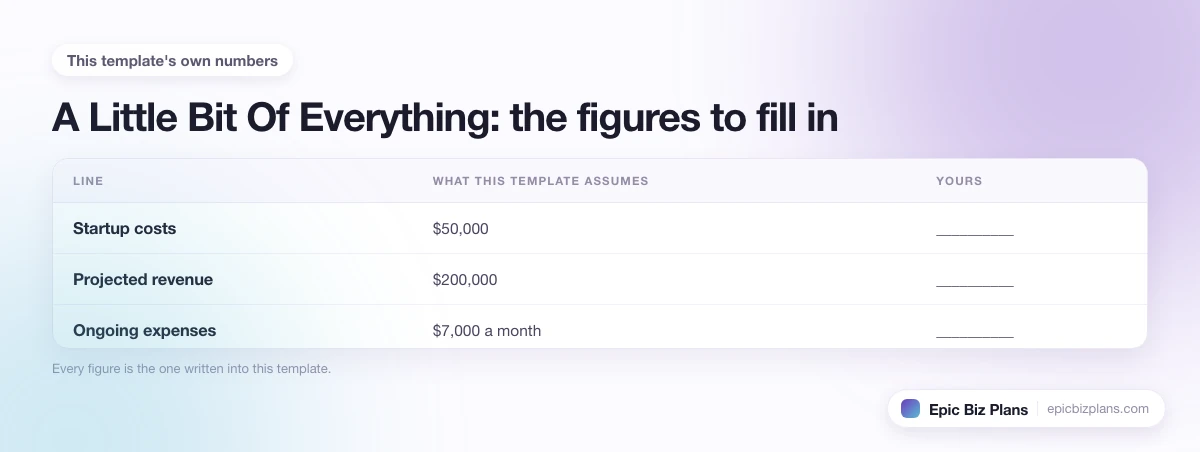
Startup costs are estimated at $50,000, covering initial inventory across our key product categories, Shopify store development, photography, and the first three months of marketing spend. We project Year 1 revenue of $200,000, with ongoing monthly expenses of approximately $7,000 covering operations, marketing, and inventory replenishment. Positive cash flow is targeted by the end of Q2, managed through careful inventory turn rate tracking and a cap on slow-moving SKU investment.
Startup Cost Breakdown
- Initial multi-category inventory: $20,000–$30,000
- Shopify store development and design: $2,500–$5,000
- Product photography: $2,000–$4,000
- Brand identity: $1,500–$3,000
- Marketing (first 3 months): $8,000–$12,000
- Warehousing setup: $2,000–$4,000
- Legal and business registration: $500–$1,500
- Contingency reserve: $5,000–$8,000
Legal and Compliance
We will register the business and conduct trademark searches before finalizing our brand name. E-commerce compliance - including applicable sales tax collection, consumer protection disclosures, and privacy policy requirements - will be addressed with legal counsel before launch. For any products making specific claims (natural, organic, safety ratings), we will verify supplier documentation before listing.
Operational Plan
Core operations will focus on product sourcing and supplier relationship management, inventory tracking, order fulfillment, and customer service. We will maintain relationships with multiple suppliers across each product category to reduce single-source risk. An inventory management system integrated with our Shopify store will track sell-through rates and flag slow-moving SKUs for promotion or markdown before they become dead stock.
Founders interested in building adjacent lifestyle product categories should review the home and lifestyle business plan and the subscription box business plan for complementary product and business model strategies.
Contingency Planning
Key risks include supply chain disruptions across multiple product categories, slower-than-expected customer acquisition, and inventory that doesn't turn at projected rates. We will address these by maintaining a conservative initial inventory investment, building our email list aggressively in the first six months to reduce paid acquisition dependency, and holding a cash reserve covering at least two months of operating expenses.
Why Start an A Little Bit Of Everything Business?
Multi-category retail done well is genuinely appealing to consumers who are tired of scrolling through massive, poorly curated platforms. When your brand makes discovery easy and enjoyable, customers come back not just to repurchase, but to see what is new. That repeat-visit behavior is the foundation of a sustainable retail business.
-
 SemrushSemrush is a platform with literally any online tool you will need to promote your business. Spy on your competitors, get search traffic, keyword research, social info, ad copies and much more. Used by most of the top online companies in the world. Besides all its tools, Semrush also has many available integrations possible with many other tools that will make your work even better.
 -
 Surfer SEOSurfer SEO is an incredibly smart AI tool that will give you exact explanations what to do in order to make your website rank better. They use hundreds of parameters, check your competitors and decide on the best course of action. Whether it be inner links, bold text, paragraphs, headers, images and much more. Surfer is a must-have in 2026.
Types of Businesses in the Niche
This category includes online gift stores, lifestyle brand shops, curated subscription boxes, and local eclectic boutiques, overlapping with the broad approach of an everything business plan. Each model has different inventory and capital requirements, and the right choice depends on your sourcing relationships, marketing strengths, and how involved you want to be in the physical logistics of the business.
Grow and Evolve Your Plan
Your first year will reveal which product categories drive the most repeat purchases, which marketing channels deliver the best customer acquisition cost, and which price points your audience is most comfortable with. Use that data to update your plan and make deliberate decisions about where to expand and where to trim back.
Practical Uses for Your Plan
Use this plan to approach potential wholesale suppliers, secure a small business loan or investor funding, and communicate your business model to partners and team members. A written plan also helps you stay focused on your strategy when the daily demands of running a retail business make it easy to drift toward reactive decisions.
Your A Little Bit Of Everything business plan is 100% free - with unlimited edits, unlimited downloads, and unlimited chances to get it right. Build something worth finding.
